Unlike
Robinson
Crusoe on Mars (1964), Ib Melchior’s The Angry Red Planet
(1959) didn’t earn many positive reviews from critics of its day, or afterwards,
either, for that matter.
The
low-budget AIP film was shot in just ten days on a budget of two-hundred
thousand dollars and its primary visual gimmick -- a technique called Cinemagic
which was to render two-dimensional drawings 3-D in appearance -- never quite
worked. The film’s big visual conceit is thus a red filter slathered over all
the sequences set on the Martian surface. Commendably, the red tint hides many
trespasses, including painted backdrops
Yet
in a way, it’s a shame that The Angry Red Planet isn’t more
fondly remembered today. The film is very static, and even cramped
visually-speaking, it’s true, yet it nonetheless possesses a rich sense of
imagination, and its story of a doomed space mission is both mysterious and
suspenseful. The narrative twists and turns keep creating new and more menacing
challenges for the astronaut characters to face and defeat. In the end all the pieces fit together nicely
into a unified whole; a complete story that makes sense and even proves chilling.
I’ve
noted before that I’m a sucker for space mystery/doomed-expedition cinematic stories;
adventures in which human astronauts travel to the stars and find terror and
awe there. The Angry Red Planet fits right in with that template. The
acting is no great shakes, and some of the special effects don’t come off that
well, but the film is fast-moving, and maintains the sense of mystery and
grandeur that I find so irresistible about these tales.
There
be dragons over that next hill. Or across that sea. Or on that dark plain, just beyond the
landing site…
The
Angry Red Planet
and movies (and TV shows like it…) are thus pioneer tales; stories of man perched
on the edge of known territory, venturing out into realms new, mysterious,
wondrous and terrifying. Man could meet anyone out there, on that frontier…or anything. The limit of the storytelling
is thus, simply, the imagination of the storyteller
The
Angry Red Planet
veritably bristles with the uncertainty and thrills of a manned landing on
Mars, and despite the dated aspects of the film’s visualizations and screenplay,
still holds together remarkably well. One scene involving a forty-foot denizen
of Mars -- a sort of crab/rat/spider-thing -- still manages to forge a sense of
real terror. Another monster, a giant amoeba,
proves almost as disturbing to the psyche.
Regardless of all the film’s deficits in terms of characterizations and
visualizations, there is the feel of a legitimate, alien ecosystem broached here, and that vibe works immeasurably in
the film’s favor.
How
to say this? The Angry Red Planet succeeds almost in spite of itself, and
again, I credit the imagination of the screen-writers, Ib Melchoir and Sidney
W. Pink, for that quality.
“Mars…the
red planet…our destination.”
On
Earth, Major General Treager (Paul Hahn) recalls the long-missing MR (Mars
Rocket) 1. He orders his men to bring the vehicle back to terra firma via
remote control, and land it in the Nevada Desert.
There,
it is soon revealed that only two of the crew, Colon Tom O’Bannion (Gerald
Mohr) and Dr. Iris Ryan (Naura Hayden) remain alive. However, O’Bannion has
some kind of infectious and deadly growth covering one of his arms.
With
the mission tapes mysteriously erased, the traumatized Ryan must recount to
Treager and her doctors the story of the landing on Mars if there is any hope
to diagnosis and reverse Tom’s grave condition.
She attempts to remember everything, and explains how, after forty-seven
days in flight, the rocket touched down on a still, silent Martian surface.
Exploratory
teams to the surface discovered strange, man-eating fauna, and weird
life-forms, like a giant carnivorous rat-spider, there.
Soon,
the team’s scientist, Professor Gettell (Les Tremayne) realized that the Earth
crew was being tested by such challenges and confrontations, and urged the
mission to depart for home. Unfortunately, as the crew learned, a force-field
was holding their rocket back.
Hoping
to find and reason with the intelligence behind that force-field, the four man
crew set out via inflatable raft across a Martian ocean. There, the astronauts spotted
a magnificent, highly-advanced city, but one guarded by a colossal, hungry
amoeba. Chief Warrant Officer Sam Jacobs
(Jack Kruschen) was absorbed and consumed by the amoeba as the others returned
safely to the ship. Attempting to save him, Tom’s arm was infected by the green
substance.
After
electrifying the hull, and repelling the amoeba, the rocket returned to the
stars, but not before the Martian intelligence, perhaps a “super intelligent community mind” issued a warning to the crew -- and
to all mankind -- about returning to the angry red planet unbidden.
“I
wonder if some things are better left unknown.”
The
Angry Red Planet
reveals its low-budget origins in myriad ways. For example, the opening
sequences of the film cut repeatedly to stock-footage of real mission control
rooms, a ploy which makes the movie’s small mission control “corner” look all
the more pitiful by comparison. This early sequence features shot after shot of
technicians turning knobs, moving dials, adjusting head-sets and otherwise
working in mission control.
Similarly,
all views of the MR-1 in space are…cartoons. The ship is literally animated as
it moves through space.
And
finally, once the ship has landed on Mars, those 2-D drawings (which were
supposed to become 3-D with Cinemagic) are displayed front-and-center. We see a
close-up of an alien plant or flower that is clearly just a two-dimensional
illustration. And we get a view of Martian landscape (and road?) that similarly
fails to convince, let alone impress.
Beyond
these obvious deficits, the movie does not vet its story adroitly or
artistically in terms of the language of movies, or film grammar. The shots of the
rocket interior during landing and lift-off look woefully static and sedate,
failing to capture the idea of a desperate escape, or a daring descent into
unknown territory. These shots do not suggest movement, velocity, gravity, or
much of anything. Similarly, there is no sense of scope on the Martian surface.
All the shots are tight and even cramped.


But,
from the opposite point of view, these tight shots do convey a sense of
claustrophobia, and, perhaps unintentionally, make the action feel more
suspenseful. So much is out of our view, out of frame, that danger could appear
suddenly from any direction. The film’s leitmotif, that man himself is under
the Martian microscope, becomes more pronounced through the compositions which
restrict the astronauts’ space in the frame. When they are on a raft in the
ocean, for example, the frame does not extend much beyond their conveyance and
oars. Everything else exists outside the
rectangular screen frame, and therefore suggests a great unknown.
The
issues tallied above all suggest significant problems and yet, in the final
analysis, the film’s story itself carries the day, and one is drawn in a little
at a time, hoping to discover the mystery behind Mars.
In
this case, that mystery is one that ties together the carnivorous plant, the
giant bat-spider, the amoeba, the erased tapes, and the three-eyed being who
noses into view occasionally. They are all part of a secret, carefully
engineered agenda.
It’s
a neat little conceit, and one that holds up well. As the Earth astronauts
explore the surface of the Red Planet -- believing that that they are the ones
conducting tests and gathering data -- the Martians are actually collecting
data about them, and putting them through a dangerous series of paces. Mankind
is under that microscope and he doesn’t realize it. In fact, he is arrogantly progressing with
the idea that he can land on another world, unbidden, and learn all about
it. Call this conceit ironic, or simply
a reversal of expectations, but it adds a sinister feel to all the action in The
Angry Red Planet.
I
have described the visuals that don’t work in the film, mainly the 2-D
drawings, the animated rocket footage, and the rocket interior shots during
launch and touch-down. But this list does not tell the whole story. Many images in the film are quite powerfully
rendered.
Although
the carnivorous plant looks largely lifeless, the bat-spider thing remains
impressive and creepy today, in part because the red filter hides the seams in
much the same way black-and-white photography would, and in part because of the
bone-crunching sound-effects that accompany the creature. This horrible thing
has sense of weight and physical presence to it that is hard to deny, and
remains very unsettling. The set-up for the creature’s presence is good too. Iris
mistakes one of the monster’s bony, crab-legs for a tree trunk and takes a
machete to it. The creature suddenly howls in pain, and that tree trunk starts
moving…
The
amoeba -- which seems to serve as the guardian for the Martian metropolis -- is
terrifying too.
We see the thing chase
the crew across the sea, and then devour their inflatable raft. It then eats
Sam, consuming him a little at a time, and envelops the MR-1 itself. The question, of course, is: was it
unleashed or released by the Martians to prevent the humans from reaching the
city, or was it happenstance that it blocked their path just as they were about
to get answers?
That
question aside, I can acknowledge this: had I seen The Angry Red Planet at
age eight or nine, both the bat-spider-crab and the amoeba would have proven terrible
nightmare fodder, and troubled my slumber.
I have no doubt the creatures did just that for the generation that
first encountered them in theaters and on TV.
Using
these weird monsters as dramatic stepping stone, The Angry Red Planet
boasts a powerful structure in the way that danger keeps escalating (from
man-eating plant to man-eating rat-spider, to giant, man-eating amoeba), and
the scientists don’t realize until too late that they are the ones under a
microscope.
The
film’s final punctuation arrives in the form of a message for the human race
taped by the Martians. The voice informs the humans that they are “spiritual and emotional infants,” and therefore
not yet ready for contact with the planet Mars.
Their
words make sense in the film’s framework. Iris faints twice in the course of
the story, horrified by the appearance of the alien creatures…and she’s a
scientist who should know better! And
Sam doesn’t go anywhere without his sonic gun, taking a kind of glee from the
destruction “Cleopatra”—the gun’s name -- causes. Professor Gettell, meanwhile,
seems entirely consumed with fear throughout the mission.
The
underlying message here could be, indeed, that though man is technologically
capable of visiting Mars (or another world), he may not be psychologically
ready to do so. His science has grown faster than his wisdom. Beings who faint
when confronted with a different form of life, and carry fearsome weapons into
first-contact situations, shooting first and asking questions later, don’t
belong in the wondrous, Oz-like spires of the Martian city, perhaps.

Like
Robinson
Crusoe on Mars, The Angry Red Planet features an old-fashioned or
out-of-date view of what Mars physically like. Here, the red planet boasts thick
vegetation with nervous systems, giant mammalian life-forms, vast cities, and wide
oceans. At the very least, the film doesn’t suggest that Mars has a breathable
atmosphere. Still, again like the Pal
film, it’s almost better to imagine that The Angry Red Planet is set on some
other world, in a nearby solar system, rather than on Mars since the filmmakers
get so much (we now know to be) wrong about our cosmic neighbor.
The
Angry Red Planet
is a cheap, 56-year old “B” movie, for certain, and one with legitimate
deficiencies. Yet it occasionally reaches beyond that description -- and beyond
the 1950s too, in fact -- to forge imagery of lasting terror and wonder. For
that not inconsiderable accomplishment, this Ib Melchior effort probably
deserves a bit more love than it has received.
George
Pal and Byron Haskin’s Robinson Crusoe on Mars (1964) is
fifty one years old in 2015 and remains beloved by the generation that grew up with
it. By and large, genre critics praised the sci-fi film upon its original
theatrical release and soon after, as well.
For
example, author and scholar Jeff Rovin termed the film an “excellent and offbeat ride” and a “thoroughly convincing retelling of the classic tale” in A
Pictorial History of Science Fiction Films (Citadel Press; 1975, page 131).
And
while noting that the film is “not
fast-paced,” the authors of Twenty All-Time Great Science Fiction
Films
observed that Robinson Crusoe on Mars “succeeds…in
its ability to evoke a sense of wonder in the minds of its audience at the
exploration of a new and different kind of world.”
Furthermore,
the same authors wrote that director Haskin accomplished this task by making
Mars itself one of the film’s essential or key characters (Arlington House;
1982, page 174).
That
last observation is the most trenchant one because Robinson Crusoe on Mars impresses
even today on the basis of many of its colorful and dynamic visualizations. Shot
in Death Valley and buttressed by some still-impressive matte paintings, the
film feels both authentic and vivid in its depiction of a desolate, lonely
planetary surface.
At
times in the film, the landscape itself feels almost oppressive in its craggy,
mountainous appearance, and at other junctures -- such as the discovery of the
polar ice caps -- it appears downright wondrous. The film conveys the idea of not just a
single locale, but of an entire, harsh ecosystem, and that’s quite an
accomplishment.
In
terms of narrative, Robinson Crusoe on Mars succeeds too because it clearly has the
literary model -- Daniel Defoe’s 1719 book -- to fall back on, and it needn’t
veer too far from that impressive source material.
In
fact, by retelling Defoe’s famous story in a “final frontier” setting, the 1964
film suggests some universal qualities about mankind. Specifically, Robinson
Crusoe on Mars meditates about both the human desire to survive even
when survival is damn near impossible, and about our need for
companionship.
In
fact, companionship is right up there with the other essentials to human life
-- air, food, and water -- and Robinson Crusoe on Mars does a good
job of exploring that powerful notion.
I
count Robinson Crusoe as one of my favorite stories of all time, and
find that in 2015 Robinson Crusoe on Mars still captures the essence of that classic
tale well, even if all the details of life on Mars in the film don’t conform to
modern scientific knowledge.
Indeed,
this George Pal production remains just the brand of imaginative, colorful
sci-fi epic that spurred my fascination with outer space and other worlds in
the first place. And in its exploration of companionship as a key “resource” permitting
humans to survive in any frontier, Robinson Crusoe on Mars makes a case
about man in space that we must not forget.
When
at last we travel to the stars, we should go in great numbers, because we will
likely find it impossible to thrive there in isolation. As Robinson Crusoe on Mars
reminds us, we need each other, whether here on Earth, in darkest space, or on
the surface of the red planet.
In
the near future, Mars Gravity Probe 1 narrowly avoids a disaster in planetary
orbit, specifically a collision with an asteroid.
Unfortunately,
the ship cannot hold altitude after altering its trajectory, and the crew must
eject from the vessel.
Kit
Draper (Paul Mantee) lands his craft in a crater, scuttling it, and finds that
his commanding officer, McReady (Adam West) has died during his landing
attempt. The ship’s monkey, Mona (The Woolly Monkey), however, has survived.
With
Mona in tow, Draper attempts to solve the problems of human survival on Mars.
He finds the atmosphere thin, and therefore breathable only for short
durations, and must determine a way to maintain a breathable air supply. With
the use of native rocks, he does just that.
Draper’s next problem is locating water on Mars. When Mona doesn’t
evidence signs of thirst, Draper decides to investigate her daily routine, and
discovers a water source.
Sometime
later, Draper sees a ship landing in the distance, and realizes that it is an
interstellar craft. Alien slavers have
come to Mars, but one of their slaves -- whom Crusoe names Friday (Victor
Lundin) -- escapes from their custody. The two survivors become friends, and
set about to evade the aliens for as long as possible.
Draper
and Friday make a long trek to the polar ice caps, and there receive a happy transmission
from an Earth vessel and rescue ship.
Robinson
Crusoe on Mars
remembers and translates to the “space age” virtually all of the important
story beats of the famous Defoe literary antecedent.
In
Robinson
Crusoe, as you may recall, the sea-going protagonist escapes a
shipwreck, and salvages what he can from it, with only the captain’s dog (and a
cat or two) for companions. Crusoe then lives on an inhospitable island alone
for some time, dwelling in a cave and growing his own food.
Over
the course of his stay on the island, Crusoe becomes more religious, reading
the Bible, and ultimately saves a man, whom he names Friday, from cannibals. He
eventually converts Friday to Christianity, and together the men leave the
island on an English ship.
In
Robinson
Crusoe on Mars, Kip Draper is marooned on the planet Mars, rather than
on an island. He has no humans to keep
him company, but rather an animal companion like the captain’s dog: the monkey
named Mona. The alien slavers substitute
for the novel’s cannibals, and of course, Crusoe’s Friday is a one-to-one
corollary with Draper’s alien friend. The topic of the Divine and religion come
up in both stories as well, with Draper quoting Scripture to the alien at times
in the film. Finally, the two men are rescued by an Earth ship as the film
closes.
Beyond
its relocation of narrative points from the Defoe story, Robinson Crusoe on Mars’
strongest interlude occurs shortly before Draper first encounters Friday. He is
ensconced in his home cave, at night, and the shadow of a humanoid falls across
his transparent-rock cave door. Draper opens the door and suddenly encounters a
silent, zombie-like McReady, who refuses to speak to him, or even acknowledge
him.
Draper
awakens --sleepwalking -- and realizes he has experienced a nightmare. This
scene is creepy as hell, from the first appearance of the silhouette
(surrounded by weird Martian lighting), to McReady’s unearthly demeanor as
Draper desperately tries to make him talk to him. The scene beautifully
expresses the absolute terror of Draper’s predicament as the only intelligent
being, essentially, on an entire planet. He also, no doubt, feels survivor’s
guilt. He lived, and McReady didn’t.
Importantly,
this sequence in the film follows those in which the resourceful Draper has
licked a number of survival problems. He has learned how to breathe on Mars
(using yellow, air-producing rocks) and he has found food and water.
But
the problem of companionship is not something he can tackle alone, and his so
Draper fears his mind will fall apart, that he will start to lose his grip on
sanity. Draper notes that the “hairiest” problem for astronauts is “isolation,”
and also makes a special point of describing how for astronaut training he was
in an isolation tank for a month to prepare for the hazards of lonely space
travel. But, as he says, he knew, at that point, that he would be with people
again. At this juncture, there is no certainty. He could live the rest of his
days without seeing anyone else. That is a tremendous psychic weight to carry.
Thus the movie equates companionship with the survival necessities of air or
water, or food.
If
the small, intimate scene of McReady’s visitation sells Draper’s terror at
being the only living being on Mars (outside of Mona), then the many shots of
the astronaut traversing the landscape alone help enormously as well.
In
sustained long shot after sustained long shot, we witness Draper making his way
from one dead zone to another, from one rocky outcropping to the next. Seen
against the land, he looks truly small, truly insignificant. Some shots see the camera pointed at our eye
level (and below) so that we don’t even see the red sky. Instead, we see a lot of ground. On one hand, this prevents the need for every
shot to be fixed with a Martian skyline in post-production. On the other hand,
the effect is that we see just this one tiny figure moving against a sea of
rock and sand. He seems truly lost
there.
But
impressively, the film’s visuals aren’t boring or repetitive, and don’t sacrifice
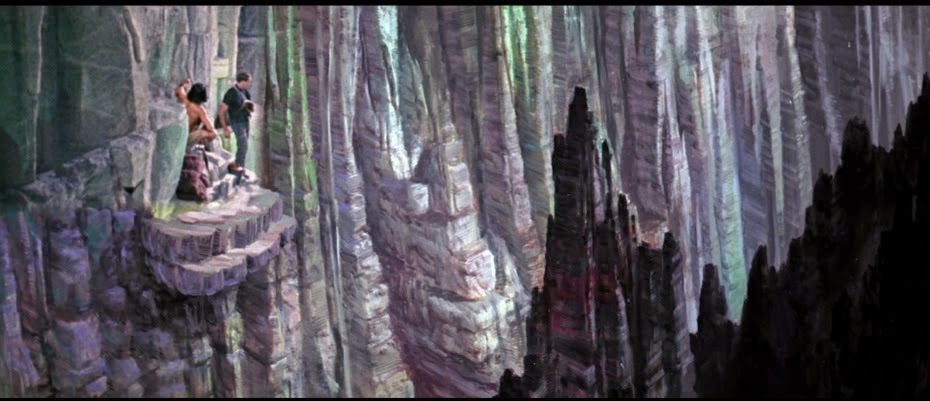
interest, even considering the desert landscape. There’s one scene set in a grotto
or grove, where Draper goes swimming, and the view is magnificently imaginative.
At
another point, Draper and Friday seek to escape the slavers, and head down into
a subterranean world, where they must navigate a narrow ledge.
Again,
the effects work is stunning, and a reminder of how Hollywood successfully performed
“world building” in an age before CGI. The
film’s final visual flourish plays as catharsis and relief. We see Friday and
Draper at the polar ice caps, surrounded by cleansing water and immaculate
white ice. They have been delivered from
the red, fiery Hell of Mars’ surface.
This is a great note to go out on.

Robinson
Crusoe on Mars
also features, perhaps to its detriment, a strong colonial tone. Almost
immediately after meeting Friday, Crusoe assumes his superiority over his new
friend and tells him that he is the boss, demands that Friday learn English,
and attempts to convert him to his own religion. In 1964, this attitude would not have been
questioned, but today it seems as dated as the portrayal of Mars’ atmosphere as
breathable by humans.
Later films of
this type, like Enemy Mine (1985), go out of their way to suggest that
representatives of different cultures have much to teach each other, but here a
lot of the teaching is one way: Draper to Friday. In fairness, however, this was also the
nature of the Defoe literary work. It concerned a "civilized" Englishman sharing his culture (and breeding) with a savage.

It
is not fair, perhaps, nor entirely appropriate, to judge a film made fifty
years ago on the basis of knowledge we possess today, but if Robinson
Crusoe on Mars is judged not to pass muster by some viewers today, it is
likely because the film doesn’t conform to our 21st century fund of
knowledge about the red planet.
To
put this another way, film lovers and science fiction lovers can and will look
past this particular deficit, and judge the film accordingly, based on its
historical context. But there will be some viewers who can’t do that, and who
will be put off by Robinson Crusoe on Mars’ flights of fancy about a Mars consisting
of subterranean water pools, ample (purple) vegetation, and a breathable
atmosphere. Today in September 2015 -- we know that part of this depiction may actually be accurate! On Monday, NASA announced that there are flowing, salt-water streams on Mars, so perhaps in this one regard the film is ahead of its time.
The
film’s re-use of some stock props and miniatures, such as the costumes from Destination:
Moon (1950) and the Martian war machines from War of the Worlds (1953)
-- as well as some oft-repeated footage of those alien ships -- may prove more legitimately
disturbing to some fans than do these scientific errors. The alien slaver ships are seen, in
particular, in the same three or four shots, and these shots are repeated over
and over again. For a film that features such lush visuals in other arenas, the
sort of cheap-jack depiction of the slavers is doubly disappointing.
These
points diminish Robinson Crusoe on Mars significantly, but they do suggest how far
ahead of their time later works, like 1968’s 2001: A Space Odyssey were
by comparison. In some ways, the Pal film feels like the last gasp of a 1950s
version of outer space, while Kubrick’s film (followed by efforts like
Moon Zero Two and Journey to the Far Side of the Sun)
feel much more modern.
Yet
what doesn’t age Robinson Crusoe on Mars -- and indeed what renders it relevant fifty years later -- is its focus on the human equation, and
its message that friendship is as nourishing -- and as necessary -- to the
human animal as oxygen, or fresh water.

 Posts
Posts