Subscribe To JKM


 Posts
All Comments
Posts
All Comments
Showing posts with label The Films of 1990. Show all posts
Showing posts with label The Films of 1990. Show all posts
Friday, June 16, 2017
Movie Trailer: Predator 2 (1990)

 award-winning creator of the web series Abnormal Fixation (2024), the audio drama Enter the House Between (2023) and author of 35 books including Horror Films FAQ (2013), Horror Films of the 1990s (2011), Horror Films of the 1980s (2007), TV Year (2007), The Rock and Roll Film Encyclopedia (2007), Mercy in Her Eyes: The Films of Mira Nair (2006),, Best in Show: The Films of Christopher Guest and Company (2004), The Unseen Force: The Films of Sam Raimi (2004), An Askew View: The Films of Kevin Smith (2002), The Encyclopedia of Superheroes on Film & Television (2004), Exploring Space:1999 (1997), An Analytical Guide to TV's Battlestar Galactica (1998), Terror Television (2001), Space:1999 - The Forsaken (2003) and Horror Films of the 1970s (2002).
Thursday, February 18, 2016
The Films of 1990: Dick Tracy

A
key question involving Warren Beatty’s ultra-stylized Dick Tracy (1990) is,
simply: are (gorgeous) pictures worth a thousand words?
Your
response to this film may depend wholly on what qualities you believe matter
most in a movie. Are brilliant images enough to intrigue you, even if the
narrative fails to engage your senses?
Undeniably,
Dick
Tracy is a visual masterpiece.
The
film is a unique, beautifully-realized, and downright dazzling comic-strip on
screen. Beatty’s picture doesn’t recreate the 1930s so much, actually, as it
recreates a comic-strip version of the
1930s.
It
does so in loving homage to the compositions of comic strip creator Chester Gould
(1900 – 1985), who wrote and drew Dick
Tracy strips from 1931 to 1977.
Accordingly,
Dick
Tracy is beautiful to look at, and to intellectualize as a fully-executed work of art that evokes its source material
with remarkable fidelity.
And
yet, despite such glorious visualization, Dick Tracy never really dramatizes a
compelling story, nor makes us feel, through its dialogue, that the characters it
depicts are living, breathing people with concerns that matter.
Perhaps
that wasn’t the intent of the filmmakers.
Perhaps
the intent was to translate Dick Tracy to the silver screen,
note-for-note, from the old strip, leaving out all three-dimensional detail and shading in
the process.
This
is a comic-strip displayed on the silver-screen, no more, no less.
If
so, that’s understandable as a creative or artistic strategy, but the ambitious
plan doesn’t exactly work as intended, or like one might hope it would.
Why?
There’s
a kind of remoteness or distance from the film that occurs while one watches Dick
Tracy.
There’s
almost no emotional impact at all in any of the action or character arcs. And
the story-line feels so generic that, at times, it is difficult to focus at all
on what is happening, and why it is happening.
The
characters are all simple, off-the-shelf “types,” or clichés, such as the dedicated, good woman (Tess
Trueheart), or the marble-mouth informant, Mumbles (Dustin Hoffman), and they
simply don’t ever become more than their names suggest they are.
They
are, merely, the sum total of their faces and their names.
And again, that’s precisely what they are in the
comics.
Symbols.
Representations
of character traits such as loyalty, avarice, or even dogged determinism.
Madonna’s
Breathless Mahoney may be the closest thing to an exception in the film. She
registers strongly as a person, perhaps because Stephen Sondheim’s songs so
effectively give her character a distinctive “voice” in the proceedings. Also, Madonna is not shy about transmitting sexual charisma.
But since most of the people featured in the film are brush-strokes as much as they are legitimate
personalities, one’s enjoyment of Dick Tracy is based almost entirely
on intellectual or cerebral grounds.
To
wit, the color scheme is gorgeous (and faithful to the strip), the camera-work
is craftily brilliant in the way that it respects the boundaries of the
comic-book frame, and the prosthetics that characterize the villainous criminals are not merely
inventive, but effective in conveying the nature of their specific sins.
Perhaps
these achievements should be enough.
Dick
Tracy is a distinctive,
imaginative, inventive comic-book movie, and one can gaze at its flourishes
with appreciation just as one might gaze with approbation at a lovely painting
in a gallery.
But
Dick
Tracy’s great flaw, it seems, is that -- while the pictures are
admirable and compelling -- the words the people speak don’t move or inspire
us.
Stephen
Sondheim’s songs occasionally offer that inspiration, as I’ve noted. An
occasional montage of crime-fighting does so as well.
But
overall, Dick Tracy doesn’t provide us the meaningful words, or
emotions, to go with all the remarkable imagery.
We can read a comic strip in moments.
But a motion picture we must commit to on a
longer, more thorough basis. And on that
basis, I would have to argue that the film is a failure.
A
movie critic friend of mine has noted, before, that reviewers can’t give out an
“A” for effort on ambitious movies that, somehow, don’t manage to gel
successfully.
Yet
in my heart, I award Dick Tracy an “A” for effort despite its failings to tell a coherent story, or make us love its characters.
Warren
Beatty has directed a gorgeous, challenging film, and I love the breadth of his
imagination and fidelity to the source material.
At
the same time, the film’s story is dead-on-arrival, and I wish that the gorgeous,
inspired pictures were enough to carry the production through its nearly
two-hour running time.
The
best way to watch and enjoy Dick Tracy, perhaps, is in five or
ten minute increments.
The visuals prove powerful, and in such short “chapter-play”
bursts, the film doesn’t lose its pacinng or momentum.

“Whose
side are you on?”
In
New York of the 1930s, diabolical gangster Big Boy Caprice (Al Pacino) makes a
daring move. With the help of his minions, including Flattop (William
Forsythe), he takes out his competitor, Lips Manlis (Paul Sorvino), and steals
his place: the Club Ritz.
Included
with ownership of the Club Ritz, is a sexy torch-song singer, Breathless
Mahoney (Madonna).
While
Big Boy Caprice grows his empire and bribes the city mayor (Dick Van Dyke), he
faces legal problems from “maverick
police detective” Dick Tracy (Warren Beatty). Tracy needs someone to
testify against Caprice, but Mahoney refuses to do so.
Instead,
she admits that she has fallen in love with Tracy.
This
attraction complicates matters for Dick, because he is in love with kindly Tess
Trueheart (Glenne Headley), and is caring for an orphan boy, The Kid (Charlie
Korsmo), who looks up to him as a paragon of virtue.
As
Tracy and Caprice clash for control of the city, a new, faceless informant
shows up to complicate matters; one who seems to have both Dick Tracy and
Caprice in her nefarious sights.

“Eat
Lead Tracy.”
Dick
Tracy not
only looks great…it looks amazing.
The film’s characters and locations exist in
a comic-strip world consisting of only four or so colors: blue, red, green, and
yellow. These colors are vibrant and over-whelming, and reflect the comic-strip
color scheme to a high degree, as you can see.

In a way, these colors dictate the nature of the characters, and their
world.
Even
better than the color scheme, however, is the film’s extensive use of matte paintings.
Today, CGI would be used in such circumstances, but something essential -- a sense of the “hand-painted”
or “hand-drawn” -- would be lost in in the process. The mattes here are by Harrison Ellenshaw,
one of Hollywood’s most remarkable talents. It appears as though every establishing or
location shot in Dick Tracy is “enlarged” and colored by such paintings, and the effect is
stunning.
The
effect is not so much that we are in a giant city, but -- as noted above -- a giant
comic-strip city, one imagined, constructed, and toiled upon by very human
hands; by the hands of an individual illustrator.
Again, one should note that these
city-scapes don’t look “photo real.” You can't take them for real. They
look, instead, like they came from an artist’s viewpoint or imagination of the world, and that’s
perfect.


Similarly, Warren
Beatty achieves much here from the notion of the movie frame echoing the comic strip
frame.
There is a scene, for example, during which Dick Tracy follows the Kid
to his ramshackle home, and beats up his abusive father.
We see the fight from
outside the shack, and the only movement in the frame is the tilting of that
edifice from one side to another, as Tracy’s fisticuffs strike the abusive
Dad, and the walls of the home shift. Significantly, the action is contained within the frame, and
the camera is static, it doesn’t move.

Beatty
utilizes this technique again and again, and even creates movement out of artistic montage,
rather than via the auspices of a moving camera.
Late in the film, there’s a
crime fighting montage featured, for instance, as Dick Tracy takes the fight to his enemy. It deploys super-imposition and other old fashioned techniques that would be available to a comic-strip artist….pictures
within pictures.

This
crime-fighting montage is actually my favorite scene in Dick
Tracy because everything just comes together so perfectly, and it builds, finally, a sense of momentum. We see close-ups of
machine guns firing. We see Tracy, super-imposed over the streets. We see
villains falling out of broken windows, another method by which to show movement in the
frame without actually moving the camera, and so on. It’s so beautifully conceived and executed, from start to finish.
The
villains in the film look great too.
As their make-up reveals, these are
people who wear their sins in the very lines of their faces.
Lips Manlis boasts
huge, hanging lips…all the better to suck oysters (and demonstrate his avarice…)
with.
Caprice is hunched over, burdened by the weight of his ambitions.
R.G.
Armstrong plays Pruneface, a wizened old gangster whose face, is wrinkled beyond belief. We know from a mere
glance at these personalities that they are twisted, evil and perverted.


We
don’t need to know the specifics of their trespasses, because their visages and their bodies speak
volumes.
The
problem, of course, is that all these characters are expected to function in a
tale that lasts nearly 120 minutes.
Once we know what they are (by looking at
them), their plans need to compel us, to drive our interest.
And,
simply, they don’t.
Dick Tracy is true blue. We know this from looking at him.
Tess Trueheart is a true heart, her name and actions say.
But the movie is not
able to shade these obvious characters with any sort of three dimensional
reality. By being so stolid and stereotyped, they transmit as campy.
Again,
I know it isn't the game to humanize these comic strip individuals.
But beautiful cardboard is still cardboard, in the
final analysis.
In a two-hour motion
picture we need to be driven by a story, and by the desires of the characters.
Dick Tracy shows us beautiful and ugly people in a picturesque world, but it
never engages our heart sin a real way.
There’s
an important asterisk there, of course.
And
her name is Madonna.
While belting out a Sondheim tune, or confessing her desire for Tracy, Madonna’s Breathless Mahoney
transmits as fully -- and fallibly -- human.
As you may remember, Madonna and
Beatty were in a romantic relationship together when this film was made. It’s
no surprise then, that Beatty is best in his scenes with Madonna, particularly
the scene wherein Tracy rebuffs Mahoney’s advances.
It feels there -- like nowhere else in the film -- that feelings
and the future itself -- are on the line.
Madonna brings an incredible and playful brand of sexiness to the film, particularly in the scene wherein she crawls -- on all fours -- over Dick Tracy's office desk.

Perhaps
the problem I’m really writing about in this review involves nuance.
In a motion picture, if interest is to be
sustained, the story and the character must feature some nuance.
In a comic strip
like Dick Tracy, by contrast, the idea is the opposite. With so little space
available to tell a story, every image must transmit a surfeit of information. We must know
from a character’s name (Tess Trueheart) or his very appearance (Flattop) what that
character is all about.
In a movie, by contrast, we want to learn a little at
a time..
So
what Dick
Tracy gains in terms of fidelity to a comic strip, it loses in terms of
emotional connection and nuance.
It
seems a dilemma, doesn’t it?
Perhaps
Dick
Tracy is un-adaptable in film format, at least without serious
adjustments to the comic strip format.
The
whole problem reminds me of Big Boy Caprice’s dialogue in the film. “You get
behind me, we all profit. You challenge me, we all go down.”
Perhaps
the original Dick Tracy strips needed to be challenged a little bit more, in terms of
their efficacy as workable motion picture material.
I've tried to get behind this movie, but still, it goes down...
award-winning creator of the web series Abnormal Fixation (2024), the audio drama Enter the House Between (2023) and author of 35 books including Horror Films FAQ (2013), Horror Films of the 1990s (2011), Horror Films of the 1980s (2007), TV Year (2007), The Rock and Roll Film Encyclopedia (2007), Mercy in Her Eyes: The Films of Mira Nair (2006),, Best in Show: The Films of Christopher Guest and Company (2004), The Unseen Force: The Films of Sam Raimi (2004), An Askew View: The Films of Kevin Smith (2002), The Encyclopedia of Superheroes on Film & Television (2004), Exploring Space:1999 (1997), An Analytical Guide to TV's Battlestar Galactica (1998), Terror Television (2001), Space:1999 - The Forsaken (2003) and Horror Films of the 1970s (2002).
Tuesday, February 09, 2016
Die Hard on a Blog: Die Hard 2: Die Harder (1990)

The
biggest problem with Die Hard 2: Die Harder (1990), perhaps, is that it follows on the heels of a legitimately great movie in its franchise.
John
McTiernan’s Die Hard (1988) is brilliantly constructed in terms of its character
dynamics, its camera-work, and even its primal male fantasy sub-text. It's the gold standard in terms of the action genre, at least for its era.
Die
Hard 2 is good enough to merit a positive review, and proved an even
bigger success at the box office than Die Hard did. But watching Die Hard 2 today, one cannot help but
feel that virtually every ingredient featured this time around is a bit less artfully calibrated.
The
villains are a huge step-down from Alan Rickman’s Hans Gruber, for one thing. Similarly, McClane begins the slippery descent from Every
Man to Super Man in this movie, and the supporting characters who make a return appearance -- like narcissistic Dick Thornburg
(William Atherton) -- feel shoe-horned into the plot.
When
the movie culminates with the first Die Hard’s R-rated catchphrase, and the same
closing song too -- “Let it Snow” -- the impression of not a sequel, but a rehash, is firmly
cemented.
By contrast, the next film in
the cycle, Die Hard with a Vengeance (1995) throws out enough standards
(the isolated location, the man-alone syndrome, and the Christmas Day setting)
to transmit as a more legitimately original follow-up to a masterful action
classic.
This
first sequel, however, expertly solidifies some intriguing elements that, perhaps, aren’t
always considered in regards to the Die Hard formula. I admire here, for example, McClane’s
pattern of cooperating with other Every Men (and Women) such as Marvin (Tom Bower) the
janitor, Barnes (Art Evans) the airport engineer, and non-narcissistic journalist, "Sam" Coleman (Sheila McCarthy)
They are all real people, working real jobs,
often going up against the bureaucracy -- or Establishment -- a key obstacle, if not outright villain, of the
overarching Die Hard saga.
Undeniably, Die
Hard 2: Die Harder
is impressively-made and boasts moments of pure exhilaration. It is also
superior to some of the franchise’s later entries, so it has that going for it. Yet -- to quote again Roger Ebert and his
review of Halloween II (1981) -- this sequel is still a “fall from
greatness.”
Perhaps
this sequel is not a steep fall, or a crash on the runway, but Die Hard 2 nonetheless begins showing
the incipient symptoms of franchise-itis.

“You’re the wrong
guy in the wrong place at the wrong time.”
L.A.
cop John McClane (Bruce Willis) waits in Dulles Airport in Washington D.C. for
the arrival of his wife, Holly (Bonnie Bedelia) from California.
Unfortunately,
the renegade Colonel Stuart (William Sadler) and his team of special forces troops
take over the air-port, stop all incoming flights, and attempt to rescue an
incoming American hostage, deposed strong man General Esperanza (Franco Nero).
McClane
must now get Holly’s plane safely to the ground before it runs out of fuel, and
defeat Stuart, Esperanza, and a fiendish double agent, Major Grant (John Amos).
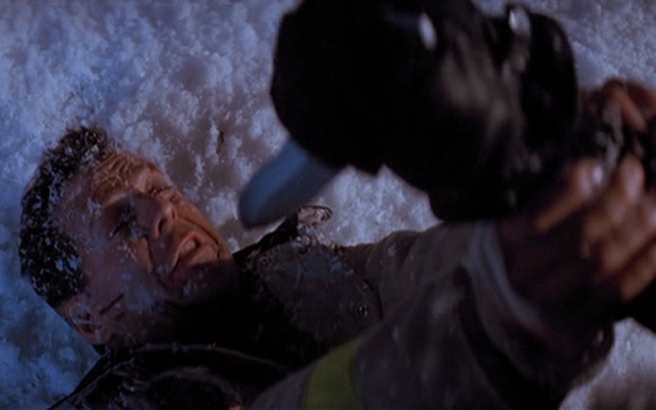
“Another basement,
another elevator…how can the same shit happen to the same guy twice?”
Die
Hard 2: Die Harder
is based on the 1987 novel 58 Minutes by Walter Wager, which concerns a
retired police detective fighting to defeat terrorists who have seized an
airport, and get his daughter --trapped on a plane overhead -- down to the
ground safely.
So
if Die
Hard was a dynamic extension of The Towering Inferno (1974)
paradigm, Die Hard adopts its setting from not only a novel (like Thorp’s
Nothing Lasts Forever), but from the disaster genre too, namely Arthur
Hailey’s Airport.
In the
Airport movies -- which were released from 1970 to 1979, approximately --
a plane in flight is jeopardized, and intrigue occurs at an airport. Die Harder adds to this common scenario
seem key real life "current events."

Colonel
Stuart, for example, is a clear corollary for convicted felon (and failed senate candidate), Lt. Colonel Oliver North, who
lied to Congress, and was a “functionary” in the Iran-Contra Scandal, which
was still big news in 1989, when Die Hard 2 was conceived.
The film also recreates the international
conspiracy angle of that illegal operation with the presence of Esperanza and Grant as shadowy colleagues. In other words, the villains in this piece are American soldiers who don’t view
the rule of law as an obstacle to them. They pursue their illegal and so-called
patriotic agenda anyway, which actually involves propping up right wing dictators in third world
nations. American lives mean nothing to these vainglorious scoundrels.
The
James Bond franchise also featured an Oliver North-like criminal -- Joe Don Baker's Whitaker -- in 1987, in The
Living Daylights.But despite the intentional resemblance to such real-life malfeasants, Stuart, Eperanza and Amos -- three villains for
the price of one -- still can’t match Rickman’s urbane, self-aware Gruber in terms of menace.
There’s even an unnecessary scene here in which Stuart apes a fake accent (Southern) to
trick a British plane into crashing. The whole attempt comes off as a pale imitation of the “Bill Clay” scene in Die Hard.
All three actors are fine in their roles, I should hasten to add, and
I’m a big fan of Sadler (see: Bill and Ted’s Bogus Journey.) But three
lesser-villains just don’t make up for one guy who is, essentially, the perfect
bad guy. I believe it was a mistake dividing the villain role across three individuals, as not one of them offers the same kind of intricacy or three-dimensional personality as Rickman projected. They don't have enough screen time, for one thing.
Renny
Harlin achieves much directing Die Hard: Die Harder, but some of
the core visual conceits here are quite different, and inferior to the original strategy. McTiernan’s furtive,
desperate, rolling, tilting, panning camera is gone, and a consequence of that absence is that the
action doesn’t feel quite as immediate.
As I wrote in my review last week, Die
Hard’s photography aped the man-alone desperation of McClane. No such technique informs the action here.
Also, the camera-work and narrative details made it truly seem that McClane was in mortal danger throughout Die Hard. He had to run across broken glass in one
scene, and paid the price in blood. He was scared and desperate, and often won
battles on the basis of pure grit and luck. In Die Hard 2, he has much greater --
and perhaps -- super-heroic luck.

For
instance, there’s a silly scene set at the under-construction Skyway Annex. McClane
is seen rolling across the floor -- in plain sight -- and terrorists bracket him.
He rolls
and pivots, in clear view, picking off the terrorists, and they don’t get in
even one clear shot. Not even a flesh
wound! Again, McClane is an obvious,
slow-moving target.
Even an Imperial stormtrooper would graze him!
The
shot looks awesome, of course. McClane looks bad-ass slowly rolling across the floor, expertly picking off his nemeses,
but the sense of furtive desperation is gone.
Similarly,
in a later scene, McClane is trapped inside a grounded plane, as Stuart lobs a
half-dozen or so grenades into the cockpit with him. The devices land next to his face, at his feet, and
around the cabin. Yet McClane still gets ample time to strap himself into a
chair, pull an eject lever, and escape the cabin before even one grenade
detonates.
At most he would have 3-5 seconds, once the grenade lands.
He
gets a lot more time than that to achieve his spectacular escape.
Again -- mea culpa -- I love this scene in terms of the special effects presented, and Willis's spirited performance.
It is fantastic and delightful to see the chair (with McClane strapped to it...) hurtle right towards the
camera (taking up a position high in the sky), as an explosion blossoms below
him.
But Harlin doesn’t get us to that
great visual punch-line without cheating the set-up.

One is left to conclude that McClane has begun the journey from determined,
gritty, human cop to Rambo-like super-hero. The slide is reversed a bit in the next
film, which gives McClane a hang-over, and restores the furtive camera-work.
But then the slide continues, unabated in the franchise.
Still,
I appreciate how Die Hard 2: Die Harder sets out to establish or
fully-cement some aspects of the so-called Die Hard paradigm.
Here, McClane
allies with people who, if not outright blue collar in terms of their jobs, are either cultural/gender minorities, or
out of power, to achieve his ends.
He
befriends a reporter named Samantha, for instance, who comes through for him right when he
needs her. McClane treats her with respect (or at least more respect than Stuart does...), and Samantha gets him access to a helicopter when he needs it.

Engineer Barnes, largely
ignored and considered unimportant by his superiors and Carmine, demonstrates ingenuity and initiative in
finding the terrorists’ headquarters at a nearby church.

And Marvin the janitor is crucial in leading
McClane from one part of the airport complex to another. These three friends -- disdained, disciplined, and lacking privilege and/or authority -- are crucial to John’s success.

By
contrast, Die Harder also diagrams the idea that there are two kinds of bad
guys in these films.
First, there are the
terrorists who actually attempt to do evil, with finely-crafted strategies and
brute force.
And then there is the
establishment, or bureaucracy, which prevents John from doing his job
successfully.
Representing the latter category, we meet two police
officers, Carmine Lorenzo (Dennis Franz) and his brother, Vito (Robert Constanzo),
who make one wrong-headed decision after the other, thoroughly gumming up the
works and making it easier for the terrorists to complete their anti-social
tasks.
Trudeau (Fred Thompson) is a more
neutral “establishment” figure, one who must be persuaded to trust McClane, but
who then qualifies an ally of sorts.
Part
of the Die Hard franchise’s Every Man appeal involves this “Fighting
City Hall” story angle. John makes friends and enemies as he fights the good
fight. And he has a perfect barometer in choosing his friends. They are are usually lower-level, disenfranchised people who
nonetheless know their jobs, and clearly see right from wrong.
Yet the nearer the distance to power someone becomes, these
movies tell us, the harder it is for people to embody that kind of clear-headed
thought. They are bogged down in red tape, and lose their clear moral compass.
Die
Hard 2: Die Harder
succeeds as much as it does because the location/setting -- a snowed in airport -- is unique and intriguing, and the danger to the planes overhead is palpable.
It is a horrific scene, indeed, when the terrorists trick a plane into landing…and
it blows up on the tarmac.
We all harbor a fear of flying, at least at some
level, and Die Hard 2 absolutely taps into that universal dread.

Yet
still, by the end of the film, I felt that the sequel had failed to tread boldly enough into new territory. Having John note “how can the same shit happen to
the same guy twice” is meta and funny, I suppose, but the in-joke doesn’t cure the film
of its particular deficit: repeating too many of the ideas that informed John McTiernan’s original. It tells the same jokes, in other words, but tells them less effectively and artfully.
For
purposes of franchise building, I absolutely believe that McClane can -- and indeed,
must -- get himself into danger again.
I have
more trouble believing it would occur again on Christmas Eve, and so intimately involve
his wife Holly and journalist Thornburg. The movie’s choice to end again with
fire and “Let it Snow” is also a sign of creative exhaustion.
Too many notes are, literally, repeated.
Clearly,
Die
Hard 2: Die Harder got the job done, both at the box office and in terms of
fan expectations. I can second-guess it all I want, and the facts don't change.
It’s a solid sequel. But at the same time, some of Die
Hard’s inspiration clearly didn’t make the flight with the rest of the luggage.
Next
Week for Die Hard on a Blog: Die Hard with a Vengeance (1995).
award-winning creator of the web series Abnormal Fixation (2024), the audio drama Enter the House Between (2023) and author of 35 books including Horror Films FAQ (2013), Horror Films of the 1990s (2011), Horror Films of the 1980s (2007), TV Year (2007), The Rock and Roll Film Encyclopedia (2007), Mercy in Her Eyes: The Films of Mira Nair (2006),, Best in Show: The Films of Christopher Guest and Company (2004), The Unseen Force: The Films of Sam Raimi (2004), An Askew View: The Films of Kevin Smith (2002), The Encyclopedia of Superheroes on Film & Television (2004), Exploring Space:1999 (1997), An Analytical Guide to TV's Battlestar Galactica (1998), Terror Television (2001), Space:1999 - The Forsaken (2003) and Horror Films of the 1970s (2002).
Thursday, March 19, 2015
The Films of 1990: Gremlins 2: The New Batch

At
a crucial juncture in Joe Dante’s Gremlins 2: The New Batch (1990), an
agreeable if dopey millionaire -- an amalgamation of Ted Turner and Donald Trump
– learns that if you create a place for things instead of people, you shouldn’t
be surprised that things eventually live there.
Daniel
Clamp (John Glover) thus comes to understand that his fancy Manhattan high-rise
-- automated to the max and designed to sell, sell, sell -- ends up being a
place not for human beings, but for gremlins.
This
is an explicit continuation of Gremlins’ (1984) technology critique,
which I discussed here on the blog the other day.
We
shouldn’t be surprised, the film suggests, when de-humanization actually de-humanizes
us. Play with the building blocks of
life, like Splice of Life does, or put people under the thumb of 24-hour
surveillance and security guards, or cook exclusively with microwave ovens….and
people begin to behave…badly.
Monsters
start popping up.
This
social critique probably makes Gremlins 2 sound like a deadly
serious film, but instead it’s a gag-a-minute, laugh-a-minute treat that
skewers the modern age, circa 1990. This
is a time, the film tells us, when technology will either carry the day, making
us all “monsters,” or humanity will re-assert itself.
Look
up from your iPhone screen for a moment and tell me which side won that
particular war.
Caustic
and hilarious Gremlins 2 is also “inventive
and explosive” according to The Christian Science Monitor’s
David Sterritt, and “thoroughly enjoyable”
according to Films in Review’s Edmond Grant. The film is much funnier than
its predecessor was, though the trade-off may be difficult for horror films
fans to accept.
As
brilliant and subversive as Gremlins 2 remains, it has lost some
of the scary, suspenseful aspects of the original film.
Yet
I suspect the trade-off is ultimately worth it. How many sequels are so
delightful, and so thoroughly unpredictable?

“We
hope you have enjoyed our programming. But more importantly, we hope you have
enjoyed…life.”
Former
Kingston Falls resident Billy Peltzer (Zach Galligan) and his girlfriend, Kate
(Phoebe Cates) are having trouble adjusting to life in expensive, impersonal
New York City. In Manhattan, the duo
works at the technologically-advanced but de-humanizing Clamp Center, the
world’s first fully-automated office building and home to the Clamp News
Network (CCN).
After
the death of Mr. Wing (Keye Luke Luke), Gizmo is taken to the Clamp Center by a
scientist working at the Splice of Life genetic laboratories inside the
building.
Before
long, Gizmo and Billy meet up again, and face another outbreak of malevolent Mogwai.
This
time, the gremlins are enhanced by Dr. Catheter’s (Christopher Lee) genetic
experiments. The Gremlins soon add to
their numbers with a brain gremlin, an electric gremlin, a vegetable gremlin
(!), a bat gremlin, a spider gremlin and…a female gremlin.

“This
is a complete failure of management.”
In
America, we tend to worship those who introduce us to the next level of
technology (and its accordant convenience) and make a fortune doing it. Gremlins
2 introduces us to the (great) character, Daniel Clamp, and it is
impossible not to love him…but also impossible not to recognize him.
He’s
a little bit Ted Turner, who founded the nation’s first 24-hour news cable
network and was a proponent of “colorization,” the expensive process by which old
black-and-white films would be updated and made palatable for contemporary (but
lazy…) TV-watching masses.
Clamp
is also a little bit Donald Trump (1946 - ), the increasingly unhinged man
behind Trump Towers in New York City, Trump Tower Resorts (casinos and hotels…)
and such best sellers as Trump: The Art
of the Deal (1987) and Trump:
Surviving at the Top (1990).

In
Gremlins
2, Daniel Clamp (John Glover) is the self-absorbed dynamo behind Clamp
Premiere Regency Trade Center, a high-tech sky-rise/headquarters and home to CCN:
The Clamp Cable News Network. Clamp is the author of the best-selling I Took Manhattan, and his cable network
airs Casablanca,
“now in full color…with a happier ending.”
And
when the Gremlins disaster occurs inside his building, Clamp even has a handy
“end of the world” message to air on CCN, a funny reference to Turner’s famous
boast that his CNN “won’t be signing off
until the world ends.”
The
social commentary doesn’t end with the (gentle) skewering of these powerful men,
who helped to reshape modern America. The film also comments on the fragmenting
or “balkanization” of television brought about by cable networks, a process which
creates (in the film) “niche” networks like The Archery Channel, Microwaving
with Marge, The Movie Police (starring Leonard Maltin), The Safety Channel and
on and on.

What’s
the point?
That
technology (in this case the new shape of television) is merely separating us
into our own little worlds, not building a community that reflects life, like
Kingston Falls, for example.
Today,
we are some way down the line from Gremlins 2. We not only have over 200 channels, we have
Internet streaming, 24 hour cable stations, and a host of other viewing options. The “glue” that the mass media once used to
hold us together as a nation is now gone. You can now choose the news (like a
pizza topping) that best reflects your already-established world-view
(conservative or liberal) and never be exposed to a new concept, or something
that takes you out of your comfortable bubble.
Dante
delves into pop-culture movie references too, commenting on the 1989
blockbuster Batman with a Gremlin-sponsored recreation of the movie’s
ubiquitous bat logo. He ushers in jokes about the Wizard of Oz (“I’m
melting”), The Marathon Man (“is it safe?”), and even laments the fact
that a sequel was made to…Gremlins.
Once
again, the point is that even our art is now de-humanized.
Batman
is now a brand name and trademark, with a corporate logo you can’t
mistake. Forget individual artistry, the
Dark Knight is an institution, not a vehicle for inventive storytelling! Matters
such as story and character are less important than the creation of a perpetual
money dispensing machine. We watch a
superhero movie from Marvel these days, and after the credits are over, we get
a tease for another character, or another movie. Then, we wait months for the trailer for that
next movie, and anticipation is ratcheted up.
The actual product – the “movie itself” -- is just one piece of a
never-ending media/marketing strategy.
Gremlins
2 likewise
mocks the de-humanized essence of business jargon, which had grown and
multiplied in American culture by the 1990s like some sort of terrible verbal
plague. Workers were no longer asked to come up with good ideas…they had to “think outside the box.” Workers were no
longer charged with blending departments, but finding and exploiting their “synergy.” They no longer had to simply do
better at their job; they had to “take it
to the next level.”
This
kind of inhuman gobbledygook -- this business-speak -- is mimicked and expanded
upon with great success in Dante’s film. For instance, the revolving doors at
the Clamp Tower entrance remind workers to “have
a powerful day!”
Similarly,
characters don’t discuss career aspirations, they reflect on “situational long term outlook perspectives”
and “career opportunity advancement.”
Even ceiling lights are no longer just lights they are part of an “illumination system.”
And
a takeover of the building by malevolent green gremlins is not a catastrophe, a
disaster or even an invasion according to some, but rather a failure of management.
So
the film tells us that to go along with our inhuman technology, we have
developed inhuman modes of communication.
If
one catalogues all of these pop culture jokes, a common thread grows detectable.
What Dante laments in Gremlins 2 is the coarsening of the
American arts and culture and even national dialogue to the point that
everything and everybody is a product; a vehicle for squeezing out a profit.
“When art and business join forces,”
declares one character in Gremlins 2, “anything can happen.” He
means it as a net positive; but Dante means it sarcastically.
Gremlins
2 is prophetic
in understanding the pitfalls of this modern approach.
Have
you been a success in real-estate?
Write a book and proselytize your
success!
Direct
a successful movie?
Market it and make a sequel!
Have
a good idea for a restaurant?
Franchise it!
Yet
in a culture where the all-mighty dollar is so important, qualities such as
individuality and creativity – nay, artistry -- eventually lose their
significance. Clamp’s two-hundred-and-fifty
million dollar high-rise, a monstrosity of mechanization, voice-operated
elevators, self-cleaning ash trays, surveillance cameras and “eye-pleasing, color-coordinated, authorized
art,” is not an environment fit for unique, individual human beings.
Instead,
it’s a big fat, high-tech “work”-extruding beast.
The
Gremlins -- the very embodiment of Loki; of chaos and anarchy – descend on Clamp
Towers and very quickly prove…bad for business.
They get into the “natural” ingredients at the Yogurt Stand. They destroy “Splice of Life,” a genetic
laboratory that is the very representation of profit put ahead of
responsibility and science run amok.
They foul the complicated phone system in the building, and in one
wicked joke, are consigned to a hell called “hold,” where the muzak never
stops.
Is
it a wonder that monsters exist in a world like this?
Gremlins
2 is probably the
closest thing to a live-action cartoon you are likely to see, but all the mayhem,
all the brilliant effects carry pro-social weight. The real movie monster is our craven consumer
culture, and our desire to possess new, better technology. This monster is
everywhere, infiltrating every walk of life.
It’s in our television (“an
invention for fools,” says Mr. Wing), it’s in our newscast, here presented
by a man in a vampire suit (a literal bloodsucker), and it’s in our most
revered businessmen like Clamp, who still wants to merchandise Gizmo…even after
all the anarchy.
What
makes this point so interesting to contemplate is that Dante decides, in this
sequel, to make the gremlins non-generic even as the world of humans becomes
more generic. There’s not just a furry creature and an evil one here, like in
the first film. Instead, we meet dozens of individual gremlins. There’s one
little guy with googly eyes who acts like he needs Ritalin, stat. There’s
Greta, the female gremlin. There’s one mogwai who becomes a gargoyle. And, of
course, there’s my favorite, the delightful Brain Gremlin (voiced by Tony Randall),
who wants only, “civilization.”


Thus,
the shape of the film might be interpreted as a mirror of the overall critique.
To destroy a world of homogenized, inhuman technology and jargon, you need a
return, perhaps, to messy individualism.
The Gremlins -- funnier, and more colorful than ever -- provide that antidote.
Gremlins
2 is wicked
good fun, and one sequel that not only differentiates itself from the original,
but in some way, exceeds it. I watched both Gremlins films with my
son, Joel, and he couldn’t decide which he liked better. He liked the original,
he said, because it told a scarier, more suspenseful story. He liked the sequel because it upgraded the
monsters and was very, very funny.
In
my assessment, Gremlins fits together better as a coherent central idea or
movie, but Gremlins 2 takes the cake in terms of ingenuity and humor. In
the final analysis, original or new batch matters little because the franchise
provides viewers two remarkable films.
award-winning creator of the web series Abnormal Fixation (2024), the audio drama Enter the House Between (2023) and author of 35 books including Horror Films FAQ (2013), Horror Films of the 1990s (2011), Horror Films of the 1980s (2007), TV Year (2007), The Rock and Roll Film Encyclopedia (2007), Mercy in Her Eyes: The Films of Mira Nair (2006),, Best in Show: The Films of Christopher Guest and Company (2004), The Unseen Force: The Films of Sam Raimi (2004), An Askew View: The Films of Kevin Smith (2002), The Encyclopedia of Superheroes on Film & Television (2004), Exploring Space:1999 (1997), An Analytical Guide to TV's Battlestar Galactica (1998), Terror Television (2001), Space:1999 - The Forsaken (2003) and Horror Films of the 1970s (2002).
Subscribe to:
Posts (Atom)

-
 It is quite difficult to believe, but in 2024, Ridley Scott’s Alien (1979) turns 45 years old. Perhaps the most amazing thing about Alie...
 -
 It is an indisputable fact that fan service and good drama don’t always go hand-in-hand in the cinema. In fact, sometimes these factors div...