Showing posts with label Flashbak. Show all posts

Sunday, October 23, 2016

At Flashbak: Mattel's Gre-gory (1980)


This week at Flashbak, I remembered Gre-gory, Mattel’s toy bat.


“It was great to be a kid growing in the 1970s and 1980s, in part because of great and weird Halloween toys like this one, “Gre-gory, Big Bad Vampire Bat” from Mattel.

This toy bat was made of reddish-brown, soft vinyl, and intended for kids aged seven and up. And Gre-gory could be all yours for under $12.00 dollars.

As the ads claimed, children would “go bats” for Gre-gory as they enjoyed “hours of frightening fun” playing with their new friend.  Gre-gory’s red eyes would never close, either, which only added to the nightmare fodder.  Maybe you could perch him over your bed at night?

What else could Gre-gory do?

Well at eight inches tall, he could literally bite the hand that fed him.  “Put your finger in his mouth and see what happens when you squeeze him!” the Gre-gory advertisements urged.  If that wasn’t wicked enough, kids were also implored to “see if your friend dare stick their fingers” in his mouth.

Gre-gory also had a see-through belly so you could watch “the red fluid” -- blood? -- “flow.” 

Gre-gory couldn’t do much else, though if you wiggled his wings and shook him, it apparently looked like he was in flight. Not very high-tech, in today’s world, I guess.”

Please continue reading at Flashbak.

Sunday, August 07, 2016

At Flashbak: Remco Energized Superheroes (1978)


This week at Flashbak, I also remembered Remco’s Energized Super Hero action figures of the 1970s.


“Here’s another great toy from my childhood in the disco decade that I have never forgotten. Beginning in 1978, Remco released a number of foot-high superhero figures that were, in a word, “energized.”

I only had Spider-Man, but Remco released Batman, Superman, and the Incredible Hulk in this format as well, splitting their line between Marvel and DC.

This version of Spidey that I remember stood a whopping twelve-inches high, and though he lacked meaningful  articulation,  he came equipped with a variety of gadgets, such as a "Spider Sense Activator," a kind of movie viewer, and a "Spider Light."  Spider-man also came with a web so you could snare the bad guys.  

Your friendly neighborhood Spider-Man couldn't actually swing from a web, but he could at least hang from a web, which was just as neat.  You could activate the web gadget and watch Spider-Man climb by activating a switch on his belt.

The ads described Peter Parker’s alter-ego as being energized “to climb,” “to pull,” “to lift,” “to throw light” and to “power his Spidercopter.” 

As I recall, Spider-Man seemed to the fulcrum of publicity and toys, because Remco also sold the aforementioned Spider-Copter, a Spider-Man HQ, and even a figure of his “worst enemy,” the Energized Green Goblin…”

Please continue reading at Flashbak.

Sunday, June 26, 2016

At Flashbak: The G.I. Joe Adventure Team (and HQ)


This week at Flashbak, I remembered one of my favorite toy lines of the 1970s: The G.I. Joe Adventure Team. Specifically, I remembered the Team Headquarters, from Hasbro.


“Although Hasbro’s G.I. Joe line had a hugely successful re-boot in the 1980s with a line of vehicles, playsets and action figures, my generation of G.I. Joe fans remembers…The Adventure Team.

This squad of 12 inch-high adventurers (competitors with Big Jim at toy stores everywhere…) had their own universe of action with playsets (and stories) in the 1970s, with titles like Secret of the Mummy’s Tomb or Search for the Stolen Idol.

But the greatest adventure, perhaps, occurred at home base.  In 1972, Hasbro released The Adventure Team HQ. This hue fold-out base came complete with a signal buzzer, an elevator chair, a map table, maps, equipment storage racks, and hangers, ear phones for Joe, and even an Adventure Team Comic-Book.

Designed for Ages "6 - 12," this Adventure Team H.Q. box was accompanied by the legend "where the adventure begins..." and could fold-up, like many play-sets of the 1970s, for "easy storage."  This feature made it easy to carry the base outside, into the backyard, and into the thick of new adventures.

The comic-book that accompanies the HQ encourages the reader to have a "different adventure every day with G.I. Joe" and to look for G.I. Joe adventures including "Danger of the Depths," "Flying Space Adventure," "Secret Mission to Spy Island," "White Tiger Hunt," "Fantastic Free Fall," "Capture of the Pygmy Gorilla," "Hidden Missile Discovery," The Shark's Surprise" and "Space Walk Mystery" and among others.

Inside the comic book, the new H.Q. is described as "incredible" and a "team member's dream."  It also notes that it "takes more than daring to operate out of this Headquarters.  It takes a good knowledge of advanced electronic technology to operate all this special equipment."


Please continue reading at Flashbak.

Sunday, April 17, 2016

At Flashbak; Mattel's Shogun Warriors


This week at Flashbak, I also wrote about Mattel’s Shogun Warriors.


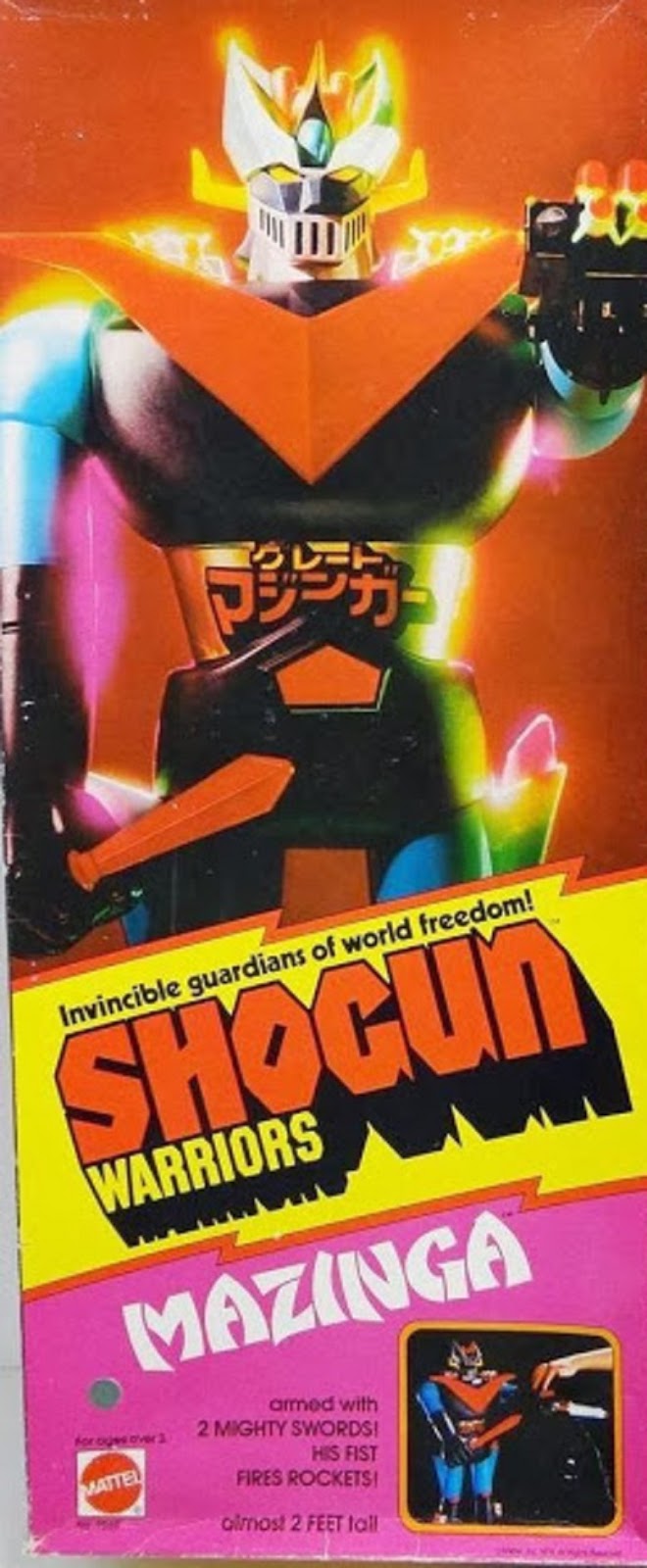
“The years between 1978 and 1980 were downright magical ones as far as fantasy and sci-fi toys go, at least for my generation. It was the post-Star Wars age, and robot and outer space toys arrived by the dozens. Mattel's Shogun Warriors -- giant robots with spring-loaded weapons and fists -- arrived in toy stores during this epoch.

Described as "Invincible Guardians of World Freedom" – Shogun Warrior toys came in three scales: the goliath-sized 24-inch monsters, the five-inch die-cast figures, and the 3.5 inch die-cast variations.  I had one giant sized toy, Great Mazinga, and many of the 5 inch and 3.5 inch models.

Uniquely, the Shogun Warriors -- although marketed as being from the same universe -- actually originated from various Japanese anime programs or franchises.  

The red Dragun came from Getter Robo (1975-1976), the aforementioned Mazinga originated with Mazinger Z (1974).  

The horned, lion-chested Gaiking was born of Divine Demon-Dragon Daiking (1976-1977), and Raydeen, with a kind of Egyptian-style head-dress, came from Brave Raideen (1975-1977).  

All these programs featured giant robots (jumbo machinder), and so it was decided to market the group as a kind of unified squad or team.

I knew absolutely none of that background information as a kid.  Instead, I religiously followed the mythology created by Marvel Comics in 1979.  A Shogun Warriors comic ran for sixteen issues, courtesy of artist Herb Trimpe and writer Doug Moench.


The comics established that "The Followers of Light" had created the colossal robots, who were then piloted by various human individuals here on Earth.  

These Shogun Warriors were integrated fully into the Marvel Universe, and some comics had cross-overs with other Marvel characters, such as The Fantastic Four.”


Please continue reading at Flashbak.

At Flashbak: Equipping Your Toy Landing Party, Mego-Style (Circa 1976)


This week at Flashbak, I recalled the great age of Mego pretend-play Star Trek toys from the 1970s.


“Many of my posts here at Flashbak this year have been written in celebration of Star Trek’s 50th anniversary this year.  This one is no exception.

One key factor in the popularity of Star Trek -- at least for my generation growing up in the disco decade -- was the merchandising of the franchise by companies like AMT (model kits), and especially Mego (action figures and make-believe play).

In the mid-1970s, Mego released a whole slew of toys that allowed young fans to recreate or imagine new adventures of the starship Enterprise.  In particular, Mego released all the items a budding Starfleet officer would need to explore an alien world, and seek out new life forms and new civilizations.

Mego even advertised this gear as “America’s favorite back-to-school outfit.”

Basically, the intrepid Star Trek fan could equip him or herself with the following instruments.


Phaser Target Game

Every landing party needs phasers -- the preferred weapon of Starfleet -- even if only for defensive purpose. This Mego Target game allowed kids to take aim at enemies, and was basically an early version of Laser Tag.  The phaser would light up, and make an electronic sound when fired.

Set to stun!


Communicator

Although not precisely show-accurate, these over-sized walkie talkies (in blue plastic) really worked, so that landing party members could communicate with another in the event of a Gorn attack, or some such thing. The walkie-talkies had the familiar flip-up communicator function, and a pretty good range.  Only the huge antenna took away from the illusion of future tech.


Tricorder

All 23rd century landing parties require this device for analysis and observation. Mego’s toy came with a strap so it could be slung over the shoulder, as it was worn on television. It also was a working tape recorder…”


Please continue reading at Flashbak.

Sunday, March 27, 2016

At Flashbak: ROM the Space Knight (Parker Bros., 1979)


This week at Flashbak, I remembered a classic “space” toy from 1979: Parker Bros.’ ROM the Space Knight.


“In 1979, ads from toy company Parker Brothers blared “The age of ROM has come,” as they introduced an “advanced electronic toy.”

ROM the Space Knight was a giant, silver action figure. At first glance one might make the assumption that he is a robot, but he is actually a living being in space armor.  He comes from “a galaxy far away” (wink, nudge) to “share heroic adventures with you.”

ROM the space knight featured “light up” rocket pads, and a respirator that could “make realistic breathing sounds.”  More importantly, he arrived in your neck of the woods with three cool accessories.

First there was ROM’s “energy analyzer,” which “lights up” and “makes strange electronic sounds” so kids could pretend ROM was detecting whether individuals he encountered were good or evil.

Secondly, there was ROM’s translator. It makes “eery” [sic] sounds too, and grants ROM the “ability to communicate with any intelligent being in the universe.

Finally, ROM’s weapon: the neutralizer. This device “flashes and make zapping sounds” and banishes “evil creatures” to the “Shadow Zone.”

To tie in with ROM’s toy release, Marvel Comics released a great series about the character.  In the comic book continuity, ROM was once a normal human denizen of Galador, but then came the Dire Wraiths: a race of malevolent invaders bent on taking over his world.

Many young patriots from Galador volunteered to fight the Wraiths, but they did so "neuro-surgically" grafted into machine suits...as Cyborgs. The battle for Galador was won, but Rom the Space Knight ultimately ended up on Earth, the Dire Wraiths' "mightiest stronghold," according to the legend.

The comic-book series followed Rom's adventures on Earth, in West Virginia, as -- armed with his aforementioned "neutralizer" -- he battled the Dire Wraiths (who looked human) and their minions, including the Dogs of the Dark Nebula. Rom's friends were a secretary named Brandy, who had feelings for him, and her jealous but helpful boyfriend Steve, an auto mechanic.”


Continue reading at Flashbak, please.

Sunday, January 31, 2016

At Flashbak: The Five Most Underrated Episodes of The X-Files' Final Two Seasons


In honor of The X-Files revival, my first Flashbak last week is called “Sunshine Days?” and remembers the best and most underrated episodes of the series final two years, the Doggett/Reyes era.


“Chris Carter’s The X-Files (1993-2002) returns to television this week with a six hour limited series, and the reunion of the pop culture’s favorite FBI agents, Mulder and Scully, is highly-anticipated.

Conventional wisdom about the original Fox series, however, tells us that the series’ last two seasons (eight and nine), were somehow a disappointment or not up to snuff.  This was the span in which Agent John Doggett (Robert Patrick) and Agent Monica Reyes (Annabeth Gish) stepped in to fill the void left by David Duchovny’s absence from the long-lived series.

As is often the case, however, conventional wisdom may not tell the whole story. A number of legitimately great “x-files” ideas were explored in the last two seasons of this cult-series, and today I want to bring your attention to the five most underrated adventures of that period...”


For my selection of great episodes, continue reading at Flashbak, please.

Sunday, November 22, 2015

At Flashbak: More Games; More Fun - Remembering the Atari VCS


This week at Flashbak, I recalled the dawn of the home video game age, and the arrival in my life (and the culture) of the Atari 2600 (or VCS).


"I officially entered the video game era on Christmas morning, 1978, when my parents -- or was it Santa Claus? --- gave me and my sister a remarkable and unforgettable gift: the Atari VCS (Video Computer System), which also goes by the designation of Atari 2600. I was nine years old.

We enthusiastically the unwrapped the huge, flat, rectangular box, but had no idea what an Atari was. My folks explained, simply, that it is a game you can “play on the television.”

That sounded….different.

My father hooked up the Atari to our family room TV set (a zenith, color model), and quickly unpacked the first game cartridges: Combat, Missile Command, and Space Invaders.

We played Space Invaders first.  And from the first moment the strange aliens began their downward march on screen (to a military-sounding thump…), I was hooked."

Continue reading at Flashbak.

Sunday, October 18, 2015

At Flashbak: Sci-Fi TV: 1992


This week at Flashbak, I selected the year 1992 for a close-up survey of old, obscure, or forgotten TV series.  Eventually, I hope to cover all the years between 1970 and 2000.  (So far, I've looked at 1976, 1977, 1979, 1982, 1987, and now, '92.)

The year 1992 brought us a number of weird and highly forgettable high-concept programs. You may (or may not...) remember them. 

One venture came from Wes Craven, another was a post-apocalyptic sitcom (!) and the third recycled an old plot-line of unlikely cop partners; one human, one robotic.

Here's a snippet and the url of Sci-Fi TV: 1992

"This installment of my blog series about forgotten or obscure sci-fi series remembers 1992 – the year of the Bush/Clinton electoral showdown (which we may get a rerun of in 2016).

In terms of sci-fi programming, the genre was in transition, and still, largely, floundering.  Star Trek: The Next Generation had not yet spawned its first spin-off (Deep Space Nine), and The X-Files was still a season away. 

High-concept programming was the order of the day, but none of it caught on with general audiences."

Continue reading (please) at Flashbak!

Sunday, October 11, 2015

At Flashbak: Sci-Fi TV: 1987


This week over at Flashbak, my ongoing blog-series looking back at forgotten or obscure science fiction TV series focused on the year 1987.

This was an age that brought some weird programming.  

First, there was the dystopian series, Max Headroom, about the rebellious digital avatar for a courageous journalist, Edison Carter (Matt Frewer).

Then, there was the pseudo-post-apocalyptic Glen A. Larson production, The Highwayman, starring Sam Jones, Jacko, Tim Russ, and the incomparable Jane Badler.


And last (though not least), is a show that aired three times before being canceled: Once A Hero. This series focus on a comic-book superhero hero, Captain Justice (Jeff Lester), who transitions from his world to the real world...and moves in with your typical '80s sitcom family.

Sunday, October 04, 2015

At Flashbak: Sci-Fi TV: 1977


My second article at Flashbak this week remembers the obscure science fiction series of the year 1977.  

This was a great year for one-season wonders. Indeed, I remember these series with great fondness (particularly, The Fantastic Journey).


"For my third installment in this blog series about forgotten sci-fi television, I cast my gaze upon 1977, the year that Star Wars (1977) premiered and became an international sensation.

On TV, meanwhile, creators were still attempting to figure out how to create the next show like Star Trek, a series that, even in syndicated reruns, remained intensely popular.

Two of the 1977 series examined here attempt to resurrect Trek’s “civilization of the week,” format, only with travelers on foot or in a hover-car, moving from culture to culture, society to society.  The third is a parody of Trek tropes, one featuring comical interaction with strange aliens..."

Continue reading at Flashbak.


At Flashbak: Sci-Fi TV - 1982


This week at Flashbak, I continued my blog series about obscure or forgotten sci-fi TV series. This year, I looked back at the year 1982.  It was a great year for sci-fi and horror movies; not such a great year for TV.

The series I look back at are: The Phoenix, The Powers of Matthew Star, and Voyagers! 

All these series survived for just one season. The Phoenix and The Powers of Matthew Star were series about humanoid aliens on Earth, and Voyagers concerned time travel.  

Looking back today, The Powers of Matthew Star looks like a prehistoric version of Smallville (2000 - 2011) or Roswell (1999 - 2002). The series also had interesting creative personnel (including Harve Bennett, Leonard Nimoy and Walter Koenig).

I watched all of these series on their original run and was disappointed when they were canceled. I'd love to have DVD or blu-ray (or heck, even streaming...) releases of these obscure programs.

You can read the whole post at Flashbak.


Sunday, September 20, 2015

At Flashbak: Marx Toys' Carry-All Action Playsets


This week at Flashbak, I remembered some great toys from the Marx Company, released in the late sixties.

Here’s a snippet and url for “Rugged Steel Worlds! Remembering the Carry-All Action Playsets by Marx:” (http://flashbak.com/rugged-steel-worlds-remembering-carry-action-playsets-marx-40212/)


"In the late 1960s, toymaker Marx introduced an incredible new concept in toys: giant fold-out “action playsets” made of “rugged steel,” or, rather tin-litho.

Specifically, Marx released these massive playsets that, when folded up, looked like suitcases and could be carried as such.  When unfolded, however, they each consisted of a whole play universe, and one you could carry over to your best buddy’s house, to boot.

Four sets were released in the Marx carry-all line. 

First, there was Fort Apache, which came complete with a fort, and opposing armies of cowboys and Indians. 

Then, there was the Fighting Knights sets, for children imagining a return to the world of King Arthur, with castle towers and spires included.

The third set was Boot Camp, for fans of the modern day army.

And the last set was my personal favorite: Cape Kennedy, later renamed the Johnny Apollo Moon Launch in 1970. 

This set came with gantries, rockets, astronauts, technicians with Geiger counters and other accoutrements appropriate to the space age.

I was too young to play with these sets on original release, circa 1968-1970, but they were a regular fixture on the flea market and garage sales circuit in the pre-Star Wars (1977) age.”

Continue reading at Flashbak!

Sunday, August 30, 2015

At Flashbak, Superhero Movie Tag-Lines: 1966 - 2001


This week at Flashbak, I looked back at the great superhero movie tag-lines of the golden age, 1966 - 2001.

Here's a snippet (and the url) for Slam Evil!: http://flashbak.com/slam-evil-superhero-tag-lines-1966-2000-38814/


"In terms of superhero films, many fans see the dawn of the new age -- or Era of Superheroes Triumphant -- commencing in the twenty-first century, with the arrival of Bryan Singer’s X-Men (2000). The years before that, starting with Batman (1966), might then be seen as The Golden Era of Superhero Films, or if you prefer…The Prehistoric Epoch.

Here’s a look at how those Golden Age films were sold and marketed to audiences. Below are the tag-lines used to promote superhero movies, 1966-2000..."


Sunday, August 23, 2015

At Flashbak: Choose Your Own Adventure Books -- Be the Star of Your Story


Also at Flashbak this week, I gazed at the Choose Your Own Adventure Books of the late 1970s and early 1980s (as well as their knock-offs).


"In the early years of the 1980s, Bantam Books published a book franchise titled Choose Your Own Adventure aimed at readers between the ages of ten and fourteen.

These books featured multiple endings, and multiple paths for the reader, and, in a very real way, therefore told a variety of stories in each volume. "You're the star of the story!" the book line’s covers declared.  Readers were implored to "choose from 40 possible endings!"

By the end of the decade, the Choose Your Own Adventure Books had sold more than 250 million copies worldwide.

Choose Your Own Adventure books were perhaps as much a game as a legitimate literary experience, but titles like The Abominable Snowman (28 possible endings!) offered intrepid readers the chance to move between alternate or parallel realities by deciding which "action" to take given any particular scenario. For instance, if you chose to go into a dark cave without a flashlight, you would turn to page 68...and promptly fall off the edge of a precipice.

Or if you decided to "go back to camp" for your flashlight, you would end on an entirely different (and hopefully more life-sustaining) path.

I recall reading these books during my early middle school years and really enjoying them. To my adolescent mind, the narratives felt genuinely suspenseful because every action had an immediate impact...sometimes deadly. Because I had a keenly developed sense of the macabre even at that tender age, I would often pick the wrong solution, just so I could experience a terrifying demise.

Not surprisingly, the popular movie/TV genre franchises of the day imitated the Choose Your Own Adventure format. Star Trek and Raiders of the Lost Ark jump to mind, and to me, this development was absolute nirvana: the chance to send Captain Kirk, Mr. Spock or Indiana Jones into adventures where I could determine the outcome."

At Flashbak: Letraset Action Transfers


This week at Flashbak, I remembered the great Letraset Action Transfers of the 1970s (and early 1980s).


"Another great line of toys from the 1970s to write about today: the Letraset Action Transfers. 

In booklets of this type, you could “rub down” two-dimensional paper figures onto a detailed background, creating an original action scene in the process. 

As the action-transfer booklets promised: “You can create your own super-action packed scene with rub down transfers on a big coloured background.”

Though Letraset Action Transfer sets existed in the 1960s, the disco sets featured popular science fiction licenses of the day and so remain of great interest to me.

For example, the popular Gerry and Sylvia Anderson series Space: 1999 (1975-1977) had two Action Transfer Sets: “Terror of the Planet Cyborg” (which was set against a painted background of the Zennite landscape seen in the Year One episode “Missing Link”), and “Battle on the Planet Insectus.”
The original Star Trek (1966-1969), popular in syndication in the 1970s, had its own Letraset Action Transfer Set as well: “Voyage to the Lost Planet.”

Popular superheroes of the era also had sets “Tarzan vs. The Catmen,” “Batman vs. The Joker” and “Superman vs. Brainiac and the Reptillians” were just a few of the choices.  Marvel’s Spider-Man had his own set as well."

Continue reading at Flashbak.

Sunday, July 19, 2015

At Flashbak: Mattel's Thingmaker (And Creepy Crawlers)


My second article at Flashbak this week remembers one of my favorite toys of the 1960s: Mattel's Thingmaker, and Creepy Crawlers.


"Although I was raised in the 1970s, a number of memorable toys from the 1960s ended up in my bed room, or on my closet shelf, including Mattel’s Strange Change Toy (1967) and the great….Thingmaker.

Mattel introduced the Thingmaker in the year 1964, and kids immediately in love with the toy and its concept. Basically, you would pour a slimy substance called “Plastigloop” -- available in a variety of bright colors -- into a metal mold, and then heat it up on an open hot-plate. 

After a few minutes, you would have your very own (and very strange…) rubbery creature that you could scare your sister or brother with, not to mention your parents.

The Thingmaker later became known as “Creepy Crawlers,” and it is under that name that the concept has endured to the 21st century, and been introduced to further generations.

Here’s a couple of looks back at the first iteration of Mattel’s Thingmaker:"

Continue reading at Flashbak.

30 Years Ago: Independence Day (1996)

"In less than an hour, aircraft from here will join others from around the world. And you will be launching the largest aerial battle i...