Showing posts with label 2009. Show all posts

Friday, March 24, 2017

The Films of 2009: Pandorum


Important note to architects of the future: the space ark or "sleeper ark" is a very problematic vehicle. At least, that is, if we are to believe the examples of science fiction novels, TV series, and films focusing on the topic.

I’ve been thinking about this matter recently, after watching 2016’s Passengers, which concerns a crisis on just such a sleeper ship, the Avalon.

But way back in 1941, author Robert Heinlein first demonstrated some of the pitfalls of the colossal, space ark in two stories that would eventually form the novel Orphans of the Sky (1963). In that tale, the vast vessel Vanguard, bound for Proxima Centauri became pilot-less en route; and the passengers and flight crew aboard her separated over time into distinct classes or sects (like the mutants or "muties.") They even forgot they were aboard a ship.

After Heinlein, sci-fi television soon took the lead in terms of huge space ark dramas. Cordwainer Bird (a.k.a. Harlan Ellison) created the Canadian program The Starlost (1973), which concerned three Quakers learning that they were living not on a planet surface, but rather in a dome that was part of a much larger vessel, an ark.

Led by a man named Devon (Keir Dullea), these unlikely explorers discovered that the ark was actually on a collision course with a star, and that it -- like the Vanguard -- was essentially pilot-less. They spent the series visiting different domes (and different cultures) and trying to control their ark.

In Johnny Byrne's "Mission of the Darians," an episode of Space: 1999 from 1975, the errant Alphans came across the space ark of an alien race called the Darians. There had been a nuclear disaster aboard the vast ark, transforming some crew into mutants while leaving the remainder of the crew physically intact. Across the centuries, the "pure" Darians resorted to cannibalism and transplant surgery from the ranks of the mutants to stay alive; so they could reach a "new Daria." The Darians rationalized this exploitation of the lower caste for one reason. Carried about the ark was the DNA gene bank of the entire Darian race. Theoretically, this gene bank would ensure that, by landfall, the Darian race could re-constitute itself.

In Doctor Who's "The Ark in Space" (also in 1975), another twist on the space ark format was developed. Man's future generations -- the crew of a space station in this case -- was being devoured while asleep in their cryo-tubes by a predatory race of alien insectoids called The Wirrn.

There are other examples of this narrative, both literary and video, including David Gerrold's Star Trek novel The Galactic Whirlpool (1980). And there’s also an example I like very much, director Christian Alvart's harrowing horror film, Pandorum (2009), a recent permutation of the formula.


In Pandorum, the generational space ark Elysium departs from Earth in 2174, bound for the only habitable planet ever discovered: distant Tanis. Early on the Space Ark's journey, however, the crew receives a frightening message from Mission Control on Earth. "You're all that's left. Good luck and god speed."

And then, mysteriously, Earth blinks out of existence. Perhaps -- as one crew member suggests -- the planetary disaster was "nuclear" in origin. Or perhaps the demise of our world was caused by an asteroid collision. Regardless, the 60,000 human colonists on Elysium are all that remains of the human race...the seeds of our future. The seeds of our hope.

The film then jumps to an undisclosed time in the future. A likable technician, Bower (Ben Foster) awakens from extended hyper-sleep in a state of disorientation, and suffering from temporary amnesia. The ship itself is a wreck: no one is at the helm, and the bridge is locked and sealed.

Bower awakens another crew member on the flight team, Lt. Payton (Dennis Quaid), and together these two men learn that the ship's reactor is going critical in a matter of hours. The ark -- and the human passengers -- will be destroyed if the reactor can't be fixed. (And yes, this is also the problem in Passengers!) While Payton attempts to gain access to the bridge, Bower heads down into the ship's bowels, bound for the reactor core. So, metaphorically speaking, his is an Orphean journey into the Underworld.

And what Bower encounters throughout the gigantic ship is terrifying indeed. A species of sub-human monsters has turned the passenger section -- the cryo-chamber rooms -- into their hunting and feeding grounds (like the Wirrn on Doctor Who.) These beasts were once "sleepers" and colonists themselves, but the synthetic accelerator that was pumped into their cryo-chambers (to help them adapt to life on Tanis) has instead adapted them to life aboard the ruined, out-of-control. Elysium. 

These monsters -- who physically resemble John Carpenter's Ghosts of Mars and Joss Whedon's Reavers -- have set nasty booby-traps for flight crew members throughout the ark, often using live human beings as bait.

There are some normal human survivors left too, but they seem to possess no knowledge that they are even on board a ship (The Starlost!). Eventually, Bower encounters a woman -- a scientist -- named Nadia who takes him to a laboratory where all of Earth's biological heritage and legacy is stored; Pandorum's equivalent of "Mission of the Darians'" gene bank.

This biological legacy must be protected or Earth is really and truly lost.


An unexpected twist in the familiar space ark format arises from the film's unusual title: "Pandorum."

Pandorum is a feared disease of the mind that sometimes afflicts astronauts in deep space. The illness begins with quivering, shaking hands and then culminates with hysteria, paranoia and violence. For a comparison, recall Michael Biehn suffering from the High Pressure Nervous Syndreom in Cameron's The Abyss (1989). Pandorum is the space-borne equivalent.

There's an oddly beautiful -- if utterly horrifying sequence -- regarding Pandorum early in the film's first act. Payton recounts the tale -- and we see it unfold in flashback -- as a crew member on another space mission goes irrevocably mad, and ejects all his crew into space, in their separate sleep chambers (which, let's face it, are the equivalent of space-bound coffins).

The film cuts to a spectacular long shot from deep space as the troubled ship literally ejects hundreds of these tiny flowering, technological spores. Then, at closer range, we detect a screaming human inside one of these tubes and quickly realize he is headed into oblivion...alive and conscious of his fate.

Simply stated, Pandorum is pandemonium.

And that quality is both the film's greatest strength and the film's most troubling weakness.

The movie opens with total chaos and we -- like Bower himself -- have no idea what the hell is happening aboard Elysium. We experience the horrors of the ark alongside Bower, and it's a scarifying descent into a man-made, technological Hell. Then there's some wild action and jolts that really get the blood rolling. But before long, alas, the story starts to feel repetitive, and there are some plot points that I would have preferred to see explored with deeper insight. I don't exaggerate when I say that this movie is madness, violence, madness, more violence, and more madness, until you feel whiplash. It's all a bit exhausting.


Pandorum is also, perhaps, stuffed with one narrative u-turn too many (particularly the schizoid psyche of one character), though I understand why he's present. This schizoid crew man reflects the schizoid personality of the ship, as well as the new cultures that have sprung up aboard her. I only wish this character's back story felt more organic and less like a de rigueur third act "twist." By film's end, Pandorum is already ramped-up to insanity; it doesn't need more of it.

However, I have always enjoyed stories like the one dramatized here: stories of lost and imperiled space arks bound for disaster. I love the intriguing concept of cultural identity, heritage and history forgotten; and the accidental birth of a new social order, one based on the environment at hand. Pandorum encompasses all that (and indeed, will seem very familiar to fans of Space: 1999, The Starlost and Dr. Who).

Outside the space ark template, Pandorum also borrows from The Abyss, as I mentioned above, and even, to some extent, The Poseidon Adventure, since much of the film involves traveling from one end of a damaged, dangerous vessel to the other, facing all kinds of hazards on the trip.

An authentic horror film, Pandorum also lingers on some extreme violence and gore. In particular, there's one scene here that will definitely cause nightmares: an innocent crew member awakes from cryo-sleep only to be viciously set upon and devoured by the cannibals. Grotesque stuff, but vivid and memorable.

Pandorum may not be a great movie, but it is a good one; a hectic one that captures the essential elements of the space ark tale. The lead character, Bower, is drawn well enough that he anchors most of the crazy action...at least until the over-the-top climax, which relies on a surprise you'll probably see coming a mile away.

Pandorum ends with the legend "Tanis, Year One." And instead of seeing Elysium's journey end right there, I wanted more...which probably indicates the movie is better than I'm giving it credit for in this review. But Pandorum made no money at the box office and critics hated it, so we'll probably never see "Tanis, Year Two."

To tell you the truth, that makes me sad. This largely-effective, technologically updated re-telling of the classic space ark adventure would make the perfect prologue to an updated "colonizing a new planet at the edge of the galaxy" story. (I may just have to wait for Alien: Covenant [2016] for that tale).

Besides, there are lots of episodes of Dr. Who, Space: 1999 and The Starlost left to mine for inspiration. Pandorum may ultimately be a derivative riff on a familiar, oft-told science-fiction tale, but at least it isn't a remake, a re-boot or a re-imagination. And in my book, that's what passes as "original" in Hollywood these days.

It’s sort of intriguing to put Pandorum and Passengers side-by-side, and assess similarities, and differences.

Movie Trailer: Pandorum (2009)

Thursday, September 01, 2016

Movie Trailer: The Descent 2 (2009)

Thursday, May 14, 2015

Welcome to the Post-Apocalypse: The Road (2009)


John Hillcoat's The Road, a cinematic adaptation of Cormac McCarthy's 2006 best-seller, opens with idyllic views of Mother Nature. We see crimson and yellow flowers and abundant green leaves. The wind blows gently....but only briefly.

Still, these stolen glimpses of Earth's natural beauty immediately set the appropriate tone; reminding audiences of the paradise we have now...and largely take for granted.

The remainder of this haunting, deeply-affecting film is set on a scorched, post-apocalyptic Earth, a washed-out, gray world in which a beloved piano is but more kindling for the fire. In this time and place, shampoo and toothpaste are not merely luxuries...but archaeological discoveries: relics of a lost world, a lost time.

And yet this is not at all a film about "things" or material possessions.


Instead, The Road very explicitly -- and very emotionally -- concerns the bonds of family, and in particular the relationship between a loving father (Viggo Mortenson) and his young son (Kodi Smit-McPhee) as the duo attempts to navigate a planetary graveyard; one populated by hungry vultures, in the form of scavenging human cannibals. The boy's mother (Charlize Theron) has taken her own life rather than exist in such a world, and in his quiet moments, the boy fantasizes about joining her. The child doesn't really understand death, and wonders, when his father dies, if he will see him again; or if he can take him with him.

In a word, the movie is heartbreaking.

The father, who is battling a terminal illness, realizes it is his most important task now to toughen up his innocent and imaginative son -- God's hand on Earth, in his words -- so the boy can survive this perpetual winter of Mother Earth and the human soul.

So the father demonstrates for the boy how to commit suicide by firearm (a pistol), should capture by cannibals become inevitable. He lets the boy look long and hard at rotting corpses, at death itself in hopes that it will somehow become commonplace, and therefore not frightening. Weighted down by his sense of responsibility, the father also sees betrayers and monsters in every encounter with other human beings. He trusts no one.


By contrast, the boy is so loving and pure it will make your soul ache. The child virtually craves something hopeful in his life, something good. In specific terms, the father wants the boy to survive in a frightening, menacing world, and the boy just wants to hold the hand of a lonely old stranger (Robert Duvall), who lost his own son in a tragedy so horrible he can't speak of it. The boy wants to know that he and his dad are still "the good guys."

I'm the father of a young son, myself, and I was moved by The Road, which -- without ever seeming cheesy or maudlin, or even relying on rampaging cannibals for drama -- raises questions about what it means to be a "good" parent in a grim situation like this. 


The boy is portrayed brilliantly by McPhee as, well, an absolute innocent...one who carries a stuffed animal elephant in his arms at all times, and who collects little trinkets that catch his youthful fancy: bottle caps, pennies, and the like. The boy's tenderness and vulnerability are absolutely palpable, and so you feel intimately the Father's existential dilemma.

On one hand, you want to preserve that innocence at all costs. And on the other hand, you know that it must be utterly stamped out so that the boy will survive this chaotic terrain when he is left all alone.

The weak link in this family dynamic is the Mother, who selfishly selects suicide because "all the other families are doing it," the most-bizarre form of Keeping up with the Jones you've ever encountered. She walks off into a dark winter night alone, leaving her husband and son behind...and is never seen again. If the Mother had chosen to live -- to fight -- perhaps she could have tempered the Father's harshness, and helped the boy understand his life and those in it, better. But it wasn't to be.

You know all along what's coming in The Road, and you start to dread this emotional, gut-wrenching crescendo, the impending separation. The father grows progressively weaker, until finally, there's the moment when he must say his final goodbye to his son, to his beloved boy.


By this point the Father has done everything he could for the child, and as he prepares to leave this world, the Dad must simply...let go. He must trust that his son will be okay; that he has learned the lessons he tried to impart to him.

It's terrifying, however, this thought of never seeing your child again; of knowing that there are dangers looming out there that you can never help him bypass.

But again, that's what parenting is all about, and The Road understands this reality all too well.

My wife, Kathryn, often reminds me that Joel doesn't belong to us; that he's his own person, with his own path and his own destination in life. So it's our most critical job as parents simply to set his course, to prepare him well for the challenges he will face. "Healthy and happy," she often whispers in my ear, when I threaten to over-protect or smother him with helicopter parental coddling. Because we can't fight all Joel's battles for him; because when we're gone, he needs to fight those battles successfully. He needs to have experienced successes doing so too, so he doesn't feel hopeless, or alone, or less-than-confident in his abilities to navigate life.

That's difficult, though, isn't it? To step back.

And that's the pain that Mortensen's character carries like an albatross around his neck. Has he done enough? Has he made the right calls? Has he erred by being too hard, or was he too soft? The film's powerful last scene provides an answer of sorts to these questions. The movie comes right up to its last moment before shedding, even partially, a sense of ambiguity about the boy's fate.

The Road
 also asks some pretty meaningful questions about the kind of world we are leaving to our young sons and daughters. The nature of the apocalypse in the film is deliberately left unspecified. It could be a nuclear winter after a terrible war; or it could be post-asteroid impact for all we know. But still, there's a powerful notion at work here, about the things we hand off to our children. Our morals. Our hopes. Our planet itself. Do we leave it for them better than we found it, or worse than we found it? Is this not the most important question we, as parents, should ask ourselves? Isn't everything else -- the bills, the bedtimes, the Christmas presents -- pretty damn unimportant by comparison?

There are plenty of end-of-the-world movies out there. Ones that focus on destructive spectacle (like 2012 [2009]), or the survival of the species after "the end" of our way of life (I am Legend [2004]). But The Road is surely the most intimate of such cinematic stories.

It understands that the end of the entire world is -- perhaps paradoxically -- a very...personal thing. Especially if you're a parent.

Thursday, October 23, 2014

Terminator Week: Terminator Salvation (2009)


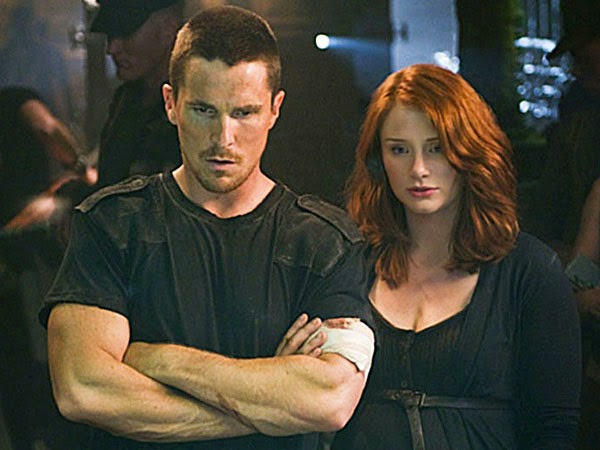
In Terminator: Salvation (2009), John Connor (Christian Bale) commands a resistance unit against the advancing forces of the A.I., Skynet, in 2018, a full fifteen years after Judgment Day.  

Connor learns that Skynet is planning to kill off high-profile targets, including Kyle Reese (Anton Yelchin) which could not only change the outcome of the conflict, but eliminate John from existence all together.  

While he tries to convince his military superior (Michael Ironside) of the situation, a mystery man, Marcus Wright (Sam Worthingon) also shows up, creating a quandary for Connor.

Can Connor trust Marcus Wright, and if so, can he use him to help rescue many captive, including Reese, from Skynet's grasp?


In light of McG's underwhelming Terminator: Salvation  the third film in the Terminator cycle, Rise of the Machine, now looks like an absolute masterpiece.

To cut to the chase, the fourth film is a colossal disappointment, a flat-line thriller that never raises the heartbeat, never engages the heart, and never, for a moment, crafts a world or characters that we can believe in. It substitutes loud explosions for thrills and inserts off-the-shelf platitudes about the "human heart" for genuine character development.

Most disturbingly, John Connor (previously played by Edward Furlong and Nick Stahl) has been transformed from quirky, ingenious individualist into a buff, strong-but-silent, dunder-headed action hero willing to leap before looking into any danger, small or large. The character's inaugural scene in Terminator: Salvation makes this trait a literal truth.

Now an infantryman of the year 2018, Connor (Christian Bale) -- without a second look -- dives into a vast subterranean machine complex attached to nothing but a tether. Connor can apparently defy the laws of gravity since he literally stops on a dime in mid-air -- without injuring his back or neck -- to light a torch. Then, amusingly, at the end of the sequence, we see Connor grunting and straining to climb out of the underground installation.

Free-falling and stopping his downward momentum in an instant? No problem.

But pulling himself up out of a hole? Tough work...


In the same vein, a later scene depicts Connor jumping out of an airborne helicopter into a turbulent ocean at the foot of a massive tidal wave in order to reach his chain-of-command on a submarine. We must wonder if he has become a machine himself because Connor's physical abilities would make Superman blush.

On set tantrums aside, the once-brilliant Christian Bale (think American Psycho [2000]...) has managed to appear less versatile and less emotionally-involved with each successive genre film role he's tackled, and Terminator: Salvation continues that unfortunate trend towards monosyllabic monotone. John Connor, the boy who grew up trained by his mother to be a warrior but who consciously and explicitly selected a different, unconventional path (even forbidding his pet terminator from killing humans...) has been transformed, disappointingly, into a gun-carrying, thick-necked, well-muscled commando who boasts a single tactical advantage: knowledge of the future.

And whether you believe this guy is a "false prophet" or "the key to salvation," would you -- as his military commander -- deploy him in the field where he could easily be killed; thus giving the enemy (Skynet) a substantial propaganda victory?


Terminator: Salvation is filled with violations of story logic just like that example.For instance, John Connor's wife, Kate (now played by a glazed-looking Bryce Dallas Howard...) must have stayed at a Holiday Inn Express between the events of Terminator 3 and Terminator: Salvation because the former veterinarian is now performing successful human heart transplant surgery.

In the field.

In a post-apocalyptic environment.


While I believe that Kate could indeed become an accomplished field medic in the fifteen year span between Terminator 3 and Terminator: Salvation, I don't believe the technology or education would be available to her in a post-nuclear world to learn the skills of heart transplant surgery. It's just moronic; Terminator: Salvation's final, lame gambit and reach for a "gimmick."

In broad terms, Terminator: Salvation's world does not much seem to resemble the horrifying future we caught glimpses of in the first three Terminator films.In Cameron's first film, the post-apocalyptic future was a world of perpetual night, darkness and gloom. Mankind barely survived, living atop mountainous layers of ash and debris (and human corpses...), in an unending nuclear winter. Terminators prowled and stalked by night, obliterating all resistance with dazzling, destructive lasers. 


A wicked joke in the original Terminator found a group of dirty, cold humans huddled around a TV set in an underground bunker. The light from the TV reflected on their sad, devastated faces, but as the camera swiveled around, we quickly registered that the set wasn't operational; that it was an elaborate fireplace.

Yet in Terminator: Salvation, the world around devastated Los Angeles is sun-lit, temperate, and mostly pretty safe. The resistance conveniently equips itself with Sony Vaio computer interface devices (product placement alert!), and fields military jets, helicopters, jeeps and submarines. The resistance also seems to have no problem remaining equipped with guns and ammo.  Even nuclear detonations are outrun with little concern or fuss.  Just another day on the front...

Even more baffling is the fact that all the humans in the film appear relatively healthy and well-fed. You'd think that acquiring uncontaminated food and water might be a full-time job after a worldwide nuclear winter, but Connor is buff, and Moon Bloodgood is certainly...fit, as a Resistance fighter pilot. Nobody mentions radiation or radiation poisoning in the film, either.  


I know that McG once expressed in an interview the idea that this is a "different" future than the one depicted in the 1984 and 1991 films because Judgment Day occurred differently in T3. But we still actually saw the nukes launch in that film, criss-crossing the country and the globe. We saw mushroom clouds too. No matter how you cut it, the planet should be deep in a nuclear winter at this juncture, and technology scarce.

Sadly, this is  also the first Terminator film in which the action scenes have failed to thrill. One particular action set-piece is a real disaster: the night-time pursuit of Marcus Wright (Sam Worthington) after his escape from the resistance headquarters. 


At the time of this chase, Connor is already struggling with his understanding of Wright, and has even come to sense that the man may be more than he seems...a possible ally. And yet Connor sends out attack helicopters, jeeps and soldiers to blow the guy away anyway...to napalm him back into the Stone Age. It's an unmotivated action sequence, especially since Connor -- after sending in the cavalry -- makes a deal with Wright anyway. This whole sequence succeeds only in slowing down the film's march towards the climax. Like much of the film, the scene makes no narrative sense.

I can only guess why, but Terminator: Salvation -- action scenes included -- is oddly lethargic and listless. It's clear now, if it wasn't before, that Arnold Schwarzenegger's presence in the previous films made some of the clunkier moments in the franchise bearable with his over-sized charisma and tongue-in-cheek sense of humor. Devoid of Arnie's catalyzing presence, Salvation is dull and mechanical. A CGI Arnold shows up late in the proceedings and is fun, if pretty darn phony-looking.

There are some nice touches here, no doubt. I enjoyed hearing Linda Hamilton's voice on the Sarah Connor cassettes. I also thought it was cool that, while going rogue, Connor listens to Guns N Roses (his soundtrack of choice in Terminator 2). 


If only there was more of that rebellious spirit left in this Connor. 

And finally, Anton Yelchin, who impressed me as Chekov in the new Star Trek (2009) and Star Trek: Into Darkness (not to mention as Odd Thomas...), is equally impressive as Kyle Reese, even if given relatively little to do in this story.  I wish he had more screen-time.

The flat, heartless, disappointing Terminator: Salvation reminds me of Skynet's diagnosis of Marcus Wright late in the film:

"The human condition no longer applies to you."


This is a generic blockbuster, start-to-finish, an expensively-composed "hit"-making engine dressed up in a cover of human skin.  Under the skin, however, this is junk, and the first flat-out bad Terminator movie.

Thursday, July 03, 2014

Cult-Movie Review: Inglourious Basterds (2009)


Director Quentin Tarantino may have intentionally mangled the English language with the misspelled title of his cinematic effort Inglourious Basterds (2009), but this prodigious talent speaks the language of film with a perfect accent. 

Although Tarantino's production shares a title (sort of...) with 1978's The Inglorious Bastards (from director Enzo G. Castellari) there's not actually much similarity between the two efforts. Both films are set during World War II, and both films concern an important mission behind enemy lines.

After that, leave your expectations at the door. The 1978 film is a low-budget exploitation actioner (with Bo Svenson and Fred Williamson), but Inglorious Basterds is Tarantino's trademark specialty: art-house exploitation.

In other words, Tarantino doesn't craft anything remotely like an action yarn here. Instead, Inglourious Basterds is an almost sedentary, deliberately-paced film about personal warfare, not the international, global variety we've come to expect from the WWII film. 


This isn't Saving Private Ryan (1998). No beaches are stormed. No wartime platitudes are reinforced.


"Looks like the shoe's on the other foot," The Powerful and the Powerless in Inglourious Basterds


The backdrop for this 2009 drama is indeed the war effort in general, and a group of American soldiers behind enemy lines, but the guts of the narrative involve feelings of personal disquiet: the overwhelming feeling of powerlessness engendered by the Nazi Regime, and the Basterds' dedicated attempts to give the Nazis a taste of their own medicine.

Some scholars and pundits have suggested that the film is morally facile, a simple revenge picture that makes the American Basterds (Jewish-American soldiers...) as reprehensible as the Nazis they fight in Europe; but that doesn't seem legitimately the case.

Tarantino's focus isn't necessarily on brutal, bloody violence, but on power, and how it feels to be the party without it. 

The Basterds in the film, as well as a Jewish cinema owner named Shoshanna (Melanie Laurent), exact violent retribution against the Nazis, it is true. But, oddly -- in almost every situation -- it feels not like eye-for-an-eye Draconian violence, but rather an assertion or re-assertion of self, or self-actualization, if that's possible.

This is why, I suspect, the film's fiery final sequence quotes extensively from De Palma's Carrie (1976) and the famous sequence at the high school prom. Both movies concern the victimized pushed too far, taking back the power for themselves in an apocalyptic showdown.

I don't want to get too far ahead of myself, however. Inglourious Basterds is a film consisting of five separate or episodic chapters. The first chapter "Once Upon a Time in Nazi-Occupied France" goes a long way towards establishing the feelings of personal powerlessness the Nazis so ruthlessly exploit.

A dairy farmer who is hiding Jewish refugees in his house is visited on his remote farm by Colonel Hans Landa (Christoph Waltz), who is nicknamed "The Jew Hunter." Landa gains entry to the house, enjoys a glass of milk, switches the conversation from French to English, and then -- without even verbally leveling much of a threat -- makes the weeping farmer, LaPadite, surrender his hidden wards. The refugees are then brutally shot down, and only 18-year old Shoshanna escapes the massacre.


The conversation between Landa and LaPadite is lengthy. It goes on and on, and Tarantino holds the scene for a duration approaching twenty minutes. 

The aspect of this scene that makes it work so splendidly and which makes it increasingly suspenseful as it continues is the very thing that remains determinedly unspoken: Landa's total and complete domination of the poor farmer. LaPadite has no options; no recourse; nowhere even to lodge a complaint. He can't fight, or he will sacrifice his family. He can't bargain, either. There's absolutely nothing to be done. Landa comes into his home, is unfailingly polite and courteous...and is completely in control. The Nazi has no need to flex his muscles (or twirl his metaphorical mustache), to assert his authority. His authority simply...goes without saying.

This powerful and frightening idea recurs in Chapter Three, "German Night in Paris." Shoshanna -- now a cinema owner in France hiding under the name Emmanuelle Mimieux (think Yvette Mimieux) -- unexpectedly meets Nazi sniper and war hero Zoller (Daniel Bruhl). He is starring in Goebbel's latest propaganda film, Nation's Pride, and he quickly devises the notion that Shoshanna's cinema should host the film's premiere.

Again: she is not asked about this. Her counsel is not sought. Shoshanna is not given an out so she can politely demure. Instead, she is escorted to a nearby restaurant and introduced to Joseph Goebbels (Sylvester Groth), who immediately and unquestioningly assumes her total and complete cooperation. 

Like Landa in Chapter One, the Nazis here are not over-the-top schemers or brutal torturers for us to sneer at. Instead, they are so confident in their total authority that there's no need for showy demonstrations, as we would no doubt see in lesser films.

In the most dramatic example of Shoshanna's utter powerlessness in the face of the Nazi domination, Hans Landa even gets to dictate to the cinema owner when she should eat her strudel. She is about to take a bite, but he has forgotten to order whip cream. 

"Wait for the cream," he utters with a wolfish smile.

It isn't a request. It's an order.

Thus -- in albeit strange and unconventional fashion -- the Nazis in Inglourious Basterds are more frightening than almost any you've seen depicted in a movie before. They appear courteous and civil, but that's only because their domination is unchallenged; unquestioned. These men walk the Earth as Gods: every demand met, every order followed, every desire sated.

From the predicaments of the farmer and Shosanna in their respective chapters, the audience quickly detects how the basic human freedom of choice (even the choice when to eat your dessert) has been removed from those living in territory occupied by the Germans.

Tarantino's selections (in actors; in tone; in holding on a particular scene) all play this idea out adroitly. The scene set in the Tavern is not much different: an S.S. officer strides onto the scene and expects to have his demands for attention met, without question.

The eminently just punchline comes in the film's valedictory scene and composition. The leader of the Basterds, Aldo Raines (Brad Pitt) has been forced to cede authority to Landa. Landa thinks that -- as usual -- he is totally in command. 


He has become used to his unlimited, unspoken power. And with one powerful, if small act, Raines questions that assumption....with a knife. It's not just revenge for the sake of revenge; it's not bloody for the sake of gore. It's a lesson, actually, in what freedom represents; and the fear that people feel when that freedom is stolen from them. 

When Aldo carves swastikas on the foreheads of his enemies, he is questioning what the Nazis believe is unquestionable; their total authority and superiority. Aldo does not kill, but he makes the Nazis experience fear -- and powerlessness -- for the first time.


"We're going to make a film. Just for the Nazis." Homage and Tribute in Tarantino's Film

Inglourious Basterds also proves intriguing in much the same the fashion as Tarantino's other films do. In other words, the movie functions as a dedicated homage to other war films, and as a tribute to the culture of movies itself.  We see this in Death Proof (2007) as well: the notion of a universe built from other movies, and allusions to other movies.

In ways simple (Aldo Raines = Aldo Ray) and ways complex, Tarantino gets in some edgy commentary here about the power of images; about the power of the medium itself.

Even casting is vitally important. For instance, horror director Eli Roth plays the "golem" nicknamed "The Bear Jew," the Basterd who brandishes a baseball bat against recalcitrant Nazis.

We already associate Roth with scenes of extreme violence and gore thanks to his role directing (the masterpiece...) Hostel (2005), and so the actor's participation in what promises to be the film's most violent scene works commendably to the movie's advantage. 


Here comes Eli Roth doing what Eli Roth does best...or so we think.

But Inglourious Basterds is a movie about movies in deeper, more meaningful ways too. 


A propaganda film, like Goebbel's "Nation's Pride,could conceivably galvanize a demoralized nation, we are meant to understand. It could literally turn around the war, and that's something that can't be allowed to happen. How Shoshanna subverts Zoller's film is one of the film's highlights; especially since her "phantom edit" plays to what is literally a captive audience.

Likewise, a movie critic like Hicox (Michael Fassbender) could conceivably boast the knowledge to make for an effective undercover agent in France, although a hand signal (not entirely unlike "thumbs up" or "thumbs down") could also doom him.

And finally, as Inglourious Basterds trenchantly reminds us, a film can be an instrument of propaganda or an instrument of justice. Film might even be, literally, a weapon. Film reels  literally double as the bomb that kills Hitler in the film's denouement.


And there's another thing about movies that Tarantino tells us here.

Movies  have no overriding responsibility to be true to the historical record. I mean...we all know how World War II ended, but Tarantino provides us a more satisfying, fairy tale, movie ending: one in which the powerful are given a lesson in powerlessness, and those without freedom find -- even for an instant -- liberty's power.

Inglorious Basterds
 is not the place to seek historical accuracy; it's a place to ponder the ways that movies -- as propaganda or vehicles of justice/vengeance -- can satisfy and offer emotional closure regarding a whole variety of issues. 


Isn't it better than history, really, that a Jewish woman victimized by the Third Reich should bring it down?

If we could write our own endings, isn't this the dramatic, poetic one we would desire? The underdog has her day, and the scales of justice are righted. 

Since this isn't real life, why not?


"I think this just might be my masterpiece." Or "That's a Bingo."

Given the importance of movie history and film in Inglorious Basterds, I find it fascinating that the last act in the film quotes so heavily from the work of my all-time favorite director: Brian De Palma.

I mentioned Carrie at the Prom vs. Shoshanna at the Premiere, but it's much more than that too.

Notice, for instance, that the interior of Shoshanna's cinema is colored and designed to resemble the palatial interior of Tony Montana's Miami home in Scarface. There are staircases bracketing both sides of the central hall, with a ledge above -- on the second floor -- and, finally, a room (in the center of the frame...) leading back to a private domain (office or auditorium).


In Scarface, this grand hall is where Tony goes out in a blaze of glory ("Say Hello to My Little Friend..."). In a very real way, that's also Shoshanna's fate.

Both characters also share something else in common: they went from being powerless, to possessing all the power. 


Only in Tony's case, he misused and abused that power (through a drug haze). By contrast, our sympathies remain with Shoshanna throughout Inglourious Basterds. She is setting things right (and ending the war...), not committing a cocaine-addled suicide.

Why quote De Palma so extensively here? 


Well, we know that Carrie is in Tarantino's top five favorite film list (at least last time I checked). But the images and compositions that recall De Palma are well picked for reasons of theme and recognition too. 

Both Carrie at the Prom -- the victim taking out the victimizers -- and Tony's last stand -- a staccato suicide by machine gun -- embody an important part of our contemporary pop culture lexicon. 

Carrie is about the effect that cruelty has on a person, even a good person. And Scarface is about power corrupting, absolutely. So Shoshanna may be Carrie; and Hitler may be Tony Montana, in some sense..

One of the qualities that I admire most about Inglourious Basterds is Tarantino's manner of making the intimate seem epic. This movie is about a big topic indeed (World War II) but it features almost no scenes of battle or any traditional war scenes, for that matter. 


The film consists mostly of a scene in a farm, in a tavern basement, and, finally, in a cinema. We see no tanks, no infantries on the move, and no impending air strikes.


Instead, Tarantino hammers home his theme of the powerful versus the powerless, and does so with just a handful of very intriguing, very human characters. The drama is entirely intimate though, in typical Tarantino fashion, the human behavior is also a bit exaggerated in some cases. In the case of Aldo Raines, I would argue it's almost cartoonish. But even he reflects something vitally important.

Sometimes you need bravado in the face of a powerful enemy. Inglourious Basterds reveals that Raines has that bravado in spades, but even more so, that the film's director does.  

Friday, May 31, 2013

Movie Trailer: Moon (2009)

Friday, July 22, 2011

CULT MOVIE REVIEW: Avatar (2009)


"Watching "Avatar," I felt sort of the same as when I saw "Star Wars" in 1977. That was another movie I walked into with uncertain expectations. James Cameron's film has been the subject of relentlessly dubious advance buzz, just as his "Titanic" was. Once again, he has silenced the doubters by simply delivering an extraordinary film." (Roger Ebert, "Avatar," December 11, 2009.)

"The last third of the movie, a battle between the Na'vi and their human destroyers, is a groundbreaking blend of digital and live-action. OK, it's unnerving that a movie preaching peace hits its visual peak with scenes of mass destruction. But Avatar is no Hollywood wankfest. It extends the possibilities of what movies can do. Cameron's talent may just be as big as his dreams." (Peter Travers Rolling Stone:, "Avatar." December 9, 2009.)

"But Avatar is also a distinctly political work of art, with a strong anti-American and anti-Western message. It can be read on several levels – a critique of the Iraq War, an assault on the US-led War on Terror, a slick morality tale about the ‘evils’ of Western imperialism, a futuristic take on the conquest of America and the treatment of native Americans – the list goes on..." (Nile Gardiner: "Avatar: the most expensive piece of anti-American propaganda ever made." The Telegraph, December 2009.)

"It rests on the stereotype that white people are rationalist and technocratic while colonial victims are spiritual and athletic. It rests on the assumption that nonwhites need the White Messiah to lead their crusades. It rests on the assumption that illiteracy is the path to grace. It also creates a sort of two-edged cultural imperialism. Natives can either have their history shaped by cruel imperialists or benevolent ones, but either way, they are going to be supporting actors in our journey to self-admiration." (David Brooks: "The Messiah Complex." The New York Times, January 7, 2010.)


This week for the Cameron Curriculum, our film selection is Avatar (2009), James Cameron's sprawling, science fiction trailblazer.

As you will no doubt recall, the movie proved itself a veritable box office Goliath, and also earned positive reviews, at least in the majority. By and large, audiences loved Avatar as well. The film stands on the IMDB's list of best rated films (currently perched at 183 in the top 250).

Yet, Avatar's success does not mean that the film is non-controversial, as the above critical quotations make abundantly plain. Some critics and audiences view this James Cameron film as an anti-American political diatribe and despise it specifically on those terms.

Others simply can't bring themselves to approve of a film that proved so hugely popular. This is the so-called "Woody Allen" critique. These fans can't be part of any club that would have them as a member. Many geeks apparently believe they can differentiate themselves from "the mob" by rejecting Avatar out-of-hand....some of them without even seeing the movie in the first place!

What those naysayers missed, however, is a film -- much in the spirit of Aliens (1986) or The Abyss (1989) -- that consists of both enormous heart and vision.  Here, Cameron obsesses on the yin and yang of the human equation.  He recognizes our natural desire to explore the new and strange, and in the process overcome hurdles. 

And -- on the other side of the coin -- he clearly "sees" our uncomfortable tradition of destroying or polluting that which we discover on our brave explorations.  

Exciting, emotional and visually pioneering, Avatar is a modern-day genre masterpiece, even if the sci-fi community has not yet entirely embraced it as such.  In time -- when there is some audience distance from some of the politics raised by the film -- the film's reputation will evolve.  And it will be for the better.

Everything is backwards now, like out there is the true world, and in here is the dream.

On the forest moon Pandora, the indigenous people -- the blue-skinned Na'vi -- unwittingly stand in the way of big business and "progress."

Namely, Earth men have come to Pandora to mine the ground for a valuable rock known as "Unobtanium."  

Business and military interests align to re-locate the Na'vi from their Home Tree in order to mine a rich deposit of the critical mineral.

The handicapped Corporal Jake Sully (Sam Worthington) fulfills his dead brother's contract and heads to Pandora to work as a "driver" for a genetically-engineered Na'vi avatar.  Collaborating with Dr. Grace Augustine (Sigourney Weaver), Jake is assigned to learn more about the Na'vi so he can facilitate their orderly departure from Home Tree.  His military superior, Colonel Quaritch (Stephen Lang), however wants Jake to gather tactical information about the Na'vi and their environs, should diplomacy fail.  For a time, Jake works both sides of the street.

Inside the body of his avatar, Jake also learns the many ways of the Na'vi.  His teacher is Neytiri (Zoe Saldana), the Chief's beautiful daughter.  She reveals to him the true Na'vi soul, and the duo soon falls in love. 

Meanwhile, Grace learns that all the creatures of the planet, including the Na'vi share a link with Pandora itself, a planet-wide symbiosis forged by "signal transduction."  The Na'vi see this bridge to the planet as a link to their God, Eywa.

Before long, the military and business interests grow tired with Jake's lack of progress, and  under Colonel Quaritch (Stephen Lang) launch a devastating assault on Home Tree, scattering the Na'vi so their giant machines can commence mining.  Neytiri's father and many other Na'vi are murdered in the strike.

Finally realizing where his true loyalties rest, Jake decides to make a stand against the Earth men, and he gathers the disparate Na'vi tribes to fight back against them. 

But to gain the trust of the Na'vi, Jake must first tame a giant flying beast of legend: Toruk Macto.

"You are not in Kansas Anymore" - Avatar as visual experience

As Roger Ebert's quote above indicates, Star Wars is likely a fine point at which to commence an analysis of Avatar.

Like Star Wars did in 1977, Avatar stands at the vanguard of a new technological age, and a new threshold in terms of special effects achievement. 

Only this time, those achievements are in the realm of CGI and 3-D rather than motion control, alien make-ups, etc.

Because of this accomplishment, Avatar truly belongs in a select group of great science fiction films such as Planet of the Apes (1968), Star Wars (1977), Blade Runner (1982), Tron (1982) and The Matrix (1982).  Like those genre landmarks, Avatar absolutely immerses the viewer in a new world of unfettered imagination, complexity, color and depth.

The film's protagonist, Jake Sully (Sam Worthington) notes that his arrival on the moon of Pandora represents indeed a "fresh new start," and that synonym for a "brave new world" might very well be our metaphor for the 3-D and CGI presentation of Cameron's Avatar

For once, CGI effects actually seem to comprehend the subtleties of flesh: the nuances of movement, expression, and even the "weight" of gravity.  

No doubt the visual wonders of Avatar will one day be eclipsed, but for now (and for the foreseeable future, given the state of films this summer..), they are certainly state-of-the-art.  In this arena, Avatar is never less than entirely convincing.  You never feel like you're watching special effects or limited, animated digital figures.

Instead, you see characters, creatures and strange lands.

What I find particularly noteworthy about the use of the CGI and 3-D is that Cameron uses the special effects techniques to make Avatar perhaps the very first movie in human history not scaled to us; not scaled to human proportions.

Although Lord of the Rings (2001) inventively blended pint-sized hobbits with human-sized elves and other humanoid beings, the general effect was still one of putting other life forms (Hobbits) into a world we recognize as ours.  Avatar takes a different and far more impressive stance.  It lands us in a world not made for us; and one in which human concerns are secondary. 

And that's very much an example of form following content.  Thematically the film is also about petty human concerns dwarfed by alien but ultimately more important ones.  The universe isn't always about us, and we see that idea (that slap in the face?) reflected in the very colorful, very dangerous, very oddly-scaled world of Pandora.

Accordingly then, Pandora exists against a backdrop that we can hardly conceive, and which is consequently awe-inspiring. Unlike many directors attempting to deploy 3-D, Cameron doesn't merely toss things at the audience in a blatant "coming-at-ya" style. On the contrary, he marshals the process to develop visceral emotions in the audience: to generate vertigo, for instance, and to dramatize for us extremes of height, and altitude and speed. 

Cameron also utilizes 3-D to reveal the depth and breadth of the Pandoran wilderness, escorting us into the greatest silver screen jungle since Kong's lush Skull Island in 1933. 

Again, the level of detail and complexity in this landscape is simply staggering.  I'm not exaggerating.  We get the feeling here not of a small geographic region in sight of a limited camera -- a region encumbered by the exigencies of movie budget -- but of a whole world stretching as far as the eye can see.

The point of the height, altitude, speed and depth, of course, is total emotional immersion.  And because of Cameron's integrated (rather than carnival...) approach to 3-D, in Avatar, audiences come to believe most profoundly in this fantasy world.  Avatar is magnificently unbound from the sound stage (and human proportions), but not at all in the static fashion of the Star Wars prequels, where characters seem to be forever standing in front of green-screen compositions.

Now, I don't share many fans' hatred of those three Lucas films (I rather enjoy 'em, actually...), but they certainly appear shallow in conception and execution next to Cameron's rich, layered vision for Avatar.  Here, every plant, every creature, every insect that swings, stampedes or skitters into view, captivates the attention and the imagination.  Cameron doesn't just record another world for us, he creates an otherworldly ecosphere from top-to-bottom.

Certainly, there's much you can debate regarding Avatar, but as a resounding technological and imaginative triumph it is virtually unimpeachable  No film director in history has utilized 3-D and CGI as inventively and in as integrative a fashion as Cameron has here, and on those grounds alone, Avatar is a watershed event.

"I see you" - Avatar and its themes

Avatar very much concerns the yin-and-yang of the human spirit.  

As a species we are always looking to explore what's over the horizon. And yet when we reach our destination, we yearn to make that new land ours; to harness the dirt and the water and make it serve our needs.  This is a fact of life.

We don't always use our resources wisely, yet the hunt for resources will one day, I'm certain, carry us to the far reaches of this solar system and beyond.  We are driven to explore. And apparently just as driven to use up that which we find along our journey.

In Avatar, we are introduced to a character, Jake Sully, who exemplifies the best aspects of this human equation.  

Despite suffering a physical impairment, he broaches not just a new world, but the "most hostile environment known to man."  And when he takes part in the Avatar program, Jake throws himself into his work.  He learns the Na'vi language. He learns to hunt, ride, fly and live as another life form all together. 

Again, Cameron reveals to us mankind at his most noble: questing and searching for meaning over the next hill.  A wise person once noted that disability is just a matter of perspective, and in some way, Jake's journey reflects that truth.  He first countenances, then embraces, a new way of living while also maintaining the finer qualities of our species (to love; to balance morality, and more).  This is what evolution  truly is: integrating new ideas and new concepts into the self as one's horizons expand.

The opposite side of that human equation, of course, is colonialism and imperialism, and Avatar's central conflict revolves around those very controversial issues.  Although we boast a history of imperialism in this country, we are not alone in that characteristic.  Not by a long shot.  Ancient Rome, England, Nazi Germany, the Soviet Union, France, China and other nation-states have also gone to war (again and again...) over a desire to "take" strange lands and harness them for explicit purposes of Empire-building.

Specifically, Avatar crafts a futuristic metaphor for the settlement of the American continent. 

It's easy to read the lines of the comparison.  The Earth men are the Europeans, come across the ocean of space to take and develop the land.  And the Na'vi are the Native Americans who see their existence and way of life threatened.

In film history, we've seen this very dynamic played out in Kevin Costner's Dances with Wolves (1990),  Walt Disney's Pocahontas (1995) and Malick's The New World (2005), among others.  It's not a new idea by any means, but that's acceptable because the presentation is new...and cutting-edge. 

Star Wars wasn't new in terms of narrative, either, especially if you have any familiarity with the oeuvre of Akira Kurosawa.  And Star Trek, of course, looks very much like a variation on Forbidden Planet (1956)  Avatar harnesses the familiar metaphor of the Native American/European conflict to tell its tale, but does so in ways that boast resonance both as science fiction, and as a reflection on contemporary times.

In the case of Avatar, I would argue that the film succeeds rather admirably in making its case about the moral evils of colonization or occupation.  It does so -- as is Cameron's tradition -- in entirely emotional, manipulative, and even grandiose fashion.  

That's the very nature of the medium of film and Cameron exploits that nature.  Ruthlessly.  As an artist, he is not merely interested in making audiences think about an issue; he wants us to feel it, intensely. 

Some people may object to this approach, but in doing so, they object to Cameron's singular gift as a filmmaker.  Using breakthroughs in movie technology, he brings the experiential, emotional aspect of visual storytelling closer to the audience than ever before. He constructs these intense dramas (like Titanic) based on intimate human relationships and ideas (like the interconnectedness of all life) because he apparently believes in a unique axiom: the more advanced the film in terms of technical prowess and achievement, the more it can impact your heart.

Not that the emotional approach doesn't have downsides.

For instance, the villains in the film are not truly fully developed people, but rather true evil-doers.  Giovani Ribisi plays a despicable character named "Parker Selfridge."  Selfridge?  Sounds like selfish.  Or maybe his name is about what we hope to find over that next horizon or ridge: something for the self

And the nasty Colonel Quaritch refers to the Na'vi as "blue monkeys" or as "cockroaches," and basically attempts to bomb the Na'vi back to the stone age.  He's a racist and a destroyer, and entirely easy to hate. 

Yet, to give Avatar some credit, it's pretty clear why Quaritch thinks as he does.  It's not because Cameron is anti-military as some insist, but because Quaritch has had a very negative personal experience with the Na'vi. 

On his first day on the planet, he was badly injured (and scarred) by them.  Fear and hatred have thus colored his perception of the planet and its people.  Quaritch can't put aside his negative experience with the Na'vi in the face of new thoughts, new ideas.  He can't evolve.  He stays as he is...never outgrowing his fear. He is thus an effective counterpoint to Jake in the story, if not a fully dimensional character in his own right.  This echoes the character of Coffey in The Abyss as we discussed last week.  Both characters effectively move the plot forward and effectively reflect a larger, symbolic issue (intransigence or stagnation in the face of facts, the self-destructive nature of nuclear war, etc.), but on some human level they aren't adequately developed.

Avatar: Does it hate America?
Many people have asked: Is Avatar anti-American?   Unfortunately, that's the wrong question to ask. 

Certainly, Avatar knowingly mirrors much of America's journey in the last decade (2000 - 2010).  Colonel Quaritch notes near the end of the film that "Our only security lies with pre-emptive attack.  We will fight terror with terror," invoking the Bush Doctrine.  

Furthermore, his mission to drop a bomb on a Na'vi holy site is also equated with a "shock and awe" campaign, conjuring memories of our siege of  Baghdad in the second Iraq War.   Also, we have seen people like Tom Tancredo suggest bombing the holy sites of our political enemies.  He mentioned bombing Mecca, specifically.

Following this line of thought, many critics have also looked at the Home Tree assault -- with twin plumes of smoke stretching high into Pandora's sky -- as a thinly-veiled reference to Al Qaeda's attack on the United States that Tuesday morning in September. 

Even the Earth men's hunt for natural resources on Pandora -- with war backing up that hunt -- can be seen as a coded reflection of the belief by many Americans that the war in Iraq was launched so our nation would have direct access to Middle East oil.

These points are certainly unmistakable; but they don't make Avatar anti-American.   That's where there's a crucial fallacy.

On the contrary, all of these issues simple reflect what many Americans truly feel about the direction of our country in the last ten years.  This commentary by Cameron is only anti-American if you assume that America never makes mistakes, that America is always right in the international actions it pursues, and that President Bush's decisions represent the full spectrum of American beliefs about this country.

I mean, is what Tom Tancredo suggested doing to Mecca the American way?  Is pre-emptive war the American way?  Is that the America that people defend when they claim that Avatar is anti-American?

And frankly, I'm baffled by people who want to view Avatar only as some kind of America-hating film anyway.  Avatar is the same story, essentially, as Battle: LA (2011), a film which has clearly not been debated in such terms. 

To wit: in both films a race of extra-terrestrials attack and occupy another planet to gather its resources (alternatively Unobtanium and water). And the natives in both situations strike back against the invaders, mounting a violent resistance to the plunderer.  The invaders in Battle:LA are non-human.  The invaders in Avatar are human.  That's the only difference, in broad strokes, in terms of narrative. 

So why is Battle: LA not anti-American, but Avatar is?  Both films argue the immorality of occupation/colonialism and the imperative to fight back against invaders.

The plain truth of the matter is that Cameron aims for a higher morality here. His statement is simply that it is not right to go to someone else's land and take their resources.  Simple as that.  It seems to me that ought to be something everybody can agree on in principle. It's true whether you're American, Chinese, Russian, Klingon, Jedi or Sith.  In the situation depicted by Avatar, the human beings are seeing only what they can take, not that they have no right to take it.  Now, you can argue the Machiavellian politics of the whole thing; that if mankind is dying out, he must take the Unobtanium and is justified in doing so.  Self-preservation and all.

But by the same Machiavellian mind-set, then, you must accept that the Na'vi -- in trying to protect their own existence -- are also justified in fighting back against the Earthers.  It doesn't only work one way.

It always bothers me when people are unable to see both sides of an issue.  We would hate it if aliens landed on our soil and began mining our land.  We'd fight back, and rightfully so. Just as the Na'vi fight back in Avatar.  But since humans are placed in the role of bad guy (as they are in many sci-fi films, from Conquest of the Planet of the Apes, to District 9, to Blade Runner, even...) then Avatar is suddenly anti-American.

Here's my long-winded point: being leftist is different than being anti-American, and to conflate the two is the facile trick of the propagandist.

Go back and watch Planet of the Apes (1968) -- made at the height of the Cold War and the Vietnam War -- and honestly tell me that it is not a leftist film too; about man's self-destructive, warring nature.   It ends with a symbol of America, Lady Liberty, destroyed.  So is it anti-American too?  If Avatar is, then Planet of the Apes is.

It's only because we live in such hyper-partisan times that Avatar is constantly saddled with the moniker Anti-American, when what the film actually concerns is a human truth: that our drive to explore and increase our knowledge is a double-edged sword; It keeps us alive, but also, often, puts us in conflict with each other, and with nature itself.

Again, it's much easier to brush off Avatar with a simple label ("anti-American") than it is to examine Cameron's story and take it for what it is really about - human nature.  Does the film have a leftist bent?  Absolutely. Just as some science fiction films have a rightward leaning (Zardoz [1974] for one.). 

The right has not been alone in attacking Avatar for perceived "philosophical" flaws.  The left (plus David Brooks) have really gone after the film as being an example of "The White Man's Burden."  In other words, this is a film in which a white man saves a native culture and ascends to leadership of it.  Apparently, that's insulting to ethnic minorities or something.

Again, this is a more simplistic view of the film than is merited.

For one thing, when was the last time that a handicapped character took a leadership role in a major, over-200 million-dollar action film?  Jake Sully is a white man, it is true, but he's also one who has been largely discarded by his culture because of his physical impairment.  He's not physically powerful alpha male Kevin Costner, for instance.

Jake is not the typical "messiah" in that regard.  Instead, he is a perfect man to lead the fight because he is also, like many of the characters in the film, separated and isolated from his true nature.  His physical handicap has prevented him from being what he knows he can be; from doing what he knows he can do.  The avatar program grants him the capacity to tap that potential and to become whole again. 

The film is as much about the Na'vi (and the Na'vi experience) saving Jake as it is about Jake saving the Na'vi.  He learns much through their interconnectedness, after all.

David Brooks' comments bear closer scrutiny.  He writes that the film depicts colonists as "rationalist" and "technocratic" while colonial victims are "spiritual and athletic".  He should take a gander again at Quaritch, a man who is also quite athletic; so damned athletic in fact, he can pick off human targets some distance away while holding his breath for minutes at a time (in Pandora's poisonous atmosphere).  Qauritch is no armchair general.

And why does Brooks assume that the film says "illiteracy is the path to grace."   Nowhere in the film is illiteracy even broached.  The path to grace in the film is through inter-connection; through the link and harmony between man/woman and the land.  Because we cannot see this psychic connection, the Na'vi might very well call mankind "psychically illiterate."  

Again, this attack on Avatar is too simplistic. 

Would it have been nice if the Na'vi could save themselves without Jake as the leader?  Well again, look very closely at the actual specifics of the text in question.  Which character destroys the villain?  Hint: it's not the white man Jake.  No, he is rendered paralyzed, in the final battle featured in the film. 

No, Neytiri finally takes out Quaritch.  She is no mere "supporting player" (as Brooks puts it).

And who turns the tide towards the Na'vi in the battle?  Again, it's not Jake or any other "white man." 

It's Eywa, who through her powers of inter-connection, summon the forest animals to attack the occupiers.  So again, it's not entirely accurate to say that Avatar suffers from this movie "Messiah Complex."   
On the contrary, Jake is present in the film to serve as surrogate for the audience.  He is our (human) entrance point into the world of the Na'vi, an example of -- again -- how mankind can go beyond what he knows and explore a new and alien situation. 

Even the film's ending is about this idea of crossing the next hill; evolving to the next point.  Jake is able to cast aside his human body and become fully Na'vi.  This is because he has embraced the better part of our human nature.  He has overcome his limitations (physical and mental) and become what he had only once "dreamed."   If you're James Cameron, you can't make this argument about human nature without featuring a human protagonist in the film.

In terms of the Cameron Curriculum, there's many points of commonalities between Avatar and Cameron's other films.  For instance, the Na'vi saying that goes "I see you," (meaning "I see your true self") is carried forth from Titanic. In that film, Jack and Rose share an exchange that seems familiar. "You see people," says Rose.  "I see you," says Jack. 

Also, like Aliens, The Abyss, The Terminator and even Titanic to an extent, Avatar features as a hero someone who is "blue collar," in this case a so-called "grunt."  This also makes three Cameron films (Aliens, The Terminator and Avatar) in which a military man is amongst the protagonists, making it more difficult and less plausible for critics to argue that Cameron is somehow against the military.

And, of course, like out-of-time Ripley, an emotionless Terminator in T2 or Mrs. Tasker in True Lies, Jake is an outsider or fish-out-of-water in Avatar.  In a way, he is both outside of the human race because of his handicap, and outside the Na'vi because of his nature as a "Sky Person."  In many Cameron films, only those who are "outside" the dominant coalitions can bring a sense of balanced perspective to crises.

Earlier in the review, I brought up George Lucas and the Star Wars films.  Avatar treads on some territory familiar to that franchise, namely a primitive people waging a war against a technological foe. 

In Return of the Jedi the Ewoks battled the Empire, and in The Phantom Menace, the Gungans battled the Trade Federation.  Lucas essentially played both of those battles for laughs. 

By contrast, the final battle in Avatar is anything but funny: it's a harrowing, tense descent into all-out war.  In Avatar, the primitive species carries the day only because of a gift from Pandora: the ability of all  native creatures to communicate and connect with one another.  That's something the humans can't do, at least on a planetary scale.

Interestingly, Eywa does not normally "take sides."  She protects "only the balance of life."  But in this case, man is so egregious, so awful in his attacks, even God herself must become involved.   This is the environmental message of Avatar, another point that has enraged some people, apparently.

It's another critiique I don't really get.  What could be more conservative, more traditional, than taking good care of the planet you happen to live on?

Avatar is a great film because of the advances it makes in terms of technology, because of the commentary it offers about the double-edged sword of human nature, and because, perhaps, people just can't stop arguing about it.

So many people "see" Avatar.  Or at least they think they do. My recommendation to them is to watch the movie again, this time keeping in mind Neytiri's admonition for those whose mind is already sealed tightly shut.

"It's hard to fill a cup which is already full."


Next Week:  Are you ready to go back to Titanic?