Showing posts with label At Flashbak. Show all posts

Sunday, November 13, 2016

At Flashbak: Coleco's Adam (1983)


This week at Flashbak, I remembered Coleco’s Adam, a “family computer system.”


“The year 1983 was not a good one for video games or computer systems.

On the former front, the worst video game ever made (Atari’s E.T.) caused a market crash.

And on the latter front, Coleco created one of the great disasters of home computing: Adam – The Colecovision Family Computer System.

On paper, Adam looked great. The computer was advertised as “thinking like you, so you don’t have to think like a computer.”

And Adam was also promoted for being an all-in one system, selling in stores with a disk drive, a printer, word processing software (Smart Writer) and even a game: Buck Rogers: Planet of Zoom. 

The price for Adam wasn’t extravagant either, under 600 dollars.

But something went terribly wrong.

The Coleco Adam missed multiple shipping dates in October of 1983, jeopardizing profits in the holiday season, and ultimately failed to sell 100,000 units by Christmas of that year.

Worse, it was rumored that five out of six Adam computers were being returned by consumers because of defects.

What kind of defects you might ask?

Well, one catastrophic and all-too-common glitch caused disks in the disk drive to be erased on boot-up.  That meant all data was lost…permanently.  And this was a “Family” computer system, meaning that Adam was being used by students in school, on term papers and other projects.”


Please continue reading at Flashbak.

Sunday, November 06, 2016

At Flashbak: They're Not What They Appear to be (Enemy 'V' Visitor Action Figure; LJN)


This week at Flashbak, I remembered the Enemy Visitor Action Figure, from V (1983).


“Back in 1983 Kenneth Johnson's science fiction mini-series V was event television. It aired over two nights on NBC in May, and everybody was buzzing about the scene in which the leader of the alien Visitors, Diana (Jane Badler) devoured a gerbil.

It wasn’t long before LJN had an action V "Enemy Visitor" action figure on the market.  This 12-inch alien soldier was the embodiment of Visitor evil. He hid beneath a human face and sun glasses while wearing his red space Nazi uniform. He was also armed with a laser weapon.

Designed for ages four and up, the Visitor figure's box came emblazoned with the legend "THEY'RE NOT WHAT THEY APPEAR TO BE!

A graphic below the figure revealed that youngsters could "unmask the Visitor to reveal his lizard face," and made note of his "extendable [forked...] tongue."  

On the back of the box, LJN noted: "The Visitor keeps his true identity hidden behind a human face.  Unmask him and reveal the lizard creature!"  It reports too that "The Human Mask is worn whenever you want to disguise the Visitor's true identity.  To remove the mask, grasp one corner between your thumb and forefinger and gently pull off."

The box also suggests: "To make the Visitor's tongue move in and out, push the hidden button on his back." 

Yes, you could actually extend the figure’s forked tongue by pressing a lever on the back of his neck.”

Please continue reading at Flashbak.  

Sunday, October 23, 2016

At Flashbak: Mattel's Gre-gory (1980)


This week at Flashbak, I remembered Gre-gory, Mattel’s toy bat.


“It was great to be a kid growing in the 1970s and 1980s, in part because of great and weird Halloween toys like this one, “Gre-gory, Big Bad Vampire Bat” from Mattel.

This toy bat was made of reddish-brown, soft vinyl, and intended for kids aged seven and up. And Gre-gory could be all yours for under $12.00 dollars.

As the ads claimed, children would “go bats” for Gre-gory as they enjoyed “hours of frightening fun” playing with their new friend.  Gre-gory’s red eyes would never close, either, which only added to the nightmare fodder.  Maybe you could perch him over your bed at night?

What else could Gre-gory do?

Well at eight inches tall, he could literally bite the hand that fed him.  “Put your finger in his mouth and see what happens when you squeeze him!” the Gre-gory advertisements urged.  If that wasn’t wicked enough, kids were also implored to “see if your friend dare stick their fingers” in his mouth.

Gre-gory also had a see-through belly so you could watch “the red fluid” -- blood? -- “flow.” 

Gre-gory couldn’t do much else, though if you wiggled his wings and shook him, it apparently looked like he was in flight. Not very high-tech, in today’s world, I guess.”

Please continue reading at Flashbak.

Sunday, October 16, 2016

At Flashbak: Vincent Price for The Shrunken Head Apple Sculpture Kit


This week, in anticipation of Halloween’s approach, I remembered a “horrific” collectible of the mid-1970s: The Shrunken Head Apple Sculpture Kit.


“In 1975, Whiting (a Milton Bradley Company) released The Shrunken Head Apple Sculpture Kit, and had the good sense to have horror icon Vincent Price advertise it. 

Price appeared on the box art, and offered a testimonial of sorts for the product too.

“Create your own collection of delightful shrunken heads,” Mr. Price urged.

With this kit -- which “attaches to any standard table lamp” -- any macabre-minded minor could “turn apples into shrunken heads.

Apples were not actually included with this craft, but the kits came with enough material to decorate six heads. 

Basically, you had to bake the apple in the device and thereby shrink them.  “Before you know it,” the promotions promised, “you’ll have shrunken heads hanging from your belt. Or your neck.”

The kit came not only with the heating cone (Termed a “shrinker”), but with beads and hair for decoration.  That just left the carving of the apple face to contemplate and complete…”


Please continue reading at Flashbak.

Sunday, October 09, 2016

At Flashbak: Tomy's Blip


This week at Flashbak, I remembered a “high tech” toy of the 1970s: Tomy’s Blip.


“Here’s another crazy artifact from the 1970s, a handheld game console from Tomy called, simply “Blip.”

Released in 1977, Blip is “the TV type game that you can take with you anywhere.” 

The big selling point was, not surprisingly, the mobile nature of the device.

Take BLIP anywhere. On boats, trains, cars, rocket-ships and planes,” the box’s writing suggested.

So basically, Blip was like having your own small device dedicated exclusively to PONG. 

The box writing continues:

Press the serve button and watch the light emitting diode (L.E.D.) come at you. But don’t watch it too long. To win, your hand must be quicker than BLIP. Quickly press one of the numbered BLIP buttons to send the L.E.D. back where it came from. If your opponent misses, it’s score one for you on the automatic digital billboard.”

The back of the box provides a diagram of BLIP, showing the “Game Selector Switch,” “Individual Serve Buttons, “Automatic Timing Mechanism” and the aforementioned “Numbered BLIP buttons” and “Permanent light emitting diode.”

It’s quite a lot of glorified description, again, for a game that simply plays Pong.

I got Blip as a Christmas gift in the late 1970s and thought it was the cat’s meow.  I loved it (at least until I got my hands on an Atari 2600).

Today, of course, it’s absolutely nut to think that anyone would spend entertaining themselves with this basic “digital game” in the age of iPhones and modern apps…”


Please continue reading at Flashbak.

Sunday, October 02, 2016

At Flashbak: Toys of the 25th Century (Buck Rogers!)


This week at Flashbak is a piece that was supposed to run last week.  It’s a hold-over from my Buck Rogers Week here on the blog.


“Thirty-seven years ago this week, Buck Rogers in the 25th Century (1979-1981) aired for the first time on NBC TV.  Although the series only ran for two seasons, it left an indelible impact on the Star Wars (1977) generation.

For one thing, Buck Rogers helped pass the (interminable) years between Star Wars and The Empire Strikes Back (1980), and for another, the series captured well Star Wars’ sense of humor and sense of comic-book inspiration. Before the second season, anyway, it never took itself too seriously.

Accordingly, Buck Rogers toys soon dominated toy store shelves.  Today, I want to look back at some of my favorite merchandise from the era.

First up, HG Toys “Galactic Play Set.”

This huge Buck Rogers toy came complete with "over 35 pieces.” The set included a "space station with movable ladder, 2 Draconian marauders, 2 starfighters, 8 space commandos, 10 aliens," and "fully detailed figures of Buck Rogers, Wilma Deering, Killer Kane, Dr. Huer, Tigerman, Draco, Twiki and Princess Ardala."

Also present: "a colorful diorama set-up and assembly instructions."

The toy company Mego, meanwhile, released small action figures, toy ships, and one very memorable playset: The Starfighter Command Center.  The toy box suggests: "Issue commands to Buck and monitor his flight pattern with this authentic replica of the Buck Rogers Star Fighter Command Center!"

The toy also includes "2 level deck with radar screens and railings," "Cut-out landing and launch pad for Buck's Star Fighter," and "landing control console for use with Mego Buck Rogers 3 3/4 action figures and all other poseable 3 3/4 action figures."

Please continue reading at Flashbak.


Sunday, September 25, 2016

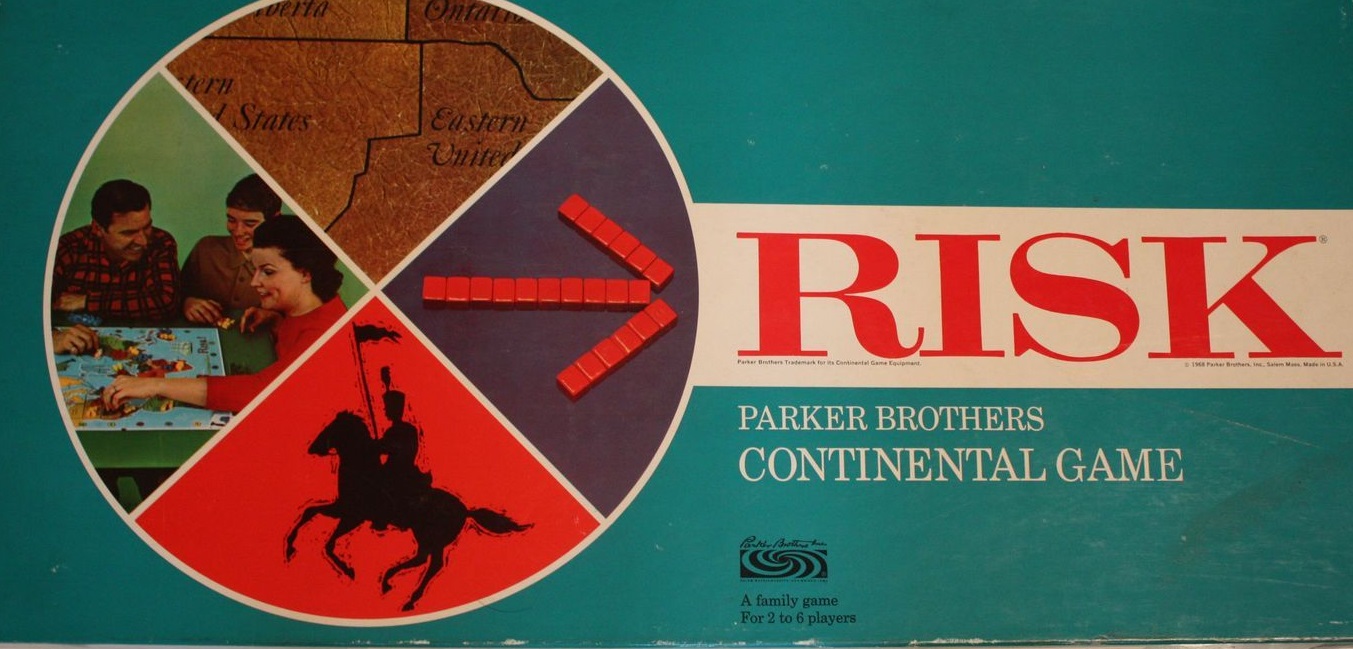
At Flashbak: Parker Brothers' RISK


This week at Flashbak I celebrated one of my favorite, classic board games: RISK.


“In 1959, Parker Brothers licensed from creator Albert Lamorisse (1922-1970) a game called “Conquest of the World.”

You probably know the game by the name it has gone by ever since: RISK, “The Classic World Domination Game.”

Designed for 2-6 players, ages 10 and up, the object of RISK is to occupy every territory in the world.  Yes, you are out to literally occupy the entire planet Earth.

Here is how the game’s directions describe the campaign: “You are battling to conquer the world. To win, you must launch daring attacks, defend yourself on all fronts, and sweep across vast continents with boldness and cunning.

The game comes down to a folding board that separates the Earth into forty-two territories over six continents. Each player gets armies to sweep across the continents, and five dice with which to battle: three red and two white.

And what about alliances with other players?

Well, they’re….risky.

An advertisement in the seventies put the matter: “Trust is something you’ll have to take a risk on.”  Instead, the player should focus on “maneuvering options” and “shrewd assessments.”

I remember playing RISK with my father as a teenager, and then taking the game to college at the University of Richmond, where I relentlessly played it with my roommate and other best friend.  The sad thing is, as I recall: I sorta, kinda cheated. 

I didn’t mean to. Honest.  I just didn’t remember the rules right and we all used three white dice for defense instead of two, and that made conquering the world that much harder.  At this point, I’d like to humbly apologize to my friends for not reading the rules more carefully…

Since the game’s premiere in 1959, the RISK Empire has grown by leaps and bounds.  There are variations of the game such as Castle Risk (1986) and RISK 2210 AD (2001). Similarly, there have been RISK variations based on pop culture properties.  Over the last few years I have seen Doctor Who, Plants vs. Zombies, Lord of the Rings, Star Wars, Transformers and Game of Thrones versions of the classic game. You can also find RISK apps and computer games…”

Please continue reading at Flashbak.

Sunday, September 18, 2016

At Flashbak: The American Heritage Games of Milton Bradley


This week at Flashbak I also remembered some of the great military board games of my childhood: The American Heritage Games of Milton Bradley.


“In 1961, American Heritage Magazine and toy-maker Milton Bradley teamed up to release a series of memorable “American Heritage” war games. Each of these board games recreated for young gamers a war scenario or milieu from American history.

There were five games in all.

In 1961, Milton Bradley premiered the American Heritage Game of the Civil War (also known as Battle-Cry). This game was set in the 1860s, and pit the Blue (North) against the Grey (South), using cavalry, infantry, and artillery. In some cases, rails could be used to advance troops to their destination.  For two to four players.

In 1962, two games were released under the American Heritage banner (and they happen to be my favorites of the bunch.)

First, there was Broadside, a sea-bound “Command Decision’ game featuring miniatures of ships (and their sails, which had to be inserted manually).  Basically, the goal was to cannonball the enemy ships, and destroy your opponent’s fleet. You could play as the red fleet, or the blue fleet.

Even better, however, was Dogfight, a game set during World War I, the age of the Red Baron In this case, you could play as either the Americans or the Germans, and had a squadron of three bi-planes with which to battle the enemy.  Once in the air, you could perform maneuvers including a loop or barrel roll, and the ultimate goal was to strafe your enemy’s landing field, preventing future take-offs…”


At Flashbak: Captain on the (Toy) Bridge


This week at Flashbak was posted a hold-over from the Star Trek 50th anniversary celebration on my blog.  It concerns…plastic toy versions of that great Star Trek hub adventure: the starship bridge.


“It’s funny to think about, but all the great adventure -- in all the various iterations of Star Trek, Prime or Kelvin -- starts on the bridge of a starship. 

Accordingly, various toy companies over the last fifty years have recreated the U.S.S. Enterprise’s famous control room in plastic.

A model doesn’t promise the same interactivity as a playset, but in the 1970s, Star Trek fans were thrilled nonetheless when AMT released the U.S.S. Enterprise Command Bridge model kit. 


This kit replicated “the nerve center of the United Federation Starship Enterprise,” and came with three figurines of the crew (Kirk, Spock, and Sulu) that required assembly and painting.  The bridge itself – and all accouterments like chairs and consoles – had to be assembled and painted too, and the set also came with details to recreate the colorful displays on the upper wall of the original NCC-1701 bridge.

The kit had a number of drawbacks (including chair stands that broke), but the big drawback was that Uhura, Scotty and Chekov were not included in the model.

More interactive -- and more durable too -- was Mego’s Star Trek U.S.S. Enterprise "Action Playset, the toy of choice for a generation of Trekkie kids. This mock-up of the U.S.S. Enterprise interior (bridge and transporter room) was a "giant, 24" long command center," "with captain's chair, console, two stools" plus six interchangeable "view screen scenes."  The set comfortably housed all the Mego Star Trek figures of the era, and, while not very show accurate in terms of design, was nonetheless a great toy.

In 1979, to coincide with the release of Star Trek: The Motion Picture, Mego produced the new bridge playset to reflect the changes to the Enterprise since the end of the TV series. "All scaled for Mego 3 3/4 inch Star Trek crew" figures, this bridge "measures over 24 inches long and 12 inches wide and features" the following: "Working Docking Port," "Helm Control Center," "Navigational Station," "Captain's Chair," "Science Center," Communications Console" and "Authentic Decals."


Alas, this highly prized (and incredibly expensive) toy is made of the flimsiest, most lightweight plastic, and held together only by tiny square adhesive stickers.  The control panels, meanwhile, are simple stickers. It’s a beloved toy for me, but also a bit of a disappointment..."


Sunday, September 11, 2016

At Flashbak: The Life and Times of Mr. Spock


This week at Flashbak, I marked the 50th anniversary of Star Trek with a look at the career of the great Mr. Spock.


“…Although we all have our own favorite characters from the franchise, the series may be known best for one personality in particular: Leonard Nimoy’s half-Vulcan/half-human Mr. Spock.

The late Mr. Nimoy brought so much humanity and dignity to the role of Spock, and the writers -- from the original series to the feature films -- also did their best to make the Enterprise science officer an individual of importance, tolerance and dignity, in universe (well, except for  noticeable exceptions such as “Plato’s Stepchildren” or “Spock’s Brain.”)

So, looking back at the fifty year (fictional) career of Mr. Spock, here is a short recap of his greatest accomplishments. 

These accomplishments might be considered, essentially, in a handful of useful categories.

Scientist: In his time aboard the U.S.S. Enterprise, Mr. Spock used his Vulcan mental abilities to advance the frontier of galactic knowledge, and save imperiled life-forms. He discovered, for example, the location of the mythical planet Eden (with help from Mr. Chekov) in “The Way to Eden.” More significantly, he saved the last survivor of an endangered species, the silicon-based life form called a Horta, on Janus VI (“The Devil in the Dark.”)

Diplomat: Although Spock often disdains diplomacy and diplomats too, he surely must rank as a great one. He is, for example, the individual who opens up negotiations with the Chancellor of the Klingon High Command, Gorkon (David Warner) in Star Trek VI: The Undiscovered Country (1991). His efforts secure an alliance with the Klingon Empire that, by the time of the Next Generation (1987-1994) several decades later, permits Klingons like Worf (Michael Dorn) to serve in Starfleet.  Also, in the same span of in-universe history, Spock undertakes a diplomatic mission to unify Vulcan and Romulus, though unsuccessfully.

Friend: Spock’s loyalty is such that he stands on trial with the rest of the Enterprise bridge crew in Star Trek IV: The Voyage Home (1986), even though he was not a part of the mutiny (being, technically, deceased at the time). Again and again throughout Star Trek, we have seen Spock’s loyalty to Kirk, whether saving him from an intruder in his own body (“Turnabout Intruder,”) rescuing him from dimensional interphase (“The Tholian Web”) or even helping the good captain to forget a hurtful emotional episode (“Requiem for Methuselah)…”


Please continue reading at Flashbak

Sunday, September 04, 2016

At Flashbak: Merlin, the Electronic Wizard


This week at Flashbak, I also remembered a fun (if now antiquated…) toy from the disco decade: MERLIN.


“In 1978, Parker Bros. introduced the world to a hand-held electronic game that became beloved by generation of kids…even if it pales in comparisons to today’s smart phones and their 21st century computing capabilities

The toy in question, is, of course, MERLIN, a red telephone-like “computer brain.” 

The copy on the back of the box lays down a challenge for intrepid youngsters:

"Can you outsmart MERLIN?

Before you answer, consider further details. “He's remarkably intelligent,” the box reports.  “With lights, a powerful computer brain, and a vocabulary of 20 different sounds he challenges you to beat him at these six games of strategy, memory and skill…"


Please continue reading at Flashbak.

At Flashbak: Sub Search (Milton Bradley)


This week at Flashbak, I remembered the great 3-dimensional board game Sub Search.


“Milton Bradley’s Sub Search (1973) is another board game blast from my youth in the 1970s. It is a “three level Navy strategy game” intended for ages ten to adult. 

The object of the game: “Both surface fleets search out and sink enemy subs.”  One is encouraged to “be the first to sink either the 3 opponent subs or the 3 opponent surface vessels.”

But there are hazards for the surface ships to face too, including “mines and torpedoes from the subs…”

After all these years, I think the thing I love best about Sub Search is the complexity and size of the playing board. Fully assembled, it’s a giant blue rectangle. On top is the ocean surface, where the ships drop depth charges.  But below that level are three levels of oceans, allowing patrolling subs (and destructive bombs…) to go deep.  Just imagine if Battleship had three levels or surfaces of ocean, instead one.

Each player could see the surface ships, and their own underwater subs, and then had three “grids” by which to keep track of their guesses regarding enemy sub locations.  It’s a complex set-up, and yet game play is fun and easy.

There’s also a torpedo launch spinner, and a bin for storing white pegs (indicating a “miss”), and red peg and red flags to mark hits.

As I wrote in my post about Stratego, my father introduced me to a number of strategy games in the 1980s when I was a young teenager. We played Tank Battle, Dogfight, Broadsides, Stratego, Risk, and Sub Search.  Sub Search was one of the most immersive because of the elaborate, three-dimensional playing board, and a real upgrade from Battleship...”

Please continue reading at Flashbak.

Sunday, August 28, 2016

At Flashbak: Monsterous [sic] Combiner (Tonka)


This week at Flashbak, I remembered Tonka’s robot combiner who was added to the Gobot toy line in the mid-1980s: “Monsterous” [sic])


“Today, everybody loves Hasbro’s Transformers toy line, but back in the mid-1980s the Autobots had mechanical, transforming competition…from Tonka’s Gobots (“Mighty Robots/Mighty Vehicles”). 

Like the Autobots of Cybertron, the Gobots had two opposing teams: Guardians (the good guys) and Renegades (the bad guys). 

And for a while, the Gobots even had their own TV show: Challenge of the Gobots.

One of the weirdest and most wonderful toys from the 1980s Gobot catalog is the (notably misspelled…) "Monsterous," a large-scale combiner, consisting of six Gargoyle-like Gobot villains.

The toy box describes Monsterous as a “Renegade Robot Giant.”    It also notes a bit about his shapes/abilities: “Six Robots to Six Vehicles to One Monsterous Giant!”

And where did Monsterous hail from, at least in terms of Gobot mythology?

The box had an answer there too.  “Out of the depths of the Antares Solar System arises a band of six renegade monsters.”

The story continued: “Apart, they’re awful. Together, they’re: Monsterous, a Renegade Robot giant that’s more gruesome than the evilest being alive. Their mission is destruction...The starting point is Earth!”

The six individual Renegades that convert into the Monsterous being are: Weird Wing, South Claw, Heart Attack, Gore Jaw, Fangs, and Fright Face…”

Please continue reading at Flashbak. 

Sunday, August 21, 2016

At Flashbak: The Dinky Starfleet of the 1970s


My second article at Flashbak this week remembered some fantastic die-cast metal spaceship toys of the 1970s. In particular, I remember the Dinky “Starfleet.”


“Although Dinky Toys was in operation as early as 1935, I first learned of the company’s toys in the mid-1970s, when I was a young fan of Star Trek (1966-1969) and Space: 1999 (1975-1977).  Older fans probably knew the company -- a maker of high-quality die-cast metal cars and vehicles -- for an earlier generation TV tie-ins to Thunderbirds (1964), Joe 90 (1967) or even The Prisoner (1967).

But what interested me as a youngster was that the company had produced highly-detailed, heavy-duty miniatures of my favorite TV spaceship in the pre-Star Wars era.

For example, Dinky Toys produced two versions of Space: 1999’s amazing trademark, work-horse space craft, the Eagle. One was a transport, with a removable passenger section in the middle. The other was an Eagle freighter, which, with a magnet, could lower or lift barrels of radioactive waste.


From Star Trek, Dinky produced two great die-cast metal ships.  The first was the Constitution Class Starship Enterprise of Captain James Kirk.  The starship could fire small round projectiles from the saucer section.  Also, a small shuttle craft could be dropped from the bottom of the Starfleet vessel.

The second Trek vehicle was the Klingon D7 battlecruiser. Like the Enterprise, it could also fire small orange projectiles from its forward section…”


Please continue reading at Flashbak.