Subscribe To JKM


 Posts
All Comments
Posts
All Comments
Showing posts with label 2010. Show all posts
Showing posts with label 2010. Show all posts
Friday, December 23, 2016
Movie Trailer: Rare Exports (2010)

 award-winning creator of the web series Abnormal Fixation (2024), the audio drama Enter the House Between (2023) and author of 35 books including Horror Films FAQ (2013), Horror Films of the 1990s (2011), Horror Films of the 1980s (2007), TV Year (2007), The Rock and Roll Film Encyclopedia (2007), Mercy in Her Eyes: The Films of Mira Nair (2006),, Best in Show: The Films of Christopher Guest and Company (2004), The Unseen Force: The Films of Sam Raimi (2004), An Askew View: The Films of Kevin Smith (2002), The Encyclopedia of Superheroes on Film & Television (2004), Exploring Space:1999 (1997), An Analytical Guide to TV's Battlestar Galactica (1998), Terror Television (2001), Space:1999 - The Forsaken (2003) and Horror Films of the 1970s (2002).
Friday, October 30, 2015
Movie Trailer: A Nightmare on Elm Street (2010)
award-winning creator of the web series Abnormal Fixation (2024), the audio drama Enter the House Between (2023) and author of 35 books including Horror Films FAQ (2013), Horror Films of the 1990s (2011), Horror Films of the 1980s (2007), TV Year (2007), The Rock and Roll Film Encyclopedia (2007), Mercy in Her Eyes: The Films of Mira Nair (2006),, Best in Show: The Films of Christopher Guest and Company (2004), The Unseen Force: The Films of Sam Raimi (2004), An Askew View: The Films of Kevin Smith (2002), The Encyclopedia of Superheroes on Film & Television (2004), Exploring Space:1999 (1997), An Analytical Guide to TV's Battlestar Galactica (1998), Terror Television (2001), Space:1999 - The Forsaken (2003) and Horror Films of the 1970s (2002).
Thursday, August 06, 2015
Beach Week: Movie Trailer: The Reef (2010)
award-winning creator of the web series Abnormal Fixation (2024), the audio drama Enter the House Between (2023) and author of 35 books including Horror Films FAQ (2013), Horror Films of the 1990s (2011), Horror Films of the 1980s (2007), TV Year (2007), The Rock and Roll Film Encyclopedia (2007), Mercy in Her Eyes: The Films of Mira Nair (2006),, Best in Show: The Films of Christopher Guest and Company (2004), The Unseen Force: The Films of Sam Raimi (2004), An Askew View: The Films of Kevin Smith (2002), The Encyclopedia of Superheroes on Film & Television (2004), Exploring Space:1999 (1997), An Analytical Guide to TV's Battlestar Galactica (1998), Terror Television (2001), Space:1999 - The Forsaken (2003) and Horror Films of the 1970s (2002).
Friday, July 10, 2015
Movie Trailer: Atrocious (2010)
award-winning creator of the web series Abnormal Fixation (2024), the audio drama Enter the House Between (2023) and author of 35 books including Horror Films FAQ (2013), Horror Films of the 1990s (2011), Horror Films of the 1980s (2007), TV Year (2007), The Rock and Roll Film Encyclopedia (2007), Mercy in Her Eyes: The Films of Mira Nair (2006),, Best in Show: The Films of Christopher Guest and Company (2004), The Unseen Force: The Films of Sam Raimi (2004), An Askew View: The Films of Kevin Smith (2002), The Encyclopedia of Superheroes on Film & Television (2004), Exploring Space:1999 (1997), An Analytical Guide to TV's Battlestar Galactica (1998), Terror Television (2001), Space:1999 - The Forsaken (2003) and Horror Films of the 1970s (2002).
Tuesday, April 29, 2014
Movie Trailer: Monsters (2010)
award-winning creator of the web series Abnormal Fixation (2024), the audio drama Enter the House Between (2023) and author of 35 books including Horror Films FAQ (2013), Horror Films of the 1990s (2011), Horror Films of the 1980s (2007), TV Year (2007), The Rock and Roll Film Encyclopedia (2007), Mercy in Her Eyes: The Films of Mira Nair (2006),, Best in Show: The Films of Christopher Guest and Company (2004), The Unseen Force: The Films of Sam Raimi (2004), An Askew View: The Films of Kevin Smith (2002), The Encyclopedia of Superheroes on Film & Television (2004), Exploring Space:1999 (1997), An Analytical Guide to TV's Battlestar Galactica (1998), Terror Television (2001), Space:1999 - The Forsaken (2003) and Horror Films of the 1970s (2002).
Tuesday, March 29, 2011
CULT MOVIE REVIEW: Skyline (2010)

Purportedly the first in a sci-fi film franchise by the Brothers Strause (AVP: Requiem [2007]), the 2010 alien invasion movie Skyline (2010) is literally a wonder to behold.
Unfortunately, I mean that description in both the positive and negative senses.
The film's amazing special effects sequences re-define "shock and awe" ably, with Los Angeles falling under siege from impressive alien ships for most of the film's running time. Without reservation, I can state that the Brothers Strause execute some jaw-dropping, gorgeous shots of extra-terrestrial attack in the film, and more importantly get across some authentically powerful ideas about what it might feel like for the average Earther to suddenly awaken to, well, planetary regime change.
Yet for each great effect, and each great concept featured in Skyline, there's also the undeniable sense that the movie's narrative is developmentally arrested. In particular, the film's first half-hour is a long, slow haul through screenwriter hell as shallow rich people talk about nothing, argue about nothing, and generally act like narcissistic reality-tv show personalities.
If human life in 2010 is really this inconsequential, really this petty, really this shallow, then go ahead and bring on the brain eating aliens; that's all I can say.
When the going gets tough, the tough just get indecisive in Skyline, and the not-very-likable young characters endlessly argue the merits of staying in one place to hide, or making a run for it in broad daylight. It's this terminally uninteresting and extended case of -- cue The Clash -- "Should I Stay or Should I Go?" that makes the film feel not only enormously frustrating for the viewer, but which makes the storyline feel terminally stalled. An alien invasion is happening outside a high rise apartment, and for much of the film, the protagonists just hide in their room, peeking out timidly and arguing the same point. Stay or go? Go or stay?
After awhile, you just want the characters to do something, anything, to move the plot forward.
Don't You Get it? We're at War

In Skyline, Jarrod (Eric Balfour) and his girlfriend, Elaine (Scottie Thompson) visit Jarrod's friend, Terry (Donald Faison) in Los Angeles after he has become a success in the movie industry, specifically in special effects.
Meanwhile, Terry is cheating on his girlfriend, Candice (Brittany Daniel) with his assistant, Denise (Crystal Reed). At the same time, Jarrod and Elaine argue because Terry has offered Jarrod a job there in California, and she doesn't like L.A. Elaine is also "late" and informs Jarrod that she is pregnant with his child.
After a night of celebration, the group awakes at 4:27 am to witness a blinding blue light outside the windows of Terry's high-rise apartment building. Anyone who looks at the light is mesmerized by it, and "sucked" outside. Jarrod narrowly survives this fate when Terry pulls him back from the precipice.
Some time near dawn, Terry and Jarrod head to the roof to see what is happening outside, and learn that the blue flares are present all over the city. Worse, at every instance of the unearthly illumination, unsuspecting humans are being drawn high up into the air, into the bellies of strange, bio-mechanoid spaceships.
An escape attempt goes wrong as aliens invade the city, and Terry is abducted by one of the invaders. Later, the survivors join up with the apartment manager, Oliver (David Zayas), and watch from Terry's apartment, as the U .S. Air Force engages the alien ships in combat. The battle ends with the U.S. forces decimated, and an alien ship nuked. Unfortunately, the extra-terrestrial ship rises triumphantly from the mushroom cloud and begins to re-assemble and regenerate itself.
Jarrod, who is feeling strange effects from his first encounter with the blue light, leads Elaine to the roof, in hopes that an Army helicopter they witnessed earlier will return and rescue them. After another pitched battle, Elaine and Jarrod are captured by the aliens as well. As they are sucked up into the sky, they share a tender, final kiss.
Meanwhile, all over the world, the human race falls to the alien blitzkrieg. Aboard one ship, Elaine watches as the strange aliens remove and then absorb human brains. But there's something different about Jarrod's brain...
They're not dead. They're just really pissed off.

Skyline has received really terrible reviews from most film critics, and certainly there are reasons why that's been the case. But before I delve into the film's many valleys in quality, allow me to take a moment to examine the film's creative summits.
First of all, Skyline does a surprisingly effective job of introducing and maintaining the mystery of the extra-terrestrial incursion on Earth. Many War of the Worlds-type films open with alien saucers and war machines arriving, and then decimating the Earth with energy beams that we recognize as variants of lasers; variants of our technology. Then, the aliens send in the ground troops (Battle LA, which I haven't seen), and combat on terra firma ensues.
Here, the Brothers Strause go another, more intriguing route. They introduce alien technology that feels, well, legitimately alien, or at least unfamiliar to us. The blue light that comes down to hypnotize and catch humans is actually a pretty creepy device, and tremendously powerful in forging terror in a surreal, nightmarish fashion. As one character rightly notes, "who wouldn't want to look at something so beautiful?" The idea is that the blue light suffuses an area of the City, and curious humans -- by their very nature -- are drawn to gaze at it. Of course, if that happens, it's too late and the aliens have you.
The second part of the alien attack equation, also splendidly visualized, involves human bodies being drawn upwards into the underbelly of the mecha-organic spaceships. At least early on, the film doesn't over-do this view or special effect and again, real terror is generated. We catch two or three glimpses of hundreds of human beings -- seeming to defy gravity -- pulled up through the air in a terrible cluster. It's an odd, incongruous and disturbing inverse image of what our nation witnessed on that horrible day, September 11, 2001. There, bodies plummeted down to the ground from the heights of the World Trade Center. But this opposite image -- with bodies sucked skyward by some alien force -- nonetheless resonates. It seems both frighteningly recognizable and absolutely, horrrifyingly un-real. It is a defiance of the Laws of Physics as we understand them; but that's just fine because the source is alien.
My point here is that any alien force with the high technology to get to Earth from another solar system would also likely possess weapons of invasion far in advance of anything we could accurately imagine or comprehend. They wouldn't come with bullets and missiles and machine guns. Instead, the alien arsenal would likely be terrifying, extremely efficient and wholly alien to us. For all of its myriad flaws in storytelling, Skyline really broadcasts this idea dramatically.
The alien ships themselves -- in all their various and sundry iterations -- are a wonder to behold too. They seem to be an unholy combination of machine, squid and insect, literally swimming through our skies, seeking out prey. Once more, the special effects are downright amazing; so much so that the reality of alien siege is immediately and viscerally established. Looking at the alien tech, you can readily believe that these beings and their machines could dominate our world in a mere three days.
And even here -- in the pitting of alien tech against human tech -- Skyline gets a few things right. About mid-way through the film there's an extraordinary battle between our unarmed drones and the alien ships. There's a stealth bomber, armed with nukes, in the mix as well. In most alien movies, an aerial attack like this would be a total rout, with the Earth forces repelled and destroyed, and nuclear missiles rendered ineffective immediately. Skyline treads a more original path, and really gives the audience hope that the human counter-attack is going to work. The drones and the Stealth bomber acquit themselves well, and the nuclear missile takes down the alien ship, smashing it to pieces.
And then -- again -- we see something really alien occur. The vessel starts to regenerate itself; literally pulling pieces back together from the scattered debris. In alien invasion movies such as this, we're accustomed to invisible force fields that protect alien saucers or such, but here, just a little twist, a ship picking itself up and re-assembling, gives the impression of something new, that we haven't seen a dozen times.
I can't fault the Brothers Strause for their imagination or execution of the aliens featured in the film; they do a terrific job in this arena. I just wish that these skilled special effects experts had devoted as much energy and imagination to the human and narrative elements of Skyline.
For instance, as Skyline reveals, the giant monsters from outer space are here to rip out our brains and, well, eat them up. That is an incredibly hoary idea, and one you couldn't get published with in this century. But more to the point, it doesn't make a lot of sense. The aliens come to our planet to steal and use our brains as a power source (think of the A.I. in The Matrix [1999] co-opting our bodies as batteries...), but how does a culture from somewhere in a solar system or galaxy far, far away design and build its tech around something found, ostensibly, only right here on Earth?
Before they got here to eat our brains, how did they move their incredible machinery from their planet to ours? I appreciate the idea that the aliens are here on Earth to rob a precious resource, but the whole brain angle plays as pulpy, simplistic, and unconvincing.
Also irritating is the fact that probably nine-tenths of the human race in Skyline go through exactly the same process as Jarrod, and yet he is the only person who begins to develop, ahem, alien powers that come in handy during the finale. We see Elaine go through the same procedure in the film as well -- the blue light -- but she isn't changed or altered as Jarrod is. So is he just a fluke, or -- again like The Matrix -- is he The Chosen One? The guy with the power to save all our brains?!
Someone might note at this point that all these questions could be answered handily in the inevitable sequel. That may be true; but as a standalone Skyline still plays as a bit...stupid. And the sentimental, senselessly romantic moment in which Jarrod and Elaine share an intimate kiss inside the alien light stream (as they are hundreds of feet in the air...) adds to the feeling of general dopiness.
That grandiose, romantic kiss in mid-air isn't earned by Skyline because the characters mostly come across as petty and mercurial, capricious and arbitrary in their concerns. In the first half-hour, they argue over nothing of consequence. Elaine is angry that Jarrod is offered a job in L.A. Is that his fault? He could still turn it down. But she's needlessly mopey and hostile about it. When he asks her why she didn't tell him she is pregnant, she replies that she didn't want to ruin his trip to California? Really? Then why has she been such a bitter pill to deal with since setting foot on the tarmac?
Later in the film, Elaine is malleable and changeable to the point of comic absurdity. Elaine argues that the survivors should stay and hide in the apartment, but lets herself be dragged outside by Jarrod, and disaster ensues. Later, she continues to argue that it is best to stay inside for the time being. At this juncture, Jarrod's eyes turn milky and his blood vessels turn dark -- a telltale sign of the alien influence -- and he argues again that they should go outside and attempt to rendezvous with an army chopper. Jarrod and Oliver fight, and Jarrod says that he is not leaving his "family" behind.
This alien/emotional outburst miraculously changes Elaine's mind, and she willingly goes outside, to the roof, with Jarrod when she was just arguing the opposite course of action. So tell me: if your significant other began evidencing signs of physical alien takeover, would this make you more or less likely to follow his lead? Would you change your mind or stick to your guns?
So much of Skyline plays like that bizarre moment. The screenplay is not merely nonsensical, it's anti-sensical, if that's a word. For instance, early in the film Jarrod notes that the aliens aren't hovering over the marina, so they should get out on the water pronto. All the sudden, I had visions of Signs (2002), and water-fearing alien invaders. But here, the idea is left entirely undeveloped. Why aren't there any ships over the water? Is it a coincidence? Or is Jarrod actually onto something? The movie never, ever decides; it just sort of floats the idea of water as a sanctuary, so the survivors have something to further argue about before dying.
Another difficult to swallow plot element involves Elaine's pregnancy. While carrying a child in her womb, Elaine gets exposed to alien takeover light, gets grabbed and squeezed by an alien bio-mechanoid arm, and is contaminated by the fall-out of a nuclear bomb in close proximity. All this occurs before she is air-lifted and yanked hundreds of feet and sucked into an alien spaceship.
That's one tough baby she's still carrying in the film's last scene, let me tell you.
Moment by moment, scene-by-scene, Skyline piles absurdity and frustration upon absurdity and frustration. People look directly at nuclear blasts and don't go blind. Nor, in close range, do they get radiation sickness. Alien probes can climb stairs to reach the roof, but don't stop to check individual rooms where the survivors are hiding. A lighter doesn't light at a crucial moment, and then, at another crucial moments does light. A character named Oliver lectures Jarrod about survival ("The city's a vacant lot...we need to survive") and then turns around and commits suicide when he could have just run out of the room and escaped an alien threat entirely.
Again, not just nonsense, but vehemently, proudly, courageously anti-sense. That's Skyline in a nutshell.
Still, "beggars can't be choosers," as one character in the film notes. At least in Skyline you can actually see the action, which differentiates it from the Strause Bros.' previous, horrible outing, AVP: Requiem. That movie was so dramatically under-lit, you just kind of gave up half way through.
On the other hand, actually seeing the impressive action in Skyline gets one's hopes up that the movie's storyline is going to prove as powerful and affecting as the awe-inspiring special effects. And the Strause Bros. just don't pull it off. After we finished watching the film, my wife was silent and I asked her what she thought.
Her answer was a quote from the movie's hilariously bad dialogue: "I'm not dead, I'm just really pissed off."
That made two of us.
award-winning creator of the web series Abnormal Fixation (2024), the audio drama Enter the House Between (2023) and author of 35 books including Horror Films FAQ (2013), Horror Films of the 1990s (2011), Horror Films of the 1980s (2007), TV Year (2007), The Rock and Roll Film Encyclopedia (2007), Mercy in Her Eyes: The Films of Mira Nair (2006),, Best in Show: The Films of Christopher Guest and Company (2004), The Unseen Force: The Films of Sam Raimi (2004), An Askew View: The Films of Kevin Smith (2002), The Encyclopedia of Superheroes on Film & Television (2004), Exploring Space:1999 (1997), An Analytical Guide to TV's Battlestar Galactica (1998), Terror Television (2001), Space:1999 - The Forsaken (2003) and Horror Films of the 1970s (2002).
Sunday, March 06, 2011
CULT MOVIE REVIEW: Unstoppable (2010)

Let's face it: sometimes a big, fat generic Hollywood blockbuster is exactly what you hanker for.
A good one can taste great and be less filling...and that's certainly the case with with the high energy, extremely entertaining Unstoppable (2010), a Tony Scott thriller starring Denzel Washington, Chris Pine and Rosario Dawson.
"Inspired by true events" that occurred in Ohio in 2001, Unstoppable is the harrowing, fast-moving tale of two very different men and one woman as they attempt to avert disaster and stop a runaway train in industrial Pennsylvania.
Now, that sounds like an extraordinarily simple plotline -- and it is -- but as always, the devil is in the details.
The runaway train, AWVR 777 no mere "coaster." Rather, she's traveling at 77 miles an hour through heavily populated towns and transporting 30,000 gallons of a toxic, flammable chemical called Molten Phenol.
As the film's put-upon train yard boss, Connie (Dawson) aptly notes, AWVR 777 is not merely a train, but a "missile the size of the Chrysler Building" racing towards 752,000 innocent people in downtown Stanton.
How did the train get out of control in the first place?
Well, through a combination of "human error and bad luck," according to Connie, but she's just being gracious. The real culprit is Ethan Suplee's character, the dimwitted, under-trained Dewey, He's a slack yard worker who absent-mindedly leaves the train-in-question on full throttle and unforgivably forgets to activate the air brakes before jumping off.
Now his mistake could decimate the sleepy little town of Stanton and cost innumerable lives.
 Reckoning with the runaway train on the front line are two unlikely blue-collar heroes: 28-year train company veteran and soon-to-be forcibly retired Frank Barnes (Washington) and wet behind the ears rookie, James T. Kirk...er, Will Colson (Chris Pine).
 Each of these guys is carrying abundant personal baggage.
Barnes' wife died of cancer and he is estranged from his two daughters, who work at Hooters. Colson is from a well-known local family but has a chip on his shoulder the size of a locomotive. He's also estranged from his wife and child over an incident in which he pulled a gun on a police officer.
Unstoppable moves at a relentless, driving pace as Will and Barnes become the last two people on "the main line" capable of stopping AWVR 777. Efforts to slow down the runaway train with another train fail...explosively. A daring attempt to land a U.S. Marine on the back of the speeding train ends...with catstrophic injury. And the dangerous strategy to derail AWVR 777 with "portable de-railers" just short of a hairpin curve near Stanton proves absolutely futile. It seems nothing can stop this rolling goliath.
As the train speeds irrevocably towards its rendezvous with certain disaster, death and destruction are at every turn. Early on, a train carrying 150 school kids on a field trip celebrating "railroad safety" (!) assumes a collision course with 777. Later, a horse trailer (with frightened horses inside) stops on railroad tracks as the runaway monster bears down on it.
Soon, the nature of the threat becomes widely-known. Press helicopters circle AWVR 777 like buzzards; and eventually the heartless train company gets involved too, just in time to really muck things up. An executive in charge gets the bad news out on the golf course, and his first instinct is to check the company's bottom line. "What's the stock de-valuation?" he wonders, should absolute catastrophe ensue.
This less-than-flattering portrait of the white-collar bosses is part and parcel of the movie's dramatic blue collar aesthetic. Scott shoots the entire movie in an over-saturated, colorful, and gritty palette, one wholly befitting its workaday characters. And the final conflict comes down to two guys who may not be saints but who know how to do their jobs versus over-paid buffoons and telephone jockeys who just want to keep their jobs and fortunes intact.
Like all movies, Unstoppable is a product of its time, which means that the subtext here is entirely Great Recession Populism. Good, hard-working joes like Barnes are being pushed into early retirement on "half benefits" to satisfy suit-and-tie executives hoping to reserve enough cash in big bonuses for white collar class. The message, none too subtle, is that the runaway train called the economy -- the vehicle for wealth --- is barreling out of control, and only the know how of Main Street, not Wall Street can right the course.
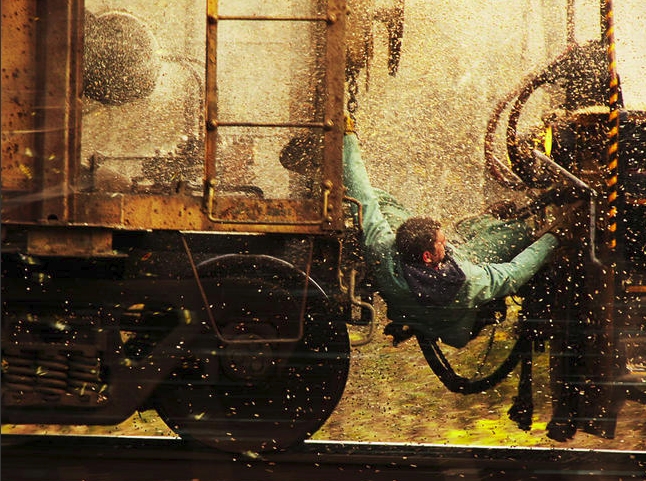
But Unstoppable succeeds well outside of it deliberate class warfare metaphors too. There's a more simple, basic story here, one explicitly about human nature.
Human error causes the danger in the first place, and then the movie brilliantly charts the domino effect of each and every response to that initial error.
In the end, it's human ingenity and resourcefulness -- the opposite of Dewey's human error -- that resolves the crisis. I appreciated both aspects of the movie's message; that we can control all of our "runaway trains," either to our mutual detriment or to our collective glory. We just have to climb on, decide on a course, and say "all aboard..."
Director Tony Scott may not boast a reputation for subtlety, but here he certainly keeps all the trains running on time, to marshal an appropriate metaphor. His camera never hangs back or slows down. It spins, it races, it tracks, it arcs, it barrels, it circles...and the total effect is of a breathless, unstoppable juggernaut.
Because of Scott's approach, this movie grabs your attention and imagination from the first moments and doesn't let go until the end credits roll. I'm not the kind of film critic given to exhortations about movies being "adrenaline-packed thrill rides" or other hyperbolic nonsense. But those shoes fit the movie in this case. Unstoppable is one hell of a roller-coaster ride, and I recommend it entirely on that basis; as a better-than-expected, surprisingly efficient and entertaining action picture.
Frank Barnes - Denzel's character here -- has only one rule for life on the railrod track: "If you do something, you better do it right." That's an axiom Tony Scott and Unstoppable really live by. Unstoppable would make a hell of a double feature with another railrod classic: 1985's Runaway Train.
Next stop: heart attack territory...
Next stop: heart attack territory...
award-winning creator of the web series Abnormal Fixation (2024), the audio drama Enter the House Between (2023) and author of 35 books including Horror Films FAQ (2013), Horror Films of the 1990s (2011), Horror Films of the 1980s (2007), TV Year (2007), The Rock and Roll Film Encyclopedia (2007), Mercy in Her Eyes: The Films of Mira Nair (2006),, Best in Show: The Films of Christopher Guest and Company (2004), The Unseen Force: The Films of Sam Raimi (2004), An Askew View: The Films of Kevin Smith (2002), The Encyclopedia of Superheroes on Film & Television (2004), Exploring Space:1999 (1997), An Analytical Guide to TV's Battlestar Galactica (1998), Terror Television (2001), Space:1999 - The Forsaken (2003) and Horror Films of the 1970s (2002).
Sunday, January 23, 2011
CULT MOVIE REVIEW: The A-Team (2010)

Let's start this review with a useful analogy.
The 2010 A-Team movie is to the original A-Team television series as the 2009 Star Trek movie was to the original Star Trek series.
In other words, the A-Team movie is a thorough and dedicated 21st century updating and re-vamping of the familiar franchise with re-cast central roles, but also with -- globally speaking-- an abundant sense of faith and love regarding its television origins and heritage.
In fact, the A-Team movie commences with precisely the right tone of appreciation and nostalgia.
In a garage in Mexico, B.A. Baracus (Quinton Jackson) reunites with his beloved 1983 GMC Vandura Van -- an enduring trademark of the original TV series -- and notes, simply, "It's been too long. Way too long..."
In a garage in Mexico, B.A. Baracus (Quinton Jackson) reunites with his beloved 1983 GMC Vandura Van -- an enduring trademark of the original TV series -- and notes, simply, "It's been too long. Way too long..."
Indeed it has.
For fans of the A-Team who have missed the popular action series since it was canceled by NBC in the late 1980s, this sentimental touch -- which occurs almost immediately before the van gets unceremoniously crushed in an action scene -- is actually a love letter of sorts; an acknowledgement of mutually-shared appreciation of that which came before, and which is still honored here.
"During the original NBC run of The A-Team (1983 - 1987), my father had a word he used to describe the Stephen J. Cannell, Frank Lupo series:
Diverting.
Now, diverting can mean "entertaining" or "amusing," but it can also mean to "turn aside" or "distract from a serious occupation."
In the case of The A-Team, my Dad probably meant all of the above.
The A-Team is a vintage action series of unmatched cartoon violence, colorful but superficial characters, outrageous stunts...and not much narrative or thematic depth to speak of.
But taken on those very limited terms, The A-Team truly and fully "diverts."
What does this mean, exactly? Well, even today, you can't take your eyes off the bloody thing.
Oh, there are significant causes to complain, I suppose, if that's your stock and trade. Nobody on the show ever dies or is badly wounded...even in the most horrific car crash or gun-fight.
And women? They are pretty much utilized as set decoration.
How about realism? Well, let's just say that any TV series featuring John Saxon as a drugged-out religious cult leader probably isn't aiming strictly for realism.
But again, you either take a series like this on its own terms, or you don't take it at all. Your rational, logical mind may complain or rebel about some very important aspects of storyline, plot resolution and yeah, physics, but after watching an A-Team episode you may nonetheless find yourself smiling almost uncontrollably.
There's a joie-de-vivre about the players on this classic TV program, and it acts like a giant black hole...sucking you in, even if you put up resistance."
I might as well have been writing those words about this movie of 2010 vintage.
Without putting too fine a point on it, director Joe Carnahan's (Narc [2002]) film is pretty much exactly the same thing as my description of the TV series above, save for a slightly less two-dimensional role for the lead female, here Jessica Biel's Captain Sosa.
Otherwise, you've got the same style of cartoon violence, the same colorful characters, some tremendous stunts, and an overwhelming sense of fun and esprit de corps..
Are the Laws of Physics violated in the much-complained about falling tank sequence?
Yes, abundantly so.
But if you're going to dismiss this particularly movie because of that specific scene, you should be prepared to dismiss as well Indiana Jones and the Temple of Doom (1984) because of its inflatable raft-as-parachute scene, and Goldeneye (1995) too, for the most Physics-busting shot in James Bond film history: Pierce Brosnan diving after a falling plane in the prologue, catching up to it, climbing in, and flying it out of its death spin.
So yes, there is plenty to nitpick, deride or assail here, particularly if you are seeking a realistic and believable action-thriller.

"The A-Team," declares Sosa "specializes in the ridiculous."
I really can't put it much better than that.
This movie -- like the TV series on which it was based -- specializes in the ridiculous. You either go with the ridiculousness and get a kick out of the intentional over-the-top nature of it, or you won't enjoy the movie a lick.
The original series was always a low-brow, good-humored variation on Bruce Gellar's Mission: Impossible, and the 2010 movie understands that too.
Face (Dirk Benedict) was the charmer of the group; Murdock (Dwight Shultz) the pilot; Hannibal (George Peppard) the irrepressible leader, and B.A. (Mr. T) the mechanic. Together they would combine their skills to save innocent people, all while concocting ridiculous plans like, say, building flame throwers out of hot water heaters and washing machines. The stories were clearly not as tightly plotted or elaborately constructed as those on Mission:Impossible, but this fact gave The A-Team writers room to let the characters banter and do their funny shtick
That shtick is still famous today.
Hannibal crunching a cigar and optimistically -- eternally -- noting that he "loves it when a plan comes together."
Murdock's insane act; a useful insane act which always distracts the enemy at just the right time.
And then there's Face's sense of vanity and his way with all the ladies.
And finally there's Bad Attitude Baracus, who really, really, really hates to fly...and must be tricked, cajoled and sedated to fly Murdock's friendly skies.
The movie revives each and every one of these beloved, extremely silly character gimmicks and touchstones, and in the process, provides audiences the origin story of the A-Team.
The team is framed for a "crime it did not commit," in this case the theft of counterfeit engraver plates in Operation Desert Freedom. The bad guys are Black Forest mercenaries (think Blackwater) who frame the Team and steal the plates for themselves. A CIA guy named Lynch (another name you should recognize from the series...) is another heavy, and Patrick Wilson has a ball with the role.
After breaking out of prison, Hannibal (Liam Neeson) must free his friends and concoct a plan to get the engraver plates back, a plan that will --naturally -- involve lots of violence and death-defying stunts.
And on this last front, the movie A-Team -- with a whopping 100 million dollar budget at its command -- offers the goods in the way that a weekly TV series made in the 1980s simply could not afford.
About mid-way through the film, Carnahan stages a stunning heist sequence at a skyscraper in Frankfurt, with the A Team -- and its opponents too -- plummeting down dozens of stories...all while firing machine guns and launching missiles.
Even truer to the aesthetic of the original series is the film's first major action sequence, which sees the A-Team hijacking a moving convoy in Baghdad to acquire the engraving plates. The plan involves a magnet, a video camera, and several inflatable air bags. It's stereotypically an A-Team, Rube-Goldberg affair, and it's a hoot.
Carnahan edits this scene -- and indeed the finale of the film -- as a delicate dance, a ping-pong back and forth between present and future (or is it past and present?), between intention and action. The gathered team discusses the plan prior to the mission, while we simultaneously cross-cut to the plan in action.
Now, some critics or audiences might complain that this approach is somehow "spoon feeding" the audience information for clarity, but I would differ about that assessment. The cross-cutting is just a dazzling, highly visual way of leading us through a particularly byzantine action scene, without laborious exposition telling why, where, and how things are happening.
In other words, these back-and-forths move at the speed of thought. Hannibal (or Face) proposes, and then we see the proposition happening in real-time, before our eyes.
And for his final trick, Carnahan throws a monkey wrench into the movie's last shell game: a Black Forest mercentary with a rocket launcher.

Listen, I'm not going to argue that The A-Team is a great movie in any sense of that word, though honesty forces me to admit it is much better, more accomplished affair than last summer's other macho action pic, The Expendables. Contrarily, I only argue that The A-Team accomplishes pretty much the same thing that the TV series did on a regular basis.
It diverts. It generates laughs. It thrills.
In other words, this is a faithful and accurate reflection of The A-Team TV series, even if it does not involve helping people in need. No doubt that aspect of the mythos was being saved for the sequel, following this "origin story."
And I do admire the filmmakers for not transforming the A-Team universe into a brutal, sex-obsessed, angsty, brooding Batman-style world, where everything is ultra-realistic, dark-for-the-sake-of-being-dark, and serious to the point of ennui. That would have been the easy route. Instead, this movie -- like the TV series -- is an amusing, blatantly unrealistic lark, fronted by enormously appealing actors playing iconic roles.
More even that even, I admire how Carnahan's movie attempts to find current day alternatives to bloody murder. You'll remember how on the original series, cars would turn over and get destroyed in chases, but the bad guys would always crawl out of the wrecks, shake it off, and get back into the game?
Here, Carnahan pitches the film's fiercest battle between the A-Team in flight (on that notorious falling tank...) and two unmanned Reaper Drones. Hence, the bullets can fly and there's plenty of violence and action. But just like on the TV series, nobody gets hurt in the ensuing explosions. Same idea; but new, clever expression.
Again, I'm not championing this storytelling approach as realistic, scientifically-accurate, believable, or even my preferred approach in filmmaking. Rather I'm championing this storytelling approach as very, very...A-Team like.
If you liked the A-Team TV series and this brand of storytelling, there's no reason in the world you wouldn't enjoy this A-Team movie. It remembers what made us laugh, gasp and smile about the old TV series, and in the process thoroughly...diverts, to use that word again.
In the end, the A-Team movie is not about a rogue but "valuable military asset," or a realistic "clandestine operation," it's about four larger-than-life characters we love who specialize in the ridiculous.
If you can get behind that proposition, then this movie really does come together.
Without putting too fine a point on it, director Joe Carnahan's (Narc [2002]) film is pretty much exactly the same thing as my description of the TV series above, save for a slightly less two-dimensional role for the lead female, here Jessica Biel's Captain Sosa.
Otherwise, you've got the same style of cartoon violence, the same colorful characters, some tremendous stunts, and an overwhelming sense of fun and esprit de corps..
Are the Laws of Physics violated in the much-complained about falling tank sequence?
Yes, abundantly so.
But if you're going to dismiss this particularly movie because of that specific scene, you should be prepared to dismiss as well Indiana Jones and the Temple of Doom (1984) because of its inflatable raft-as-parachute scene, and Goldeneye (1995) too, for the most Physics-busting shot in James Bond film history: Pierce Brosnan diving after a falling plane in the prologue, catching up to it, climbing in, and flying it out of its death spin.
So yes, there is plenty to nitpick, deride or assail here, particularly if you are seeking a realistic and believable action-thriller.

But if you choose that route; you should at least acknowledge that you are reviewing the movie you wanted to see; and not an A-Team movie.
Indeed, the film's winking dialogue -- as penned by Carnahan, Brian Bloom and Skip Woods -- understands immediately the particular universe of this "crack commando team."
"The A-Team," declares Sosa "specializes in the ridiculous."
I really can't put it much better than that.
This movie -- like the TV series on which it was based -- specializes in the ridiculous. You either go with the ridiculousness and get a kick out of the intentional over-the-top nature of it, or you won't enjoy the movie a lick.
The original series was always a low-brow, good-humored variation on Bruce Gellar's Mission: Impossible, and the 2010 movie understands that too.
Face (Dirk Benedict) was the charmer of the group; Murdock (Dwight Shultz) the pilot; Hannibal (George Peppard) the irrepressible leader, and B.A. (Mr. T) the mechanic. Together they would combine their skills to save innocent people, all while concocting ridiculous plans like, say, building flame throwers out of hot water heaters and washing machines. The stories were clearly not as tightly plotted or elaborately constructed as those on Mission:Impossible, but this fact gave The A-Team writers room to let the characters banter and do their funny shtick
That shtick is still famous today.
Hannibal crunching a cigar and optimistically -- eternally -- noting that he "loves it when a plan comes together."
Murdock's insane act; a useful insane act which always distracts the enemy at just the right time.
And then there's Face's sense of vanity and his way with all the ladies.
And finally there's Bad Attitude Baracus, who really, really, really hates to fly...and must be tricked, cajoled and sedated to fly Murdock's friendly skies.
The movie revives each and every one of these beloved, extremely silly character gimmicks and touchstones, and in the process, provides audiences the origin story of the A-Team.
The team is framed for a "crime it did not commit," in this case the theft of counterfeit engraver plates in Operation Desert Freedom. The bad guys are Black Forest mercenaries (think Blackwater) who frame the Team and steal the plates for themselves. A CIA guy named Lynch (another name you should recognize from the series...) is another heavy, and Patrick Wilson has a ball with the role.
After breaking out of prison, Hannibal (Liam Neeson) must free his friends and concoct a plan to get the engraver plates back, a plan that will --naturally -- involve lots of violence and death-defying stunts.
And on this last front, the movie A-Team -- with a whopping 100 million dollar budget at its command -- offers the goods in the way that a weekly TV series made in the 1980s simply could not afford.
About mid-way through the film, Carnahan stages a stunning heist sequence at a skyscraper in Frankfurt, with the A Team -- and its opponents too -- plummeting down dozens of stories...all while firing machine guns and launching missiles.
Even truer to the aesthetic of the original series is the film's first major action sequence, which sees the A-Team hijacking a moving convoy in Baghdad to acquire the engraving plates. The plan involves a magnet, a video camera, and several inflatable air bags. It's stereotypically an A-Team, Rube-Goldberg affair, and it's a hoot.
Carnahan edits this scene -- and indeed the finale of the film -- as a delicate dance, a ping-pong back and forth between present and future (or is it past and present?), between intention and action. The gathered team discusses the plan prior to the mission, while we simultaneously cross-cut to the plan in action.
Now, some critics or audiences might complain that this approach is somehow "spoon feeding" the audience information for clarity, but I would differ about that assessment. The cross-cutting is just a dazzling, highly visual way of leading us through a particularly byzantine action scene, without laborious exposition telling why, where, and how things are happening.
In other words, these back-and-forths move at the speed of thought. Hannibal (or Face) proposes, and then we see the proposition happening in real-time, before our eyes.
And for his final trick, Carnahan throws a monkey wrench into the movie's last shell game: a Black Forest mercentary with a rocket launcher.

Listen, I'm not going to argue that The A-Team is a great movie in any sense of that word, though honesty forces me to admit it is much better, more accomplished affair than last summer's other macho action pic, The Expendables. Contrarily, I only argue that The A-Team accomplishes pretty much the same thing that the TV series did on a regular basis.
It diverts. It generates laughs. It thrills.
In other words, this is a faithful and accurate reflection of The A-Team TV series, even if it does not involve helping people in need. No doubt that aspect of the mythos was being saved for the sequel, following this "origin story."
And I do admire the filmmakers for not transforming the A-Team universe into a brutal, sex-obsessed, angsty, brooding Batman-style world, where everything is ultra-realistic, dark-for-the-sake-of-being-dark, and serious to the point of ennui. That would have been the easy route. Instead, this movie -- like the TV series -- is an amusing, blatantly unrealistic lark, fronted by enormously appealing actors playing iconic roles.
More even that even, I admire how Carnahan's movie attempts to find current day alternatives to bloody murder. You'll remember how on the original series, cars would turn over and get destroyed in chases, but the bad guys would always crawl out of the wrecks, shake it off, and get back into the game?
Here, Carnahan pitches the film's fiercest battle between the A-Team in flight (on that notorious falling tank...) and two unmanned Reaper Drones. Hence, the bullets can fly and there's plenty of violence and action. But just like on the TV series, nobody gets hurt in the ensuing explosions. Same idea; but new, clever expression.
Again, I'm not championing this storytelling approach as realistic, scientifically-accurate, believable, or even my preferred approach in filmmaking. Rather I'm championing this storytelling approach as very, very...A-Team like.
If you liked the A-Team TV series and this brand of storytelling, there's no reason in the world you wouldn't enjoy this A-Team movie. It remembers what made us laugh, gasp and smile about the old TV series, and in the process thoroughly...diverts, to use that word again.
In the end, the A-Team movie is not about a rogue but "valuable military asset," or a realistic "clandestine operation," it's about four larger-than-life characters we love who specialize in the ridiculous.
If you can get behind that proposition, then this movie really does come together.
award-winning creator of the web series Abnormal Fixation (2024), the audio drama Enter the House Between (2023) and author of 35 books including Horror Films FAQ (2013), Horror Films of the 1990s (2011), Horror Films of the 1980s (2007), TV Year (2007), The Rock and Roll Film Encyclopedia (2007), Mercy in Her Eyes: The Films of Mira Nair (2006),, Best in Show: The Films of Christopher Guest and Company (2004), The Unseen Force: The Films of Sam Raimi (2004), An Askew View: The Films of Kevin Smith (2002), The Encyclopedia of Superheroes on Film & Television (2004), Exploring Space:1999 (1997), An Analytical Guide to TV's Battlestar Galactica (1998), Terror Television (2001), Space:1999 - The Forsaken (2003) and Horror Films of the 1970s (2002).
Wednesday, December 22, 2010
CULT MOVIE REVIEW: TRON Legacy (2010)

"The Grid: a digital frontier. I tried to picture clusters of information as they traveled through the computer. Ships, motorcycles, with the circuits like freeways. I kept dreaming of a world I thought I'd never see. And then, one day, I got in."
-Programmer Kevin Flynn (Jeff Bridges) describes a breakthrough in human knowledge in TRON Legacy.
Nearly thirty years ago, the state-of-the-art cinematic fantasy TRON (1982) ended with a beautiful and resonant image:
Day slides quietly into night and a 1980s brick-and-mortar metropolis changes before our eyes. All the roads, skyscrapers and moving cars in the frame seem to morph into the raw, blinking data of the virtual Grid, of the movie's neon computer world. Our eyes detect colorful light trails just like those generated by the light cycles, but these light trails exist here in our world; in our cities and on our streets.
I wrote in my original review of TRON that this valedictory and artistic composition is "an image that connects man's natural world and his technological one, and reminds us, visually, that we inhabit both. To our detriment or to our glorification."
Joseph Kosinski's commercially-successful, action-adventure sequel, TRON Legacy, is constructed upon this very notion; upon the passing of a gift -- a legacy -- whose nature each ensuing generation must interpret for itself .
Specifically, ENCOM programmer Kevin Flynn's (Jeff Bridges) legacy to his adult son, Sam (Garrett Hedlund) is a virtual Grid that has miraculously sprouted independent, artificial life. The Grid and its young life forms -- Isos -- can either prove detrimental to the human race or something completely glorious: a change (or evolution?) to rock the very foundations of medicine, science, and even religion.
And as the sequel ends, Sam becomes the keeper of that torch for the time being. He can either repeat his father's mistakes...or learn from them.
That's the narrative terrain of the movie, and TRON Legacy explores it about as deeply and as meaningfully as one would desire from a high-tech, 3-D, action entertainment. Niggling complaints aside, this is a genre film featuring just about the right alchemical equation of thrills and heart.
That's the narrative terrain of the movie, and TRON Legacy explores it about as deeply and as meaningfully as one would desire from a high-tech, 3-D, action entertainment. Niggling complaints aside, this is a genre film featuring just about the right alchemical equation of thrills and heart.
Despite this relatively adroit balance of action and "think" sequences -- plus some truly kick-ass 3-D moments -- many film reviewers have been grievously unkind to TRON Legacy. But really, this just is deju vu all over again. Those of us who were around in 1982 remember that TRON also earned bad notices for the most part.
For instance, New York Times critic Janet Maslin essentially called the original Lisberger effort beautiful but stupid. And that's a variation of the same charge leveled against this sequel in the closing weeks of 2010.
However, if you enjoyed and appreciated the original TRON, it's probably a safe bet you will also appreciate this very faithful, very enjoyable follow-up film. It seems like many critics -- echoing the film's villain, CLU -- are seeking their own personal brand of "perfection." Not finding it, these reviewers fail to enjoy the movie's on its own stated terms.
In terms of narrative structure, the 2010 sequel almost slavishly apes the blueprint of the original film, and in terms of human interest, the sequel dramatizes the affecting story of an ambitious father who seeks perfection outside the human realm of his family...and ultimately comes to regret his mistake. After correcting that mistake, he passes on his legacy to another protector: the son he once abandoned.
There are indeed minor resonances of Apocalypse Now (1979) in the TRON Legacy mix too, as I had hoped there would be after seeing the early previews. Jeff Bridge's older (but not necessarily wiser...) Flynn is a Kurtz-like figure who leaves the difficult, emotional world of family and responsibility behind, and who then stakes out his own fiefdom "up river," in the virtual world, seeking to shape it exactly to his liking.
These background touches lend TRON Legacy a solid grounding in the human realm, even when the intense gladiatorial sequences come hot and heavy, and the screen is splashed with dazzling, dueling neon lights. In terms of action, the movie is also pretty much unimpeachable: it's an exciting film, legitimately augmented by the 3-D process so to feel totally immersing.
"Change the scheme! Alter the mood! Electrify the boys and girls if you'd be so kind."

TRON Legacy begins in 1989, some seven years after the events of TRON. Kevin Flynn has defeated Dillinger and the MCP, and reclaimed ENCOM. One night, Flynn informs his young son, Sam, of a breakthrough on The Grid; a miracle that could "change everything."
He is never seen again.
Decades later, a grown Sam -- aimless and hurt over the disappearance of his Dad all those years ago -- continues to be a thorn in the side of ENCOM, a software company threatening to fall into the clutches of Dillinger's money-hungry son (Cillian Murphy).
Although Alan Bradley (Bruce Boxleitner) speaks up for the missing Flynn's philosophy and wishes, the inhuman corporation is only interested in profits. Sam's attempts to hijack ENCOM"s new release (a new- but-not-improved operating system) are not greeted warmly by the Board.
Then, however, Alan comes to Sam with curious news that he has received a page from Flynn; a page originating from Flynn's Arcade. Sam visits the old Arcade and finds the means -- in the basement -- to transport himself to the Grid. Almost immediately, Sam is apprehended there, in the computer world, by the gestapo-like forces of the Grid's commandant, CLU (Jeff Bridges).
CLU -- Kevin Flynn's doppelganger -- dispatches Sam to the life-or-death gladiatorial games that the Grid's Program's seem to hunger for, but the lad escapes at the last minute, thanks to the intervention of the beautiful Quorra (Olivia Wilde). She takes Flynn to meet with his father, and Sam learns of the Virtual World's history; a history marred by Clu's attempt to achieve a "perfect system."
In attaining that lofty goal, Clu has actually resorted to genocide, destroying the self-aware beings who were born inside the grid, the Isos. Now, Clu wants to go even further: he wants to take his genocidal ways to the outside world and reshape our human life. But he needs Flynn's identity disc to accomplish this goal; to find the hidden way out of the computer world...
"Out there is a new world! Out there... is our destiny!"

In very specific terms, TRON Legacy, mimics the narrative flow of the original Lisberger film. In the 1982 effort, Flynn entered the computer world and was captured. He was then -- rather promptly -- put on the game grid. The elder Flynn first had to battle a single enemy on a dangerous game platform, and later had to engage other Programs in battle inside the light-cycle arena. Following an escape, Flynn and his friends used a beam rider as transport to cross the virtual wasteland and reach their quarry: the malevolent MCP.
In the 2010 sequel, the same sequence repeats. Sam is zapped into the Grid, and captured by a Recognizer. He is forced into disc-on-disc combat against a single opponent, and then put into light cycle combat. After an escape with Quorra, Flynn and his Dad use a beam rider to transport across the virtual wasteland and reach their quarry: a portal that can return them to the "real world."
The characters are similar too. In both films, we encounter a triumvirate or triangle involving one female and two males.
The identical order of events -- and deliberately re-use of trademark franchise moments such as the disc battle, light-cycle race and beam-rider interlude -- suggest that this "Grid test," as it were, is actually symbolic. It's a rite of passage. First the Dad had to survive it, and now it is the son's turn to run the same gauntlet.
The identical order of events -- and deliberately re-use of trademark franchise moments such as the disc battle, light-cycle race and beam-rider interlude -- suggest that this "Grid test," as it were, is actually symbolic. It's a rite of passage. First the Dad had to survive it, and now it is the son's turn to run the same gauntlet.
Since so much of TRON Legacy concerns the the son growing up, and (hopefully) avoiding the mistakes of his father, this narrative structure does not feel like a re-hash of the earlier film, but rather an important point of context. This is life, the broaching of adulthood and responsibility, the movie seems to intimate. And by putting our new hero, Sam through the same events his father endured -- and in the same order, no less --the film gets that point across rather nicely, and without forcing the issue.
The prime difference between original and sequel arises not in the order which the the action-packed events occur, but rather in the perspective in which how they are viewed. In the first film, Flynn attempted to survive in someone else's system.
Here, Kevin and his son are struggling in the system the Father engineered...a system controlled by a monstrous, calculating alter ego called CLU (voiced by Bridges and visualized by CGI).
In other words, this is the story of one father and two sons.
Sam is the human son Kevin left behind for the technological "miracles" of his work, his job. And CLU is the technological son Kevin abandoned when CLU's viewpoints about a "perfect system" diverged from his Father's ideals. Everything that occurs in the virtual world of TRON Legacy is a clear result of dear old Dad's mistakes; his vanity and arrogance. His "God Complex," if you will.
Kevin Flynn believed he could craft a utopia, a perfect system, but didn't stop to consider that his "computer" son, CLU, might execute his will in an inhuman manner (owing to his nature as a machine.) When Flynn is later greeted by his (prodigal?) son, Sam -- a fallible but wholly human creation -- he realizes, in a sense, the error of his ways. He realies that "perfection" was indeed within in his reach all along, but it was a "perfection" resting in his feelings of love and devotion for his biological, human son. "Engineering" perfection was an impossibility all along. Perhaps only God -- who created both Kevin and the Isos -- could engineer such perfect creations.
It's not too difficult, given this context, to view TRON Legacy as a kind of critique or commentary on the different stages of adulthood, really. As a young man, Flynn rebelled against "The System," (the MCP, Dillinger running ENCOM, etc.) and took down that system. Now, years later...as an older man, Kevin Flynn is The System. And all the problems encountered in the sequel are not external ones of another individual's making. They are his mistakes.
Again, this is how life is.
As youngsters, we have so much to rail and rage against: the Establishment, the way-of-things, the world at large, the slow pace of change. As middle-aged men and women, we are the ones to be rebelled against; the living, breathing results of a million choices and (some) bad decisions. The world around us is one we've made, or at least shaped.
I should hasten to add, this 2010 sequel is clearly and cleverly designed for the contemporary middle aged guy, like me. It arrives in theaters nearly three decades after the original TRON. I was twelve years old when I saw the original; only-just forty one when I saw the sequel.
Smartly, the movie makers take into account that so much time has passed and have crafted a film that appeals to that same audience, only grown up. We are now the fathers, not the sons. We are the ones who have made the mistakes. How do we want to be remembered?
TRON Legacy both passes the torch to the next generation, and brings Kevin Flynn some measure of peace and understanding about his amazing life; and the mistakes he has made. His acceptance of his flaws is visualized perfectly, and in distinctly sci-fi terms, when he must literally take them all back. Those errors and foibles have coalesced in the person of CLU, and in the end, Flynn must re-absorb CLU into himself. It's the ultimate act of responsibility, and one that paves the way for Sam and Quorra to have a positive future.
Perhaps this plot line is the reason why the younger fan boys may not groove so much on the film. Though youthful Sam is undeniably the physical hero of the pic, Kevin Flynn remains the heart and soul of the Tron universe. His journey is the one that resonates deeply, at least with those who fell in love with TRON twenty-eight years ago.
And I should add as well, that the journey of TRON (Boxleitner) himself nicely reflects and augments Flynn's journey of self-discovery. TRON too has changed over the years -- veritably going to the dark side -- before a last minute redemption saves the day. Watching our two heroes of yesteryear in this film -- responsible for and absorbed by the prevailing system -- men of my age must wonder if this too has happened to us, in the "real world."
In very simple terms, the movie reminds us to pay attention to our children, and not to let professional ambition interfere with what is perhaps the only truly perfect, unconditional thing in this mortal coil: the love of a son or daughter.
To some that idea may sound hokey or corny, and I rarely make blanket statements like "you need to be a parent" to enjoy this film. But in the case of TRON Legacy it certainly helps you enjoy this film if you are over thirty, have some familiarity and nostalgia for the original, and are the parent of a child.
In terms of visual expression and ingenuity, I would still give the nod to TRON as a superior genre film, but I feel that TRON Legacy does not dishonor the original's accomplishments in any, way, shape or form
Indeed, this 2010 sequel culminates on a tight, unassuming two-shot of Sam and Quorra (Olivia Wilde) -- an artificial life form called an "ISO" -- riding off on a motorcycle together into the unwritten, unprogrammed future.
This is an appropriate and timely image, for Man and his technology have become infinitely more intertwined in 2010 than they were in 1982. The sequel's ending thus reflects our increasing sense of comfort with computers, software and "applications." Monolithic, computerized monstrosities such as HAL and the MCP don't carry the same dramatic power they once did because so many of us "interface" with our Droids, desktops, laptops, Internet and other high-tech tools several times a day.
Not once have these advanced tools tried to bite our hands, or transform us into malevolent, unfeeling cyborgs.
So TRON Legacy's final visual flourish -- the motorcycle two-shot with Sam and Quorra -- actually portends a kind of welcoming man/machine intimacy: the total marriage of the natural world and the technological one. A new direction that -- given our vigilance -- can open up a new information age and broaden our understanding of creation itself.
Technology is our co-pilot, in other words.
This idea is a dramatic and valid next step beyond TRON's Reagan-era ending, a deliberate moving of the ball down the field to our current epoch and its unique pitfalls and promises.
In this fashion and in this ending, the 2010 sequel speaks to today's youth in the same literate and cinematic matter as its predecessor spoke to my generation.
In the end, both TRON and TRON Legacy are not about video "games," but about how people choose to use or misuse technology. Intriguingly, these movies also show how our high-tech creation's mirror -- more and more -- their creators.
Let's hope that these "programs" will continue to "fight for the users" on the Grid -- and in reality -- for generations to come.
award-winning creator of the web series Abnormal Fixation (2024), the audio drama Enter the House Between (2023) and author of 35 books including Horror Films FAQ (2013), Horror Films of the 1990s (2011), Horror Films of the 1980s (2007), TV Year (2007), The Rock and Roll Film Encyclopedia (2007), Mercy in Her Eyes: The Films of Mira Nair (2006),, Best in Show: The Films of Christopher Guest and Company (2004), The Unseen Force: The Films of Sam Raimi (2004), An Askew View: The Films of Kevin Smith (2002), The Encyclopedia of Superheroes on Film & Television (2004), Exploring Space:1999 (1997), An Analytical Guide to TV's Battlestar Galactica (1998), Terror Television (2001), Space:1999 - The Forsaken (2003) and Horror Films of the 1970s (2002).
Friday, December 10, 2010
CULT MOVIE REVIEW: The Expendables (2010)

All of the sudden -- in 2010 -- Hollywood has learned a nifty trick about reviving moribund movie franchises and action stars.
Instead of offering audiences nostalgia plus irony in these entertainments, the industry is offering nostalgia minus irony.
And you know what? The approach works, at least so far.
Both Predators (2010) and The Expendables (2010) -- commercial successes at the box office last summer -- adopt this specific approach.
To wit, both efforts resurrect Reagan Age silver screen icons (extra-terrestrial and mortal), and then play their respective action formulas entirely straight.
Ultimately, both films are all the stronger for this approach.
Predators feel like a genuine return to form (being both scary and action-packed), and The Expendables is like a family reunion of your favorite action heroes and your favorite action cliches too.
To wit, both efforts resurrect Reagan Age silver screen icons (extra-terrestrial and mortal), and then play their respective action formulas entirely straight.
Ultimately, both films are all the stronger for this approach.
Predators feel like a genuine return to form (being both scary and action-packed), and The Expendables is like a family reunion of your favorite action heroes and your favorite action cliches too.
In the case of The Expendables, when you've got pecs like Sly Stallone or fighting moves like Jason Statham and Jet-Li, who needs hipster post-modernism?
If there is indeed irony to be sussed from either film it is an irony that we -- the experienced movie going audience -- adds ourselves; not irony that the movie knowingly slathers upon the narrative fabric. It's like viewer-imposed irony, based on a communal history of movie-going, if that makes sense.
Because of this narrative strategy, Kathryn and I giggled and cackled our way through The Expendables. The Stallone-directed film trots out every age-old, corny, macho action convention and plays each one perfectly damned straight. Basically, it's a modern-day Western, best epitomized by the old chestnut of dialogue, "a man's gotta do what a man's gotta do."
Yet the movie's substantial and unexpected emotional content arises not from the developmentally-arrested script, nor necessarily from the barely-satisfactory fight staging, but rather via the preponderance of loving close-ups we get of our favorite, aging action stars.
Stallone, Rourke, Lundgren, Li and the others wear the years of movie mileage on their faces, and almost instinctively, we respond to seeing them again; older perhaps, but still in fine form. These shots are many, and in their own weird way, the surfeit of the such extreme close-ups accounts for the unexpected heart of the film.
This is an approach, actually, that director Leonard Nimoy also utilized to tremendous impact in Star Trek III: The Search for Spock (1984). On first blush, it seems counter-intuitive to stress close-ups in an epic genre film, or a spectacular action picture like The Expendables, but if you think about it for a bit...perhaps not.
The goal here (as in that Trek film) is to foster a kind of nostalgic view of silver-screen beauty. We've traveled a long road with these attractive faces, down the decades, and it is good to see them again. I mean really, who has stepped into the void they left behind? Arguably, Stallone looks as good as he did a decade ago; but the new lines on his face only deepen our appreciation of him; our sense of a shared history together.
So the up-shot of Stallone's decision to remember and champion these beloved action-genre faces is that The Expendables is a wholly entertaining actioner that capably serves as what one evil character in the drama terms "Bad Shakespeare."
Because of this narrative strategy, Kathryn and I giggled and cackled our way through The Expendables. The Stallone-directed film trots out every age-old, corny, macho action convention and plays each one perfectly damned straight. Basically, it's a modern-day Western, best epitomized by the old chestnut of dialogue, "a man's gotta do what a man's gotta do."
Yet the movie's substantial and unexpected emotional content arises not from the developmentally-arrested script, nor necessarily from the barely-satisfactory fight staging, but rather via the preponderance of loving close-ups we get of our favorite, aging action stars.
Stallone, Rourke, Lundgren, Li and the others wear the years of movie mileage on their faces, and almost instinctively, we respond to seeing them again; older perhaps, but still in fine form. These shots are many, and in their own weird way, the surfeit of the such extreme close-ups accounts for the unexpected heart of the film.
This is an approach, actually, that director Leonard Nimoy also utilized to tremendous impact in Star Trek III: The Search for Spock (1984). On first blush, it seems counter-intuitive to stress close-ups in an epic genre film, or a spectacular action picture like The Expendables, but if you think about it for a bit...perhaps not.
The goal here (as in that Trek film) is to foster a kind of nostalgic view of silver-screen beauty. We've traveled a long road with these attractive faces, down the decades, and it is good to see them again. I mean really, who has stepped into the void they left behind? Arguably, Stallone looks as good as he did a decade ago; but the new lines on his face only deepen our appreciation of him; our sense of a shared history together.
So the up-shot of Stallone's decision to remember and champion these beloved action-genre faces is that The Expendables is a wholly entertaining actioner that capably serves as what one evil character in the drama terms "Bad Shakespeare."
In The Expendables, the emotions are big, the universe Manichean. The evil is rapacious and the disorder of the world can only be overturned by the actions of a bold, if flawed hero...or set of heroes, actually. It's their burden to carry, and carry it they do...because that's what friends do for each other.
In the Shakespearean tragedy, lead characters must almost universally reckon with their own impending deaths; and in some weird way, this action film is about the action heroes of the 1980s and 1990s rejecting the inevitability of such impending death, resurrecting themselves for one, last, grand adventure. (Or maybe two, if there's a sequel...).
Only a Grinch could fully resist a movie that lands Bruce Willis, Arnold Schwarzenegger and Stallone in the same room, albeit briefly, for a mission briefing. The heart veritably races to see these three action greats assemble, even if your mind soundly rejects the risible dialogue they mouth.
But again, we bring some irony to their words and performances. While these giants taunt one another competitively, we remember the old gossip about real-life competition between Stallone and Schwarzenegger. The movie doesn't pluck that note as irony; it's only there if we remember the history of the 1980s and 1990s: Cobra vs. Commando, etc.
Additionally, Mickey Rourke has an authentically amazing moment in the film -- a quiet moment, shot (again) in intense close-up -- that serves, ultimately as the emotional impetus for all the ensuing and graphic violence. It's a cathartic, galvanizing speech about saving one person, and the actor delivers it with grace and humanity. As engaged audience members, we buy it all hook, line and sinker, even if we recognize how adolescent and cliched his words really are.
And did I mention that Eric Roberts, Rourke's co-star in The Pope of Greenwich Village (1983) is also featured in the film? As a George W.Bush-lookalike, drug-dealing, CIA spook-turned-rogue, no less? He's another welcome presence here, and Roberts gives a pretty terrific villainous performance.
The plot of The Expendables is almost ludicrously simple. After defeating Somali pirates, an elite band of mercenaries led by Barney Ross (Sylvester Stallone) scout out a high-paying assignment from the mysterious Mr. Church (Bruce Willis). The mission: take down a Latin-American dictator, General Garza (Dexter's David Zayas...) on the island of Vilena (Villain-a?).
The mission appears too dangerous to accept, at least until Barney becomes obsessed with saving the life of feisty Sandra (Gisele Itie), the general's rebellious and beautiful daughter.
After ejecting the psychotic Gunner Jenson (Lundgren) from the team, Barney and his top men -- Christmas (Statham), Yin Yang (Jet-Li), Toll Road (Randy Couture) and Hale Caesar (Terry Crews) -- lay siege to the island paradise of Vilena...and it's all out war!
Now, the first thing to acknowledge about this storyline is that there is more depth and narrative intrigue in the average hour of The A-Team.. This movie lurches incoherently -- or lumbers, in Stallone's case -- from one noisy set-piece to another with almost no rhyme or reason, until arriving at an explosive and hugely satisfying final battle.
But the over-the-top gore and Stallone's bulging, always-threatening-to-explode forehead veins will distract you from the unimportant story details. I mean, if you've seen and adored Commando, in which Arnold single-handedly takes out an army in the last act, you're not going to complain about The Expendables, in which Sly and three or four others do precisely the same thing.
Now, I will never consciously betray The Brotherhood of Adolescent-Minded Male Action Fans -- of which I am a card-carrying member, till death -- but The Expendables appeals universally and thoroughly to one nagging element of the male psyche: the Cro-Magnon Man Within. And it does so with an attractive sense of innocence and naivete, plus the aforementioned nostalgia.
And lots and lots of violence.
On the less-than-pleasant side, the women featured in the picture are remote, impossible-to-understand Madonna figures who exist only to be rescued, protected and glorified in abstract terms. They are never countenanced as thinking, feeling individuals that men must interact with.
For instance, Charisma Carpenter plays a woman attached to Jason Statham, who decries the fact that he is never around and doesn't tell her anything personal or important about himself. So -- in his absence -- she starts dating someone else. Naturally, the new boyfriend abuses her, and Statham sweeps in heroically to take down the bastard. Statham then informs Carpenter's character, in no uncertain terms, that she made a bad choice. "I was worth it," he tells her meaningfully, before apparently dropping her off on the curb somewhere.
The character is never seen again. Lesson learned.
What this interlude in The Expendables suggests is that male-to-male relationships are the important ones in life. Charisma Carpenter and Gisele Itie are saved from danger and physical abuse...and then promptly and not entirely decorously dropped off so that the bro-mance can resume. So that the heroic men can continue to enjoy their brotherhood in peace: an exclusive male relationship of teasing, competing, and triumphantly bumping fists. Yeah!
This is a deeply, deeply childish and narrow view of the world, and of the way men view women (just as childish in fact, as Sex and the City's view of women: as individuals who endlessly prattle about expensive shoes while drinking hot, designer beverages).
But undeniably, movies are vehicles for dreams and fantasies, not necessarily views of reality; and the idea that The Expendables plucks is the very one that these male-driven action movies always plucked.
It's the timeless ideal of men of action riding into danger to rescue the helpless (always beautiful women) and living a more exceptional life of "heroism" than society-at-large usually permits. This higher (and undeniably violent) ideal separates these tough guys from the wheat and chaff of ordinary males, and so the brotherhood of guys who "get it" proves important.
There's absolutely nothing wrong with that fantasy...as basic as it is.
In an artistic sense, The Expendables is barely above a lot of straight-to-video fare. Yet it is an entertaining and nostalgic effort, and -- truth be told -- I enjoyed every Neanderthal moment of it. The movie resonated with me on an atavistic level, I guess you could say.
So my advice is simple: enjoy the movie for what it is, and don't despise it for what it never attempts to be. Try hard not to think about the film's proud, caveman view of the world in terms of women; and just think about it in terms of action.
If you adopt that critical approach, you may leave a screening of The Expendables with a grin on your face, affirming that -- like Statham's character -- the movie was "worth it."
award-winning creator of the web series Abnormal Fixation (2024), the audio drama Enter the House Between (2023) and author of 35 books including Horror Films FAQ (2013), Horror Films of the 1990s (2011), Horror Films of the 1980s (2007), TV Year (2007), The Rock and Roll Film Encyclopedia (2007), Mercy in Her Eyes: The Films of Mira Nair (2006),, Best in Show: The Films of Christopher Guest and Company (2004), The Unseen Force: The Films of Sam Raimi (2004), An Askew View: The Films of Kevin Smith (2002), The Encyclopedia of Superheroes on Film & Television (2004), Exploring Space:1999 (1997), An Analytical Guide to TV's Battlestar Galactica (1998), Terror Television (2001), Space:1999 - The Forsaken (2003) and Horror Films of the 1970s (2002).
Subscribe to:
Posts (Atom)

-
 It is quite difficult to believe, but in 2024, Ridley Scott’s Alien (1979) turns 45 years old. Perhaps the most amazing thing about Alie...
 -
 It is an indisputable fact that fan service and good drama don’t always go hand-in-hand in the cinema. In fact, sometimes these factors div...