Posts
Posts


Just
about my favorite period of science fiction film and television endured from
1968 (and 2001: A Space Odyssey) to 1976, the heyday of Space:
1999.
During
this all-too-brief a span, writers, directors and production designers imagined
mankind reaching out -- and sometimes faltering -- on his journey to the stars.
Sometimes
man’s technology -- whether HAL the computer, or dangerous nuclear waste
facilities located on the lunar surface -- vexed him. Yet despite such crises,
mankind was on the very brink of some great awakening about himself, and about the
nature not merely of the cosmos, but existence itself.
This
promising future, as presented in films like Moon Zero Two (1969), and
Journey
to the Far Side of the Sun (1969) and on television programming like UFO (1970)
or Earth
II (1972), had crisp, white, minimalist lines and bright lights. It featured
talking computers, video-phones, and characters who faced the realm of outer space
with a cool, even dispassionate temperament, at least at times.

The
new film Space Station 76 (2014) from director Jake Plotnick imagines
that this early-seventies vision of the future endured, and then actually came
to pass.
In
other words, the seventies never ended.
Instead,
we took these visions of the disco decade with us not just to the turn of the
Millennium, but into the very “space age” future itself.

Accordingly,
Space
Station 76 features some intriguing anachronisms. In this future age, for
example, gay men are still firmly in the closet. African-Americans don’t get
assigned to the most “exclusive” space ships. Astronauts smoke cigarettes. Kids
watch recorded entertainment on giant VCR recorders and VHS tapes. And the latest fashion trends from Earth are displayed
not on the Internet (which doesn’t exist…), but on imported-from-Earth GAF
View-Master discs.
Yet
despite an overt lack of the social and technological progress that we
recognize and covet in 2014, men and women in this “future” live on space
stations, see robot therapists, and travel the stars together.
So
the future is fantastic and…retro.
Space
Station 76’s
premise is abundantly tricky and fun, and the film’s knowledgeable visuals make
it an absolute must-see for fans of 1970s science fiction. Several sets and ship designs will,
certainly, ring a bell for genre fans.
The
film also deals powerfully, at times, with its central metaphor that people are
like asteroids. They fly together “in space” in close proximity but never
touch, and never actually connect on a meaningful level.
Instead,
sometimes they merely collide, smashing into one another with catastrophic
force.
Perhaps
not surprisingly, there’s a feeling of widespread malaise among the characters
in Space
Station ‘76 and a spiritual emptiness too. Not coincidentally, those
things are part and parcel of the 1970s aesthetic as well.
Conspicuous
consumption arose (as did President Carter’s “crisis of confidence”) in the
seventies when many people began to fill the empty places inside with the pursuit
of material things, including wealth.
This shift towards material avarice -- which came to symbolize America
in Reagan’s Era -- is embodied in Space Station 76 through the overt
failure of several adult relationships, and the burning desire of space station
residents to move to Starship 8, a destination which features, among other
things, a shopping mall.
Unfortunately,
and despite all its intelligence and promise, Space Station 76 struggles
mightily to find a consistent tone. The film vacillates between grim, The
Ice Storm (1997)-like revelations about human relationships and overt
physical comedy, But it never finds the right mode for coherently blending the
two. Some of the characters, including the vixen Misty, come off as barely-two
dimensional cartoons, whereas others, like Liv Tyler’s Marlowe, seem more realistic.
This
inconsistent approach to the material and characters means that those seeking a
laugh-out loud comedy will be disappointed by the general seriousness of the enterprise,
and those seeking a consistent, dedicated story about life in this “retro universe”
will find the bows to conventional, crowd-pleasing humor distracting.
Space
Station 76 is smart
and knowledgeable in its discussion of the 1970s, science fiction visions of
that time period, and human nature, so it’s a shame that, in the final
analysis, the film doesn’t come together quite as well as it should have.

“Just
relax and let the drugs work.”
A
new warrant officer, Lt. Cmdr Jessica Marlowe (Liv Tyler), boards Space Station
76 following the departure of the well-liked Daniel, who left because of some secret
scandal.
Captain
Glenn (Patrick Wilson) has told various crew members different stories about
Daniel’s absence, including the lies that he was promoted, and that he suffered
a family crisis. The truth is that Glenn and Daniel were lovers, but that Glenn
has not yet accepted his homosexuality, even as he finds himself longing for
Daniel’s companionship.
Meanwhile,
the ship’s technician, Ted (Matt Bomer) is trapped in an unhappy marriage with
Misty (Marisa Coughlan), who is having an affair with another crewman, Steve
(Jerry O’Donnell).
Medicated by the station’s therapist, a robot called Dr. Bot,
Misty is also the insecure mother of a young child: Sunshine (Kylie Rogers).
As
Marlowe settles in, she and Ted start growing attracted to one another, and
Marlow befriends Sunshine, to Misty’s chagrin.
Meanwhile,
Captain Glenn is unhappy working with Marlowe because of his feelings about
Daniel, and Steve’s wife, Donna (Kali Rocha) is looking to move to luxurious
and exclusive Starship 8.
As
the holiday season nears, interpersonal stresses on Space Station 76 increase,
and a deadly asteroid approaches on a collision course…

“Your
whole vibe is stressing me.”
In
terms of its visuals, Space Station 76 takes knowing and
loving inspiration from the science fiction cinema and television programming
of the 1970s.
The
shuttle pod which first carries Marlowe to the station, for instance, looks
very much like the Seeker from the Filmation live-action Saturday morning
series Space Academy (1977).


Additionally,
Marlowe spends much time in the film inside a hydroponics dome, the interior
and exterior of which both resemble a similar garden dome on the Valley Forge,
from Douglas Trumball’s Silent Running (1972). Domes of this
very design later appeared on other productions of the 1970s including Battlestar
Galactica (1978) and The Starlost (1973).


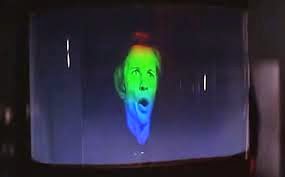
Space Station 76 also uses a device similar to an actual 1976 film in one scene. Captain Glenn talks to Daniel on a multi-colored hologram communicator, one that reflects the imagery of Logan's Run (1976) and its hologram.

More
intriguingly, perhaps, the interiors for Space Station 76 -- with their white
lights and white walls – closely resemble the corridors of Moonbase Alpha in Space:
1999.
One panel seen in the film
-- of three horizontal lighting ellipses -- actually looks like it was
transplanted directly from that Anderson-ian facility.


Impressively,
Space
Station 76’s thematic approach is in fact visualized through this
Moonbase Alpha corridor style. Early in the film, we see young Sunshine,
replete with a purple crayon, coloring on the immaculate white walls. She
scrawls the word “home” on the ivory panels as well.

The
moment is not merely a call-back to Harold and the Purple Crayon (1955), but a visual representation of the
film’s leitmotif. The purple scribbling on the white wall represents the idea
of messy humanity imposing his chaotic nature on an artificial world of
immaculate perfection and balance. The characters in Space Station 76 are
deeply flawed, even tragic in nature, and they are out of place, and
out-of-balance, with their perfectly calibrated environs.
Space
Station 76’s robot
therapist, Dr. Bot, is also a product of nostalgia for an earlier age of “futurist”
imaginings. The robot shrink is actually Tomy’s Verbot, a toy from the early
1980s. The toy was advertised as being a real robot with “a dazzling personality” who would “blink and smile at your request.”


Dr.
Bot in the film is not much more advanced than this description suggests, and
he offers only off-the-shelf wisdom and platitudes. In a way, the robot psychologist’s nature as
a proverb-quoting automaton may be an oblique reference to the robots in Disney’s
The
Black Hole (1979), who quoted Cicero and other philosophers. So again,
a call back to the disco decade’s space operas.
All
these visual touches make one aware that Space Station 76 has been created
with a humorous eye towards our historic (and therefore deeply flawed…) visions
of the future. When the film adheres to this concept, and crafts jokes based on
the fallacies of those historic visions, it is indeed rather funny.
There’s a scene here in which Keir Dullea
from 2001:
A Space Odyssey video-phones Marlowe, his daughter, and they share a
conversation. But all the emotional heart
of the moment is sacrificed -- thus reinforcing the theme that people talk, but
don’t connect -- because Dullea’s character can’t find the right place to sit
on camera for the video phone to operate correctly. He ends up half off-screen,
a funny moment which makes one grasp, instantly, the impracticality of such a
device.
Other
moments, such as Glenn’s periodic suicide attempts -- which are prevented by
the station’s computer -- don’t work very well at all, and seem downright
cartoony compared to the film’s relatively straight-faced exploration of
relationship woes. I get the idea, of course.
The late 1960s and early 1970s gave us talking computers that controlled
space flight, telemetry, life-support and so forth. Think about HAL in 2001 or Alpha’s Main
Computer on 1999 noting, in a moment of catastrophe that “Human Decision”
is “Required.”
Here,
Glenn makes the choice to kill himself, but computer protocols keep overriding
his very human decision.

In
terms of its overall story, Space Station 76’s inspiration seems
to be The Ice Storm (1997), a film based on the 1994 book by
Rick Moody.
The
novel and the film both concerned an American middle-class family in the 1970s,
post-Watergate, and during a time of sexual experimentation. Everything was
being questioned in that span, from marriage, to patriotism (because of
Vietnam), to the competence of the U.S. Government. Even marriage -- or perhaps, more accurately --
monogamy, was on the table.
Space
Station 76
deals with similar concerns. Here families
are coming apart at the seams, and there is one galvanizing outside event that
serves as a manifestation of their disquiet, not a winter ice storm, but an
approaching asteroid on collision course.

Although
slapstick humor is always fun, Space Station 76 would have been a
stronger film, perhaps had it not strayed so far from the tone of The
Ice Storm, which is more cynical and darkly caustic than outright
silly. The sillier moments in this retro space film seem out of left field,
while the more serious ones, for the most part, are genuinely affecting. Played
straight (at least on the surface), the film would have felt more powerful, and
less scatter-shot.
There’s
so much going on in Space Station 76, and I don’t mean to give the impression that
the film is a failure. I admire it quite
a bit both for its canny knowledge of the films and TV shows I love, and for
the manner in which its visual form -- asteroids and malfunctioning video chats
-- represent interpersonal alienation.
But
the over-the-top jokes tend pull the whole affair back down to Earth.