Showing posts with label From the Archive. Show all posts

Saturday, September 02, 2017

Saturday Morning Cult-TV Blogging: Ark II: "Don Quixote" (December 11, 1976)


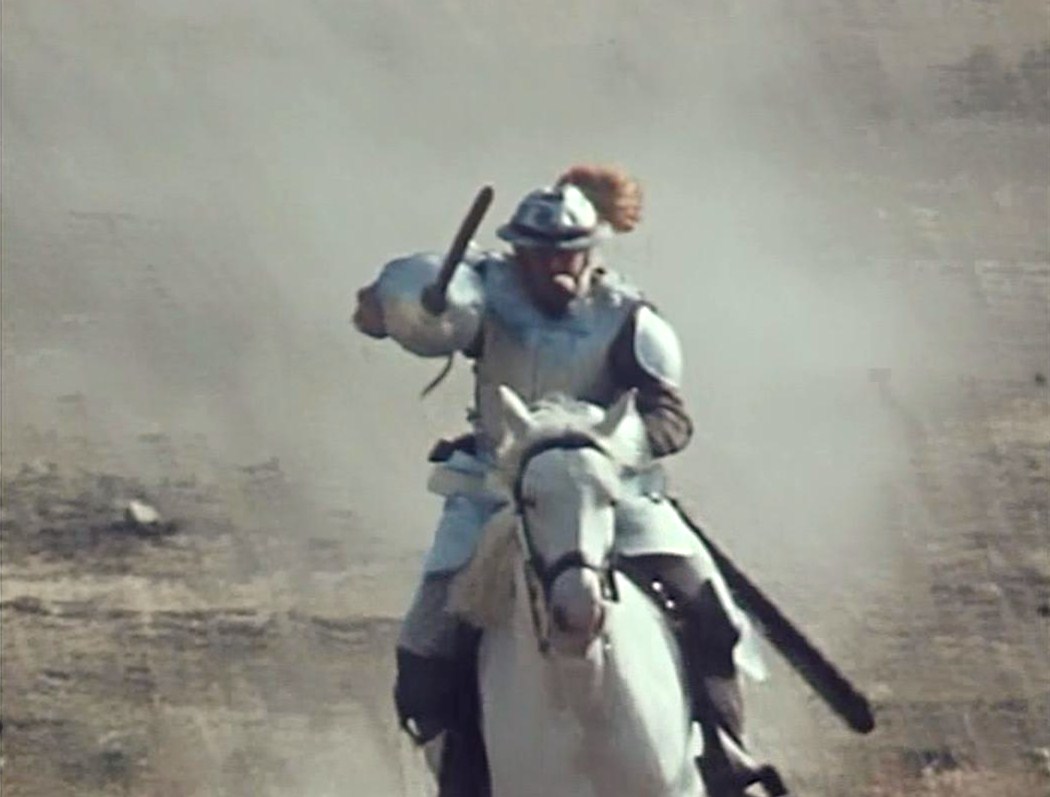
This week’s episode of the Filmation 1970s series Ark II, called “Don Quixote,” follows roughly the same outline as the episode “Robin Hood.” 

Only here, the crew of the titular vehicle encounters literary and mythic personalities who are not merry men, but rather based on Cervantes’ The Ingenious Gentleman Don Quixote of La Mancha (1605). 


Specifically, Jonah, Ruth, Samuel and Adam cross paths with two post-apocalyptic personalities who knowingly have cast themselves as the chivalrous Quixote and his loyal squire, Sancho.

The conflict of the week occurs when this (confused) new age Quixote sees Jonah not as a hero, but as his most dangerous nemesis, the Black Knight himself.  Thus Quixote seeks to interfere with Jonah’s mission to detonate two un-exploded pre-apocalypse bombs in an ancient battle area. 

Adding some comic relief to the episode, Quixote also sees the talking chimpanzee, Adam, as a damsel he can protect and love, Lady Marguerite. 


Finally, Quixote is recruited to the Ark II’s noble cause when the crew contextualizes the un-exploded bomb as a “serpent” the knight must defeat in combat.  Quixote actually proves helpful too, during the climax, because his metal knight’s armor can help to limit the range and power of an explosion, if one should occur.

Played more lightly than “Omega,” and “Robot,” and without the sharp social commentary of “The Cryogenic Man,” this installment of the Saturday morning series wouldn’t rank among the show’s best.  

Nor is it the worst, however. 


The final message of “Don Quixote is something akin to “use your imagination, but also see things through the eyes of others.”  That’s appropriately didactic for children. Yet it’s probably even more commendable that Ark II would name-check Don Quixote in the first place, no doubt causing a spate of little ones to ask their parents about the character and his story, or perhaps even visit a nearby library to find out even more about him. 

I must say, I appreciate the fact that over its run, Ark II has showcased a very literary, cerebral bent, alluding to Scripture, Dickens, the Robin Hood legends and Cervantes.  That’s an unexpected (adult) pleasure of revisiting the Saturday morning series today.

Next week, the final Ark II episode: “Orkus.”

Saturday, July 01, 2017

Saturday Morning Cult-TV Blogging: Ark II: "The Balloon" (December 4, 1976)


In this episode of the Filmation Saturday morning series Ark II, the crew runs smack into a society that, as a whole, suffers from xenophobia, a fear of outsiders or “foreigners.”  

Captain Jonah’s (Terry Lester) initial log entry describes people who “refuse to have contact with the outside world.”

But from somewhere deep inside the isolationist village, someone is sending out distress messages tied to floating balloons…written in Greek.  After deciphering one message, the Ark II crew comes to understand that the very people who have so calculatingly cut themselves off from the rest of humanity are suffering from a terrible plague, one they can’t cure on their own.

The Ark II team finds the messenger -- an old man working a printing press near “the place of the Iron Birds,” a destroyed air-field -- and learns that this is indeed the case.  The messenger says: “We have a new enemy now…disease.”


While Ruth returns to the Ark II via hot air balloon to work on a cure for the new disease, Jonah attempts to convince the village’s leaders to “open” their hearts and minds to others.  Unfortunately, he and a young boy fall prey to the disease, and only reinforce the fear of strangers.  Now outsiders are disease carriers.

Meanwhile, Ruth and Samuel must clear a path to get the Ark II inside the village, and deliver inoculations to all the sick people.

Like its predecessors, “The Balloon” is a message-heavy installment of this Saturday morning series.  In “The Tank,” we met people who shunned machines because they believe machines caused war.  Here, we meet characters who refuse to deal with outsiders, because they fear attack from them.   In both cases, people have responded to a terrifying situation irrationally, by a blanket rule about the things they perceive caused them harm.


In real life, of course, America has witnessed periods of intense xenophobia over the last two centuries, not the least of which has been in the decade following the 9/11 terror attacks.  Yet the rampant fear associated with xenophobia is ultimately counter-productive, as this episode of a 70's kid show rightly points out.  If you close yourself off, you also close yourself down to certain options, to new solutions, and to improvements your life.  When you come from a closed place, everything -- even learning -- can come to a stop.  It’s not a healthy response to fear, even if it is, on some level, understandable. 

It’s very interesting that Ark II chooses to tell this particular story, about a place that has sealed itself off from the world and in its insularity faces extinction.  “By talking instead of fighting,” says Jonah “we can move forward.”


In terms of Ark II continuity and lore, this episode reveals that the Ark II can fire a focused beam from its fore section, but the beam is still defined as “a force field,” keeping in tune with the idea of self-defense and no aggressive weaponry.  Intriguingly, the force field is also quite a limited device.  In trying to move heavy stones from the vehicle’s path, the force field’s power grid short circuits…

Although “The Balloon” carries a laudable message, it plays, at this point, as fairly routine.  

The series is in something of a rut, with tiny villages constantly being shown the error of their primitive ways by the Ark II team.  The civilizations of the week -- battling superstition (“The Slaves”), xenophobia (“The Balloon”), cruelty to the weak (“The Rule”) and technophobia (“The Tank”) -- are a bit too predictable and one-note at this point.  But the series is about to mix it up with some infusions of more science-fictional elements, from robots and suspended animation to telepathy, and that’s a good thing.

Next Week: “The Mind Group”

Friday, April 21, 2017

Cult-Movie Review: Night of the Lepus (1972)


The horror cinema of the 1970s is filled with tales depicting Earth’s imminent destruction at the hands (or paws...) of…animals.   

But make no mistake: while Mother Nature may launch her animal armies against us, it is mankind himself that is to blame for her righteous vengeance  By polluting natural environments, by dumping toxic wastes, and by using pesticide, he has only brought upon his own destruction.

Message: it is not nice to fool with Mother Nature.

The Revenge of Nature Cycle may have started as the “when animals attack” genre, a movement exemplified by films such as Alfred Hitchcock’s The Birds (1963), or Willard (1972).  

But by the mid-point of the decade, filmmakers were almost constantly coupling vicious animal behavior with man’s massive and on-going mistreatment of the environment.

Accordingly, polluting man battles amphibians in Frogs (1972).  

Pesticide-spraying man battles spiders in Kingdom of the Spiders (1977).  

Toxic-waste dumping man faces insect rebellion in Empire of the Ants (1977).  

Other films of the same ilk including The Bug (1975), Squirm (1976), Day of the Animals (1977), and perhaps the most infamous revenge of nature movie of all: Night of the Lepus.

In Night of the Lepus -- a film derived from the satirical novel, The Year of the Angry Rabbit (1964) by Russell Braddon -- the careless mistake of two scientists results in the spread of a dangerous hormone that can cause “genetic deformity.” It becomes unloosed on the out-of-control giant rabbit population of Arizona. 

Before long, the ranchers and law enforcement officials near Ajo are waging a war against giant carnivorous bunnies with teeth the size of “saber tooth tigers.”

The guiding principle behind the movie, and indeed, behind the Revenge of Nature cycle is sound, and not entirely new in the 1970s.  Just as the original Godzilla (1954) is about a monster that represents out-of-control atomic power -- the opening of Pandora's Box, so-to-speak, the bunnies represent out-of-control science and irresponsible man tampering in God's domain, in Night of the Lepus.  

The big problem with the film is that as avatars of fear, rabbits are rather un-intimidating creatures.  Even with red paint splattered on their whiskery mouths. 

Ants, spiders, worms, and even frogs seem more appropriately terrifying.  And Night of the Lepus does itself no favors by showing the “enlarged” rabbits on screen constantly with tiresomely repeat or stock footage. 

 In fact, these giant rabbits hop around -- or rather “stampede” -- across miniature sets in slow-motion, in full view of the camera for long, dull stretches of the running time, and the result is underwhelming to say the least.


“Mommy, what’s a control group?”

A newscaster on TV hosts a special report about the “imbalance in the animal world,” and a “plague of rabbits” infesting Australia.  He then describes how the same situation is bedeviling the residents of Arizona.

There, rancher Cole Hillman (Rory Calhoun) is seeing his land overrun by ever-multiplying rabbits.  One day, his favorite steed trips on a rabbit hole, breaks its leg, and must be put down, and that’s the last straw. Cole asks a friend, Elgin Clark (De Forest Kelley), to help him solve the crisis.

Elgin contacts two scientists who work with animals, Roy (Stuart Whitman) and Gerry Bennett (Janet Leigh).  With their daughter Amanda (Melanie Fullerton) alongside them, the scientists examine the problem and begin to experiment with hormones in an attempt to suppress the mating drive of the rabbits.  The experiment doesn't work, and the scientists mix up a new concoction with results they can't predict, as they readily admit.

Unfortunately, Amanda accidentally frees an affected rabbit, Romeo, from captivity, and the new hormone it carries causes a mutant strain of giant rabbit to rapidly develop.

The Bennetts, Elgin and Cole attempt to stop the onslaught of the rabbits, even blowing up a mine-shaft where they have made their home.  

But a herd of giant carnivorous rabbits escape from this trap, and make a run for Ajo, where they have the capacity to do major damage in terms of life and property value.


“There’s a herd of killer rabbit headed this way!”

You may not realize it, but if you have watched The Matrix (1999), you have seen, at least momentarily, imagery from Night of the Lepus.  

The movie plays on-screen during the scene in which Neo (Keanu Reeves) visits the Oracle, and sees children bending spoons.  The subtle suggestion is that a movie like Night of the Lepus -- about a “herd of killer rabbit” -- could only exist in a weird facsimile of reality.

That’s a good point, because Night of the Lepus is surely one of the most unintentionally hilarious horror movies of its day, particularly with Amanda, the Bennett’s little girl, asking exposition-heavy questions such as “Mommy, what’s a control group?” or speaking for the audience and noting “I like rabbits!"

Even the humorless narrator of the “Rabbit War” news report at the film’s beginning adds to the film's unintentional sense of humor by noting that these “cuddly pets” could become a terrible “menace.” 

As a general rule, it’s a good idea not to refer to your monster as “cuddly,” because an adjective like that undercuts the sense of horror. In a movie about slobbering, jumping, man-eating rabbits, the word cuddly should simply never be spoken at all.

Another moment of funny dialogue comes from Whitman who worries “Heaven help us if any of them [rabbits] get away before we know the effects of this serum.”

Guess what happens in the very next scene?

If you said that one of the affected rabbits gets loose, you are absolutely right. Amanda switches rabbits without her parents realizing it, and then the infected rabbit gets loose after Amanda keeps it as a pet for a time.  The Bennets are not merely lousy scientists, they are lousy parents too, for taking Amanda to work with them and not paying attention to her actions. It's clear they recognize what dangers could await if a rabbit escapes.

Even Janet Leigh, the great star of Psycho (1960) seems diminished by the film’s ridiculous dialogue. When she comforts Amanda after a lepus attack she soothes her.  It’s gone,” she assures her daughter.  “The rabbit is gone.”

Yes dear, the cuddly pet rabbit is gone now, and you have nothing to fear.  

Again, this is a fear that should not be named, specifically.  Even the very word, "rabbit," doesn't promote scares.

Let's be clear: Night of the Lepus features a monster that would be difficult to make scary under the absolute best of circumstances, but the movie doesn’t create or promote the best of circumstances. Director William Claxton allows for the rabbit scenes to linger on-creen -- in slow motion -- for long spells, and any illusion that they are giant, or dangerous, is lost because of their familiarity.  In fact, you get to the point where you start to recognize the rabbits.  There's the black one, the orange one, and so forth.  

And as the friendly-seeming rabbits hop across miniature sets it is painfully obvious that they are not gargantuan. The sound effects that accompany their runs  may “sound like a cattle stampede” to bystanders, but that too is kind of funny.

I should be clear, it’s not just that the shots linger beyond reason, in agonizing slow-motion, it’s that they repeat.  A scene with rabbits leaping a chasm is seen at least twice, and many scenes of the rabbits traversing a highway seem to repeat as well. Either that or are the roads are so similar as to be visually indistinguishable.


Director William Claxton -- a talent who directed several outstanding episodes of The Twilight Zone (1959 -1965) including the sensitive “I Sing the Body Electric” --  seems to approach this horror film as more of a Western, right down to Hill’s motivation for fighting the rabbits (the death of a horse), and some attractive, even picturesque landscape shots.  The rabbits are treated more as a stampede of out-of-control animals than as a threat resulting from science-run-amok, and nature’s reprisal.

Now, on one hand, treating the film’s threat as fairly realistic could be a good thing…if the monsters inspired fear. 

But on the other hand, Claxton goes way over-the-top in terms of fake-looking gore, a step which moves the film out of the zone of realism. The scene vacillates between deadly dull conversations and over-the-top moments of ridiculous violence, and the approach is not pleasing.

As one might expect from this approach, critics weren’t terribly impressed with the results of Claxton’s efforts.  

Roger Greenspun, writing in The New York Times, noted the “technical laziness,” “stupid story” and “dumb direction,” a kind of trifecta of utter terrible-ness. 

Alan Frank, in 1982, treated the film more gently, though drew the same conclusion, noting that the “enlarged rabbits” don’t “really carry a genuine monstrous charge.

Watching the film again for the first time since I wrote Horror Films of the 1970's I felt a little bad for the out-dated wonders of Night of the Lepus. The movie features a lot of likable performers in it -- it’s great to see De Forest Kelley again, for instance -- and it surely capitalizes on the eco-terror Zeitgeist of its moment.  

And yet beyond that, this is a horror film unable to enunciate even a single moment of authentic horror.

Almost funnier than the movie itself is the trailer, which discusses a “night of total terror” and a “devil creature.”  It asks “what happened the night science made its greatest mistake?”

Well, what happens when the horror film makes a great mistake?  

Sunday, February 26, 2017

From the Archive: The Unforgettable Doomed Space Missions of Cult-TV


In the vast immensities of cosmic space, bold adventurers streak their way to join battle with strange enemies on strange worlds: the alien, the unknown, perhaps even the invisible, armed only with Man's earthbound knowledge...”

-          The Control Voice narration to “The Invisible Enemy” on The Outer Limits (1964).


One of my a favorite sci-fi and horror sub-genres (due to be explored this summer in Alien: Covenant [2017]) is the failed outer space expedition.   

In stories of this type, courageous astronauts brave the dangers of the void in their rockets and spaceships, and discover not wonders of nature…but the very horrors of Hell itself.

Films have visited this trope in such efforts as Alien (1979), and Europa Report (2013), but this list focuses on TV instead, a realm where the failed space expedition trope has seen many iterations.  

Many cult-television series are actually predicated on the concept of a “failed” space expedition, from Lost in Space (1965 – 1968) and The Starlost (1973 – 1974), to Planet of the Apes (1974 – 1975), Buck Rogers in the 25th Century (1979 – 1981) and Farscape (1999 – 2003). 

Not all those series, however, tread in the terrain of pure terror: the unexpected conjunction of amazing high technology with Gothic “monsters” in an arena that should be reasonable, scientific, and wondrous…but determinedly isn’t.  Highly-trained and resourceful astronauts in these episodes suddenly find themselves confronting things that shouldn't exist at all; things like ghosts, dragons, and vampires.

Other TV series (not featured below) offer variations on the formula, but don’t necessarily focus on spaceships: Doctor Who’s “The Waters of Mars,” for instance, concerns a base on Mars that falls to an implacable alien horror called “The Flood.”  

In terms of categorization, a good “failed space expedition” story not only terrifies, it sets up a high level of danger for those who discover the expedition's aftermath, and must tread (warily…) in its footsteps.

So without further introduction, here are my selections for the five most horrific failed space expeditions in cult-television history. 

To be included on my list, the mission must end in abject failure, and with lots and lots of death and destruction.  

These are my choices, but no doubts others will choose other episodes.


5.The final journey of the U.S.S. Essex (“Power Play,” Star Trek: The Next Generation [1992]):   

Nearly 200 years before the days of NCC-1701-D, a Daedalus class starship called U.S.S. Essex, encounters terror on Mab-Bu IV and is never heard from again. 

When the Enterprise answers its distress call two centuries later, the captain of the Essex and his top crew are reportedly alive, albeit in a strange form.  They “survive” as disembodied “ghosts” inside a planet-wide storm.  

The truth is much more bizarre, however.  The planet is actually a penal colony containing the Ux-Mal’s most monstrous (but non-corporeal) criminals.  The Essex captain and his ship died generations ago, when the prisoners seized the ship, and it failed to escape the planet’s gravity well.

This is one of my all-time favorite Next Generation episodes because it boasts no preachy messages, and the Enterprise crew spends the hour trying to figure out exactly whom it is dealing with when Troi, Data, and O’Brien are apparently possessed by the Essex’s command crew.  

But in terms of the failed space mission premise, I love “Power Play” because it points out the danger of space travel in early Starfleet history.  Here, a starship “boldly went where non had gone” and encountered new life forms of a most malicious variety.  Star Trek isn't a universe where one expects to find "ghosts," but that's a good term for the merciless aliens Picard combats here.  This episode also offers one of the few instances in the series when it is possible to resolve a situation by peaceful diplomacy, and talking to an enemy.


4.The ill-fated mission of the M-1 (“The Invisible Enemy” The Outer Limits [1964]):

In the year 2021, the M-1 rocket lands successfully on Mars.  But this giant step for space exploration ends in terror, when the first astronaut on the Martian surface screams in terror, and then disappears without a trace.  The second astronaut heads out to the surface, and meets the same mysterious fate. 

Six years later, the crew of the M-2 discovers the grisly disposition of those unlucky men.  They encountered dragon-like shark creatures that “swim” the sandy terrain of the red planet.  Now, the four-man crew of the M2 is similarly imperiled by the over-sized, carnivorous beasts. 

This episode of the classic anthology series plays adeptly on the fear that something might exist beneath our very feet, something that could pull us down into the very ground itself, and destroy us.  And the episode’s final revelation -- of a whole school of the sand-sharks laying in wait -- is unforgettable in terms of its imagery.

Here there be dragons...


3. The bizarre fate of the E-89 (“Death Ship,” The Twilight Zone [1961])

This mysterious and unsettling story from the late Richard Matheson occurs in the year 1997, as three astronauts -- Captain Ross (Jack Klugman), Lt. Mason (Ross Martin), and Lt. Carter (Frederic Beir) -- visit a distant planet and are afforded an unwelcome glimpse of their own future.  
On the surface of the planet is a wreckage of a spaceship…their spaceship.  Captain Ross believes that they have somehow "circumnavigated" time and arrived on the planet in their own near future, perhaps as the result of a time warp.  
Now the question remains, how does the ship’s crew avoid a future in which it is fated to die?
Unlike the other stories on this list, “Death Ship” involves no overt “monster.”  There are no sand sharks, ghosts, vampires or other creatures to contend with.  Instead the crew’s nemesis is time itself, and perhaps that is an even scarier enemy.  As I wrote in my review of the episode, "Death Ship" is a great story because it arrives at its shocking ending side-ways.
The episode features all the trappings of futuristic science fiction drama, with discussions of time travel and alien life, but as is so often the case on The Twilight Zone (and in the work of Richard Matheson) the resolution of the enigma involves the very nature of man; the metaphysical not the technological. 
In crafting a tale of a protagonist and captain who sees what he wants to see, and the men who follow him in that (tunnel) vision, Matheson's "Death Ship" takes the mysteries of outer space and links them right back to the essential nature of humanity, right here on Earth. For a time it looks like the story is about "fear -- the "death fear" as one character describes it -- but the tale actually involves the acceptance of the unacceptable in our lives...and in our deaths.
This is one of the darker corners of The Twilight Zone, no doubt.


2. The last voyage of the I.S. Demeter (“Space Vampire” Buck Rogers in the 25th Century [1980])
An unknown presence -- believed to be the “Denebian virus” or “EL7” -- begins to kill the passengers and crew of the I.S. Demeter in “Space Vampire.”   

Although the last survivors hold out hope that they can reach their destination alive, it is not to be.  All hands have perished by the time the vessel passes through Stargate Nine and reaches Theta Station.   Their murderer is a strange vampiric entity called a Vorvon, known in legends for “draining the souls” of the living. 

On Theta Station, Buck (Gil Gerard) watches the Demeter’s captain’s log, and realizes the horror that now lurks on the station. 

The Demeter is named after the ship that transports the un-dead count to England in Bram Stoker’s Dracula, and serves much the same purpose in this entry of the 1979-1981 series: setting the stage for the next appearance (and escalation) of a terrifying entity.

Where most episodes of Buck Rogers are light-hearted and breezy (and quite enjoyble so...), an atmosphere of  absolute gloom and dread hangs over "Space Vampire," especially the sections involving the Demeter.  There is an air of ghastly inevitably here as the captain reports death after death, until the Vorvon finally comes for her...


1.The horror of the Ultra Probe (“Dragon’s Domain,” Space:1999 [1975])

It is impossible for me to measure how deeply or profoundly this episode of Space:1999 impacted my psyche when I first saw it as a young lad (at the tender age of five).  I suspect, in fact, that “Dragon’s Domain” is the very production that catalyzed my life-long love of horror and science fiction.

“Dragon’s Domain,” by Christopher Penfold, depicts the tragedy of the ill-fated Ultra Probe, which began its weeks-long voyage to the newly-discovered planet, Ultra, in the year 1996. 

In orbit of the planet, however, the astronaut crew discovers a mysterious “parking lot” of alien spaceships. When docking with one such mystery ship, however, something...alien...gets inside the Ultra Probe (commanded by Tony Cellini), something horrible.

That horrible thing is a tentacled, slimy nightmare that can hypnotize the living, and...then devour them.  But even that isn’t the end of the terror.  After eating the crew, this monster spits out the corpses’ steaming bones from its orange-hot maw.  

The resulting image: a smoldering skeleton on a high-tech spaceship deck, is one that has remained with me my whole life, and captures perfectly the magic of the “failed space expedition story.”

You look at that image (below..) and wonder, how in the cosmos can this happen?  How can mankind achieve his highest aspiration -- the stars themselves – and end up like this? Merely charred food for something unimaginably horrific, unimaginably monstrous?


In the course of “Dragon’s Domain,” Tony Cellini gets a second chance to face his monster, and even when fully seen for a second bout, the creature loses none of his ghastly power.  The creature squirms, wriggles, shoots out fluid (ick…) before consuming its final victim.  In the end, the truth is that the parking lot of spaceships was a spider's web, and that this monster was the spider itself.

The story ends with a final, frightful thought to carry with you into your nightly slumber.  If the astronauts never determined, via their advanced scientific instruments, that the creature was alive... how could anyone be sure that it was really dead?

Alas, fans of failed space expeditions never got the TV sequel to "Dragon's Domain" that this chilling ending so perfectly set-up.

Other contenders for this list include "The Satan Pit," a Doctor Who story in which a team of space miners (again operating from a base, not a ship) excavate a "Beast" that is, in fact, the Devil, and "Planet of Evil," another Doctor Who story set at the edge of the known universe, and featuring an anti-matter universe.