Showing posts with label 2016. Show all posts

Tuesday, April 04, 2017

The Films of 2016: Arrival


[Spoilers abound. Swim at your own risk.]

The 2016 science fiction movie Arrival concerns many fascinating ideas, but two, in particular, stand-out as being particularly intriguing or noteworthy, especially given our current national and historical context. 

The first such notion involves a cornerstone of communication studies: The Sapir-Whorf Theory.

Broadly-speaking, there are two readings of this particular hypothesis, but Professor Betty Byrne explains the hypothesis best in an interview at Slate with Melissa Martinelli, from November of 2016:
There are two ways of thinking about the Sapir-Whorf hypothesis, and scholars have argued over which of these two Sapir and/or Whorf actually intended.
The weaker version is linguistic relativity, which is the notion that there’s a correlation between language and worldview. “Different language communities experience reality differently.”
The stronger view is called linguistic determinism, and that’s the view that language actually determines the way you see reality, the way you perceive it.
What is being discussed here, specifically?
No less than the idea that the code (language) that we use to express our philosophy of the universe actually shapes our philosophy of the universe. 
Denis Villenueve’s Arrival, as I noted in a response to a blog reader yesterday, actually name-checks Sapir-Whorf in the film’s dialogue. Much is made in the film of the notion that separate nation-states (with individual ideologies) attempt to teach the aliens to speak meaningfully to humans. 
But since each nation-state -- China, Russia, etc. -- possesses a different code, and a different understanding behind the code, each will define terms like “weapon,” or “war” in a very different way. For the alien learners, this is a problem. 
Will they learn that human life is a competition? A game? A battle? Or a “non-zero sum game?”
In discussing the ways that language can shape reality, Arrival eerily forecasts, the “post truth,” “fake news” world we live in now, in 2017. If those in power here view America as weak, being taken advantage of by shadowy foreign governments, and experiencing “carnage,” do they risk shaping America into the very dystopia they describe and fear?  Is our reality being re-shaped on Twitter, 140 characters at a time?
The second idea of value in Arrival is much more personal. It concerns the path one must choose once the mind has become open to new ideas. 
One can either embrace those ideas -- and move forward into a larger, more nuanced world -- or  one can attempt to deny what has been learned, and fall back on old outdated perceptions; essentially ignoring all new input.
If understanding the code of another culture can open up new doorways, reliance or dependence on the old code, the familiar one that formed our cultural understanding, can result in slammed doors. The response to understanding the world better is then, in those instances, a retreat into a bubble of confirmation bias, or pre-existing beliefs.
Arrival -- following on in the tradition of Solaris (1972), or even the Star Trek: Deep Space Nine (1993-1999) premiere episode, “Emissary” -- comments meaningfully on the human condition, and its limitations regarding perception of time. What the aliens teach us in the film goes against the familiar code our language has established regarding chronology. 
What if there isn’t a past, present or future? What if time is non-linear…a circle?
And if time is non-linear -- if there is no past/present/future -- what does this new understanding of reality do to our concrete understandings of birth and death, mortality and the afterlife?
Interstellar (2014) from Christopher Nolan was likely the last big-budget cerebral science fiction film to play so cleverly with our understanding of time, but Arrival is an even stronger, smarter film, in part, because of the lead character’s humanity, and relatability.
Amy Adams’ Dr. Louise Banks sees her conscious altered by contact with an alien race -- the Heptapods -- but the change doesn’t make her immortal, or allow her to escape the bounds of reality.  Instead, it permits her, touchingly, to better perceive time, and contextualize a tragic experience in her life. What she realizes, finally, is something amazing, and beautiful. The startling manner in which the film permits her self-discovery to unfold actually reflects the nature of the discovery itself. 
In this case, form has reflected and augmented thematic content, and -- as you know -- I believe that equation is the highest virtue of filmmaking: the ability of an image to echo, mirror or encapsulate for audiences the point of the narrative, or increase our understanding of it.
Thrilling and smart, Arrival is also filed with unforgettable imagery, not the least of which involves the visualization of the alien vessels, and their placement on our terrestrial landscapes. The design of the Heptapod ship, too, seems to suggest the something vital about the alien nature, and their way of understanding reality.
In short, Arrival, like its lead character, Louis Banks, plays a “non-zero sum game.” 
A non-zero sum game is a situation, in game theory in particular, in which one player’s gain or loss does not necessarily equate to the other player’s loss.
The aliens, the terrestrial combatants, and the individual lead characters all undertake in Arrival an encounter that changes them and forces them to grow in surprising directions.
If only they can contend with the new world-view their meeting reveals…
“Not everyone is able to process experiences like this.”
A linguist and college professor, Dr. Louise Banks (Amy Adams) watches from her class-room as twelve alien space ships set down at seemingly random locations around the world.
As panic sets in across the globe, Banks is contacted by the U.S. military.  Colonel Weber (Forest Whitaker) wants her to translate the alien language, and help him come to a better understanding of what this possible enemy may want on Earth.
Dr. Banks counters that she cannot translate an alien language until she learns something of the alien culture; until she is able to interact with the aliens, called Heptapods.
Weber is reluctant at first, but soon agrees to escort Banks to Montana, where the U.S. Army has set up a command post near one alien ship.  On the helicopter ride to the site, Banks encounters another expert in his field, physicist Ian Donnelly (Jeremy Renner), who believes, unlike Banks, that science is the foundation of civilization.
Banks argues, contrarily that language is the “glue that holds a people together.”
Upon contact with the aliens, Banks attempts to form a common fund of knowledge, or language, upon which to build mutual understanding and trust. Other scientists around the world also attempt to do so but utilize different learning approaches, some more confrontational than others.
As Banks learns more about the aliens and their strange language, she begins to understand more about them.  As other countries grow alarmed that the aliens may be bringing weapons to Earth to cause fighting among its people, Banks receives the full-language as a gift. She understands that the language is not a weapon, but a tool.
It is a tool that fundamentally transforms Banks’ understanding of life, and opens her up to a possibility that she had never before contemplated.
“How would you approach translating this?”
Language relates to culture. I think everybody agrees with that premise. But can language determine culture?
That’s a key question regarding the Sapir-Whorf Hypothesis, and also the themes of Arrival. We all understand what “war” is, for example, but what if we understand that the word originally meant “desire for more cows” (in Sanskrit)?
Does everything we fight for -- and kill for -- come down, finally, to a desire for more material wealth?  Is that how we understand war now?  
Perhaps. Our language, our code, shapes our reality, every day.
We see this idea very clearly in our understanding of time, to utilize a more illustrative example. We mark time as a force that moves in one direction only, from the past to the future. We don’t die, grow young, and undergo birth.
Instead, the opposite always appears to occur. 
But what if time is non-linear, and has no direction whatsoever? What if we can’t understand the true nature of time because of our (limited) definition of time, which reads something like this: “the indefinite continued progress of existence and events in the past, present, and future regarded as a whole.
Arrival proposes and depicts an alien race that views time as non-linear. These aliens see outside the concrete ideas of past or future, and thus view the world differently than we do. That viewpoint is reflected in the alien language or alphabet, which is visualized as a series of inky circles of different thickness and edges.
In other words, the Heptopod language reflects the way the aliens see the universe (as a circle), just as our language code reflects the way we view the universe. Our language has a beginning and an end. Our alphabet starts at “A” and ends at “Z.”
Yet Arrival travels beyond Sapir-Whorf by suggesting that if Banks learns the alien language, her perception will also change; and that she will also possess the ability to see outside linear time.  This is poetic license regarding Sapir-Whorf, to be certain, but good poetic license.
Why? Well, when we are exposed to different cultures and their belief systems, we can’t go back to the narrow, parochial ethnocentric view we held before. The mere exposure to different thoughts, different words, a different language, opens up doorways to new understandings. Arrival takes the idea literally, but I believe it also utilizes it as a metaphor for what occurs every day in intercultural communication: the ability to grow beyond one’s set of precepts to understand that existence is richer than any one world view suggests.
Stuck in our own ethnocentric bubbles, we believe there is but one way to do things (our way!). But if we open ourselves up to other languages, cultures, and world-views, we start to become relativistic in our outlook; understanding that different people, living in different places, possess different answers to problems. Sure, there are some customs or beliefs we will always reject as too alien, or too different, or even too barbaric (see: cannibalism in The Green Inferno [2015]).  But other customs or beliefs we will recognize as wise, or as having things in common with our own traditions and morality.
Indeed, Banks almost magically assumes the power to view time in a non-linear fashion in Arrival after being gifted with the totality of the Hepatopod language. Yet metaphorically, this gift is something akin to the scales falling from her eyes. Her mastery of the alien language and culture grants her a new perspective on our own. Consider for a moment that the key imperatives for studying intercultural communication are: Self-awareness, demographic, economic, technological, peace, and ethical growth. In some-sense, Banks takes on several of these imperatives in the film, or at least the peace, ethics, and self-awareness ones.
Now consider Banks’ embrace of the new understanding she gleans from the aliens, and contrast it with the xenophobia we see rampant in today’s political swamp.  Of late, have we seen “others” consistently scapegoated as dangerous bogeymen. For example, illegal immigrants are often deemed rapists and murderers. Those of divergent religious beliefs would be banned from the United States, and by a president who ostensibly supports religious liberty.
Banks reaches out to the alien viewpoint with understanding, and saves mankind.  If she simply retreated into fear and fear-mongering, the human race would have been doomed, instead, by its own self-destructive impulses.
That’s the big picture of Arrival. It is the idea that language is “the first weapon drawn” in a conflict. But that language can also be the basis not for war, or battle, but for better understanding (just rarely in 140 characters).
How does Banks come to understand herself better? How does intercultural communication make her more self-aware?
Leave the cerebral notions of Sapir-Whorf behind for a moment, and consider, what she chooses at film’s end.  With a knowledge of non-linear time, Banks comes to see that she will have a child, a girl.  She will love and raise that girl into young adulthood, and then, tragically, see that young woman taken away by incurable cancer.
But, knowing about her daughter’s death is not a reason, finally, for Louise to choose a different course.  Instead, Banks sees that her daughter’s life possesses meaning, and continues, always, even if in linear time, Louise will have to suffer her child’s absence.
Oppositely, Banks’ husband, Ian, resents her choice to have a child, knowing that the child will die young. It’s as if all that love is wasted on a life that is short. It’s as if Louise chose cruelty, giving birth to a child just to see that individual die.
But that child’s life is not wasted, and Banks is able to discern that fact. Although we are “so bound by time and its order,” Banks is able to see that the times of love and joy in her child’s life are not outweighed by the shortness of her life-span, or by the sad way that her life ends.  For if time is non-linear, then death is not an ending.
We saw this idea, in some sense, in “Emissary,” the premiere of Star Trek: Deep Space Nine. Commander Sisko (Avery Brooks) was unable to get beyond the tragic death of his young wife, Jennifer, in the Battle of Wolf 359. He later encountered the wormhole aliens, who didn’t understand the concept of linear of time, or his refusal to end his period of mourning.
If time is non-linear, mourning is no longer necessary.
Banks chooses that her daughter should exist, despite the fact that she will die of a terrible disease when she is young. 
Banks feels that because time is non-linear, her child will “come back to her” and that what she believed was the beginning and end of a journey were no such thing.
There are days that define your story beyond your life,” she concludes. Life is not a zero sum game. You don’t live and then die.  You live and die, and cycle goes on, in a circle, never-ending.
Arrival’s twist in terms of narrative structure is that the story of Louise’s child -- life, growth, death -- is told first. It is the first mini-arc of the movie’s plot. Therefore, we presume, throughout the film, that Louise’s child has died, and that she is experiencing grief and loneliness over it. 
Instead, the truth is that Louise has not yet had the child, or even met the father of her child.  She only becomes aware of these factors after encountering and mastering the alien language.  We have, like Louise, misunderstood the nature of time, and the time-line of the film.  We see her child’s story first, but are experiencing the cinematic equivalent of non-linear time.
By giving us the end of Louise’s story as a mother first, the film structurally apes the nature of the alien world view.  Form reflects content. The visuals symbolically teach us what we need to know about the Heptapod understanding of the universe.
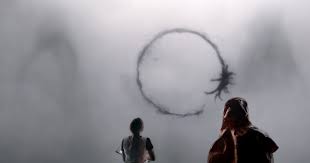
In terms of visuals, I can argue that I find the film quite lovely too.
If language is an expression of art, then imagery is, too. Consider the first, portentous visual of the alien ship in Arrival.  We are treated to an aerial view of Earth’s green, rocky landscape, and a bed of encroaching mist. Beyond and over the wall of mist is a giant levitating ship that looks like a pebble perched on its side. 
The ship, in fact, looks like a pebble you might choose to skip across a pond.  Its shape evokes the idea of a stone creating ripples in time, its influence expanding outward in all directions at once (past, present and future?)
Arrival is smart, emotionally-powerful, and beautifully-wrought. It doesn’t possess all the answers, but its brilliance arises in its ability to ask the right questions about the world, and our existence as human beings.
How would you approach translating this?
Arrival isn’t a movie about a linguist who saves the world, but about a linguist who comes to understand her own world in a way that makes her existence (and her daughter’s existence) not just bearable, but meaningful.
This is the great challenge for all of us, every day, isn’t it?

Movie Trailer: Arrival (2016)

Tuesday, March 21, 2017

The Films of 2016: Passengers


(Watch out for spoilers!)

It is ever so fascinating to consider how a big Hollywood film -- with just a small shift in emphasis -- can slip from one genre right into another.  

With a little clever tweaking and re-thinking, the beautifully shot and well-realized Passengers (2016) might have become a cinematic science fiction classic.  It features a memorable setting (a sleeper vessel in deep space), strong performances, and the kernel of a great, intellectual theme.

But in the end, it backs away from its best ideas at half-light speed.

Sans the courage to really explore its narrative’s themes, however, Passengers is ultimately just a bit more than a glorified (though enjoyable enough…) Hollywood romance.

That this expensive film from director Moten Tyldum and writer Jon Spaihts ultimately falls short of a lofty goal saddens me a bit, not because I dislike happy endings, or romantic films in general, but because Passengers, in its first hour, stakes a claim for legitimate greatness as science fiction.

The film concerns human nature, loneliness, and the way that people seek advantages in all their relationships.  Passengers is a story about love, for certain, but one about how, ironically, love can be a very selfish, hurtful thing in certain circumstances.

After contending with these worthy ideas, Passengers all but abandons them in its rock’em, sock’em third act, turning to action tropes and a romantic playbook that supports the apparent necessity of a conventional ending.

It is a long-standing rule in big-budget genre pictures that a climax must end with uplift and excitement, not reality, or emotional truth. 

That necessity to be “happy” harms Passengers, transforming this work of art from an amazing experience to, simply, a better-than-average one.  The film is not bad, for sure, but ultimately it disappoints because it gets so close to being something more than a romantic vehicle for two attractive, currently popular stars.


“I woke up too soon.”

In the future, a giant spaceship called the Avalon carries a crew of 258 and 5,000 passengers as it treks towards “the jewel of the occupied worlds,” the natural and unspoiled Homestead Colony.  All those aboard the huge vessel are asleep in individual hibernation pods, and a complex web of ship’s systems tends to their well-being.

After Avalon’s run-in with an asteroid belt, the ship begins to malfunction, and the ship’s computer seeks to restore balance to its damaged network of operations.  In one hibernation bay, Jim Preston (Chris Pratt), a mechanical engineer, awakens suddenly.  He finds that he is the only person conscious on the ship, and that the Avalon is still a full ninety years distant from Homestead II.

Thus, Jim will spend the rest of his natural life alone, on a hunk of metal, in the middle of nowhere.

At first, Preston turns all of his intelligence towards re-activating the hibernation pod. When that endeavor fails, he attempts to send a message to Earth, only to learn that he won’t receive a response for 55 years.  Jim also can’t contact the sleeping crew, because the door to that section of the ship is hermetically-sealed, and impregnable to drill, hammer, and saw.

Preston attempts to keep himself occupied for a ime by watching movies, playing basketball, dancing against a holographic game, and visiting with the ship’s android bartender, Arthur (Michael Sheen). But after a full year, he grows despondent and contemplates suicide.

And then, Preston sees Aurora Lane (Jennifer Lawrence) in cryo-sleep. He reads all about her in the ship’s files, and watches videos of her, as well. She is the daughter of a famous writer, and a writer herself.  Preston reads her books and then falls in love with her. 

He struggles mightily with what to do, but ultimately decides to awaken Aurora, an act which will end his loneliness but condemn her to his fate; 90 years on a hunk of metal traveling the stars.

Aurora awakens unaware of what has occurred, and Preston lies to her, telling her that her pod must have malfunctioned too.  As they get to know one another, Aurora and Preston fall in love.

Then one day, Aurora finds out the truth, even as the ship’s systems continue to malfunction…


“We’re passengers. We go where life takes us.”

Before I write about why I believe Passengers ultimately misses its mark, I want to discuss how terrific the first act is.

In short order, we meet Jim -- a hollowed-out looking Chris Pratt, who has gone too far losing weight -- and come to grips with his situation.  He is alone, with no way to talk to anyone, and no way to restore his hibernation pod.  Jim realizes that he will die of loneliness if he doesn’t do something, and then grapples with a moral decision. 

Should he condemn a woman that he has fallen in love with to his fate? Can he live with himself if does that? Can he survive without doing that?

I love that a movie as big, complex, and technologically-based as Passengers is turns all of its drama on one human decision.

I’ll also say this, I am ashamed of my fellow movie critics for their lack of empathy in reviewing this movie.

Many of these reviewers actually termed Jim a “stalker” and said that he was creepy and perverted for wanting, simply, companionship, and seeking to find that companionship with Aurora.  

Let’s review the facts again: Jim is alone, looking at a lifetime of isolation, and he makes a terrible, selfish mistake. But he is not a stalker, and the movie doesn’t advocate his actions, either. Jim is a man driven to the brink of suicide, who is looking for any tether to keep him alive.  That doesn’t make what he does right in any sense, but it makes him human.  It makes him one of us.  We are all flawed, and we all make mistakes.

Let’s cut through the I’m-taking-offense-because-he’s-a-stalker bullshit and face facts. All of us seek advantages in our relationships all the time, fair or not.  It’s not like Jim is alone in making a bad choice, and then lying about that choice.

That’s human nature.

We use what we are given or what we have, to get what we desire. The heart wants what the heart wants, and it’s not always right, or ethical. People cheat, lie, color the facts, and deceive to maintain relationships that are important to them. It’s a fact of human nature, and Passengers absolutely gets it right.  A good person, Jim, does something immoral and unethical, because he is, purely and simply, desperate. We can feel compassion for him, even without approving of his choices.  Calling him a stalker is snarky, and wrong, and suggesting that Passengers approves of his behavior is a totally incorrect reading.

There’s a powerful scene here wherein Jim nearly attempts suicide. All he has to do is push one red button. The scene is not powerful because of his attempt, but because of what happens next.  He catches himself, realizes what he is capable, and grow scared. He flees the airlock, terrified of what he is capable of.  He is scared…of himself.

Again, this rings very true, and suggests, once more, that Jim is a fallible, real person not a screenwriter’s cipher.

And what about love?  Jim does what he does, he says, because his in love with Aurora.

Love, we all know, is a powerful emotion. And it isn’t always hugs and puppies.

Love is selfish.

Hence jealousy.

Hence crimes of passion.

Love drives people to do things that give them the advantage in a relationship, but which -- from the comfort and distance of our judgment -- we gauge as unethical.  The movie makes it plain that Jim falls in love with the (improbably named) Aurora Lane not because of what she looks like; but because of her books; her personality, her spirit.

That doesn’t give him the right to ruin her life, or “steal” her life, as Aurora says, in any way, shape or form.  But it’s not just like he stalks her based on her looks, or a desire for sex. 

I would argue that Passengers is quite unblinking and truthful about human emotions, and the need for companionship in its first act. 

And I would simultaneously argue that it would have been a better movie had it stuck to this idea instead of veering into Hollywood conventions. There would have been a way to do it, to make a statement about human nature.

How?

Passengers should have had the courage to let Jim die in the final act, saving the ship (instead of being rescued by Aurora).

I would have Jim die in the climax, in an act of redemption (proving that he made a terrible choice, a terrible mistake, with Aurora, but is not a bad person, overall).  And then, I would have set the epilogue of the film exactly one year later.

In that coda, we would have seen a hibernation pod opening with a man inside. He would wake up, confused and scared.  And then he would randomly happen across Aurora, who was already awake.  

We would understand from this encounter that she awakened him, as she was awakened by Jim, because she too was impacted by the heavy gravity feelings of loneliness and despair that Jim felt.

She is human too, and -- if Jim died -- she would have had to fight the same feelings, and go through the same decision process that he did.

I doubt she would have decided differently.

Why?

Back to Human nature!


Human beings are naturally selfish, in some sense. As reported in Scientific American Mind (Matthew Robinson; 2014): “instances of selfish behavior also abound in society. One recent study used a version of the classic Prisoner's Dilemma, which can test people's willingness to set aside selfish interests to reach a greater good. After modeling different strategies and outcomes, the researchers found that being selfish was more advantageous than cooperating. The benefit may be short-lived, however.

If we consider Jim again, we see that he is not a stalker, but that he does make a selfish decision when he is weak.

But that doesn’t tell the whole story of the character. He is also altruistic, and thinks of the community, at times, too. He risks his life, finally, not for Aurora, necessarily, but -- specifically namechecked in the finale -- the 5,000 sleeping beauties in hibernation.  Again, this is also human nature. Sometimes we think of ourselves first. But sometimes we are able to rise above that, and think of the well-being of the entire community.

It is natural (and human, too), that Aurora rejects Jim after learning that he manipulated her, and lied to her (on more than one occasion). But to pretend that Jim is just a stalker “on the make” is so untrue to his character in the film.  Passengers could have made this point in a superior fashion if Aurora found herself having to make a choice about her future too

Ninety years alone? Or share the misery, and wake up another passenger?

Instead, Passengers settles, at the end, for some uplifting schmaltz about the life Jim and Aurora ultimately share, before dying in transit to Homestead II. 

They live a long, fruitful, productive happy life.

I submit that this outcome is unrealistic, given the situation that Jim finds himself in (vented out a tube, blown into space, in a damaged space suit…) and untrue, even more so, to the themes of the movie. 

We actually aren’t just passengers, going where life takes us. On the contrary, we are flawed people like Jim, having to make decisions on a moment-by-moment basis, and hoping for the best.  The movie is about a man who considers himself and what he wants, first, and then realizes just how wrong he was…and redeems himself.

The truth of human nature would have been validated if Passengers ended with a despondent Aurora, making the very same choice that she punished Jim for. 

What would she have realized?

We are social animals. We can’t live alone.  And killing ourselves is against our nature too, in many situations.

Consider that, according to Pascal Vrticka at The Huffington Post: “The reasons for the evolution of the human social brain are not yet completely understood. There is, however, growing consensus that two processes likely played key roles in triggering the observed dramatic increase in brain, and particularly neocortex, size. These were the development of (i) socially monogamous pair bonds, and (ii) paternal care / the involvement of the father in rising children (see here for additional information). Both of these processes offered additional defense mechanisms against infanticide and predation on offspring. In a nutshell: if the father stuck around long enough with his partner, and vice versa, the common children had a higher chance of survival…and that is what ultimately counts in evolution: promotion of survival of the fittest.”

In other words, Jim is driven both to be selfish, and to want companionship. His (unethical) action to awaken Aurora is one that stems from both aspects of human nature.

I wager everyone reading this blog would do the same thing in Jim’s situation, and the false outrage over his actions says more about our society’s lack of empathy (and self-awareness) than it does about Jim, himself. 

He made a terrible mistake, and came to regret it. Then he tried to make up for it.

I find that Passengers is actually incredibly smart, at least to start, in terms of how it addresses the reality of human nature and Jim’s big choice.

It is just too bad that the movie also makes a bad choice at the very end. Finally, it succumbs to the need to be a commercial “hit,” and becomes a happy-ending romance in which all is forgiven, and which Aurora learns nothing from Jim.

After so much careful set-up and canny insight into what makes us tick, Passengers chooses, finally, to be a stupid romance, instead of a smart science fiction picture. 

I, for one, can’t go along on that particular ride.

Movie Trailer: Passengers (2016)

Tuesday, February 07, 2017

Movie Trailer: Ouija: Origin of Evil (2016)

Tuesday, January 31, 2017

Movie Trailer: The Disappointments Room (2016)

Tuesday, January 24, 2017

Movie Trailer: Train to Busan (2016)

Tuesday, January 17, 2017

The Films of 2016: Morgan


[Beware of Spoilers]

Morgan (2016) is the directorial debut of Luke Scott, Ridley Scott’s son. Genre maestro Ridley Scott is the film’s producer. These facts prove illuminating in terms of a deeper understanding of this particular science fiction/horror film.

Where other critics have made invidious comparisons between Morgan and Ex Machina (2015), or Morgan and Splice (2010), the films to discuss here are likely Blade Runner (1982) and Prometheus (2012).

In short, Morgan concerns mankind’s unease with his/her own creation: artificial people.  That’s a recurring Scott theme; one you can see through several of his genre master works (including Alien [1979]).

Whether we choose to term these unusual beings replicants, synthetics, or hybrids is largely immaterial. Nomenclature aside, they are children of humanity and yet, at the same time, not fully human. And even though they are “made” by man (specifically, corporations), man never quite trusts them, it seems.

In fact, as Blade Runner, Prometheus and Morgan make plain, man deeply and instinctively fears this brand of progeny. After completing the act of creation, it seems, mankind stands seems ready to commit an act of destruction, snuffing out that which he has given birth to.

In one way or another, Blade Runner, Prometheus and Morgan all revolve around mankind’s inability to accept his artificial child/creation as his own heir. In all three films, man has played God, but doesn’t seem to want to parent.

In all three films, parental figures also prove cold, emotionally unavailable, and largely self-absorbed, leaving the (artificial) child without the guidance he or she needs to mature adequately. In some circumstances, the children turn violent towards their parents because of this “void” in parenting.

Morgan is a fascinating and compelling genre film, but one made all the more so if the viewer weighs it as a crucial piece of a multi-decade Scott cinematic trilogy concerning mankind and artificial intelligence; an unofficial franchise dedicated to exploring the relationship between man and a being who, finally, could -- one day -- replace man.

Ex Machina was terrific (as was Splice, actually…) but it’s almost a shame that Ex Machina remains so close in the memory for so many. Some critics want to hark back to that particular film to put down Morgan as somehow being derivative or inferior. Instead, Morgan is merely the latest work of art by producer Scott to explore the parental dynamic as it applies not to biology, but an uncanny mixture of technology and biology.

These films ask us, explicitly: can we love that which looks like us, but is not, finally, a reflection of us, in terms of psychology?

Morgan reminds us that humanity cannot yet see an artificial child (or replicant one) as truly belonging to him; and thus truly possessing the same rights and privilege we reserve for ourselves and fellow organic creatures.

Instead, humanity views these beings as ones that we created, but which are less evolved, somehow, than we are.

If one gazes at Morgan is a prequel to Blade Runner and Prometheus, the film veritably opens up as a subject of analysis, with scenes that resonate beautifully across the “unofficial” Scott trilogy.


“Above all, preserve the asset.”

After a trademarked artificial/hybrid human – a teenage girl named Morgan (Anya Taylor-Joy) -- attacks one of the scientists caring for her, Dr. Greiff (Jennifer Jason-Leigh), an investigation commences. 

A no-nonsense risk assessment specialist, Lee Weathers (Kate Mara) is sent to Morgan’s remote, countryside facility on behalf of the corporation, SECT, to determine an appropriate course of action.
Lee’s mission may prove to be one of containment, shutting down Morgan’s experiment, or one of assassination, Dr. Greiff fears. Lee is noncommittal about her ultimate course of action, choosing to interview the scientists and staff about Morgan’s violent “temper tantrum.”

Another specialist, Dr. Shapiro (Paul Giamitti) also arrives at the installation to conduct a psychological evaluation of Morgan. He pushes her during that evaluation, causing a repeat of her violent outburst…


“There was joy in her heart before we shoved her back in that box.”

Ridley Scott’s Blade Runner (1982) opens with a scene in which a law enforcement official administers a test, Voight-Kampff, to a replicant. It is, importantly, a psychological test. And it provokes a murderous response on the part of that replicant.

The central scene in Morgan deliberately reiterates this dynamic.


The arrogant, imperious Shapiro -- another establishment figure, like the blade runner -- tests the unstable artificial person, causing an explosive response by doing so. In both cases, the forces of authority trigger the key weakness of the child-like individual, a vulnerability based on psychology. 

The replicants and Morgan don’t “know themselves” and are unsure of “human” matters, like friendship, social connection, family, and parents.  In both cases, an attack on this psychological weak link results in the artificial person resorting to physical violence.

The scene in Morgan, however, plays like bullying. In Blade Runner, we are shocked by the replicant’s resort to violence. In Morgan, we are shocked that the artificial person holds back as long as she does.

Another connection to Blade Runner is revealed only in Morgan’s final sequence. Suffice it to say, Morgan gets the ending that Ridley Scott had hoped to give to the 1982 film, but was not able to, for reasons of commerce.

Specifically, the hunter or prosecutor of the artificial person is revealed to be an artificial person too. Once more, this revelation suggests two things: psychological instability on the part of this new race (and child of man), but also a second-class status for these people. They are assigned tasks no others would want, including the prosecution (and assassination) of their own kind. They have become murderous servants of man, killing their own brothers and sisters.

Morgan becomes even more intriguing after a second viewing, when one understands the film’s outcome, and watches how the second artificial person navigates matters such as sexual attraction. On retrospect, the responses are completely understandable, given a synthetic person’s lack of understanding of or familiarity with human nature, and human interaction.

As for Morgan herself, she has much in common with both Roy Batty (Rutger Hauer) and Prometheus’s David (Michael Fassbender).

Like Batty, Morgan possesses a survival instinct, and the inability to control bouts of rage. 

Like David, she is both obsequious to her human “friends” and, simultaneously, able to betray them for an agenda if necessary.  Like David, Morgan also surrounds herself with human things: human music and art, in particular.  If David has a fondness for cinema, Morgan does for opera.

Blade Runner, Prometheus, and Morgan also feature three amoral corporations (Tyrell, Weyland Industries, and SECT), and three versions of “cold” parents.


In Blade Runner, Tyrell has given no consideration to his replicants, and the fact that they might wish to outlive their four year life-span. He is a father who has created life, but does not care about what happens to that life once it is out in the world.

Weyland, in Prometheus, is not much better a father figure. He treats David like the “lesser” child in his family, noting -- in public, no less -- that David possesses no soul. Also, he ignores David’s search for meaning in life, in favor of his own search for meaning. As the parent, Weyland puts his needs first, and expects David to put those needs at the top of his list as well.

And finally, we have the character that Morgan identifies as her mother, in Morgan: Dr. Cheng (Michelle Yeoh). Dr. Cheng, in the past, has murdered her own “children” (synthetic beings) when they became dangerous. When Morgan becomes dangerous too, she falls back on the same behavior. She shows no emotion, no caring, when she orders Morgan to be executed.  In fact, Cheng rejects Morgan completely, especially after Morgan has the audacity to call her what she is: “Mother.”

The three films in this unofficial trilogy all contend with one core idea: the meaning of life. Is it any different for synthetic beings than it is for organic ones?

Roy Batty wants to outlive his termination date, so that the things he has seen -- the memories he has accumulated -- aren’t simply lost, like tears in rain.

David wants to understand why he was created. And if he can understand why the Engineers created mankind, he will be one step closer to his answer. 

And Morgan is learning to become herself, intriguingly, through her interfaces with nature, in the wild. She rebels in the first place because her outside time, in the woods, is taken away. She cannot feel the same freedom to explore herself in the installation, apparently. Her closest friend is Amy (Rose Leslie), her “eco therapist,” who introduces her to the larger world, beyond her cell.

All three characters -- Batty, David, and Morgan – are very acutely on a journey of self-discovery; of transcending their built-in limits. In all cases, they are actually impeded by their creators/parents, who don’t seem to believe they are unique, sentient life forms.  Instead, these adults would rather destroy them for making a mistake than help them learn from that mistake.

Batty and Morgan, at least, don’t get second chances. They step out of their “role” and are hunted and exterminated.

In some senses, the theme of Morgan is similar indeed to that which we saw in Splice. Basically, it goes like this: we are ultimately treated by our children in the same manner that we treat them.

I feel that this too is a lesson, overall of the unofficial Scott trilogy. It is clear that corporations like Tyrell, Weyland and SECT will create artificial life, and trademark it. As they do so, they will also attempt to abrogate the rights of those they have created, either with mandatory termination dates, or through behavior which renders them second class citizen, and subject, finally, to bigotry. In Morgan, Lee notes on at least two occasions that Morgan is not a “she” and but rather the property of the corporation, lacking human rights.

The “children” in these cases are all treated badly, and -- surprise, surprise -- treat their parents badly as a result.  They learn from their relationships with their parents how to be duplicitous, how to be violent, how to kill.

Morgan is a coming of age story for a synthetic person (or persons, in the final analysis). Morgan’s uncertainty and instability mirrors some of the uncertainty and instability that human adolescents feel as they take the final steps before “growing up.”  This is significant, because everything about Morgan -- from her attire (hoodie, especially) to her attitude -- is familiar. She is the rebellious child/teen, testing the limits of the world around her.

Technically, Morgan is an accomplished work. The film features fine performances, especially from Kate Mara, and is suspenseful, and exciting. You may figure out the final twist in the film before it is revealed, but it doesn’t take way from the action, or horror. Luke Scott does a great job using visual rhetoric, conveying through imagery the point of the narrative. He does much here with reflections, and Lee and Morgan balanced against one another in the frame, mirror-images.


But Morgan succeeds best, I would argue, when one places it in the context of its sister films, Blade Runner and Prometheus. 

All these films remind us to treat our (eventual) artificial children with a sense of responsibility but also humility.

As J.F. Sebastian would no doubt remind us, there’s much of us in them.