Sunday, December 10, 2023

30 Years Ago: "Eve" (The X-Files)


“Eve” is our X-Files episode this week as we continue to celebrate the 30th anniversary of the classic Chris Carter TV series.  This eleventh episode of the fledgling series was penned by Kenneth Biller and Chris Brancato, and directed by Fred Gerber.

“Eve” commences as Scully (Gillian Anderson) and Mulder (David Duchovny) fly to Greenwich, Connecticut to investigate the death of a suburban man who was drained of blood.  Mulder suspects alien abduction is behind the murder, citing examples of cattle-mutilations with a similar modus operandi.  At first, the only witness, young Teena Simmons (Sabrina Krievans), seems to obliquely corroborate this theory.

When an identical murder occurs in Marin County, California, however, and the only witness is a dead ringer for Teena, little Cindy Reardon (Erica Krievans).  Scully and Mulder realize that they are looking not at an alien abduction case, but a case involving illicit experiments in in-vitro fertilization.  

While Scully investigates the activities of a doctor named Sally Kendrick (Harriet Sansom Harris) at the Luther Stapes fertility clinic, Mulder learns more on the subject from his covert government informant, Deep Throat (Jerry Hardin).  

Deep Throat reveals a top-secret genetic experiment of the 1950s called “The Litchfield Project” that was designed to compete with a similar eugenics program in the Soviet Union.  The goal was to breed a new race of super-soldiers.  The American version of the project created a number of “Adams” and “Eves,” all identical, all incredibly-intelligent…and all homicidal.

After visiting with the incarcerated Eve 6 (Sansom Harris) at the Whiting Institute for the Criminally Insane, Scully and Mulder realize that Eve 7 and Eve 8 may still be free, and even attempting to kill Cindy and Teena, the grandchildren of the program, essentially. 

Unfortunately, their suspicions prove absolutely wrong, and Teena and Cindy prove to be far more cunning adversaries than either F.B.I. agent could have possibly predicted.


At the heart of “Eve” is a well-worn horror trope involving evil children.  In the 1950s, the movie The Bad Seed famously raised a crucial issue regarding diabolical children: nature or nature?  

Could a child be evil by dint of the genetic material passed on from his or her parents? Or did that evil arise out of the manner in which he or she was raised? 

The X-Files takes that notion a step further – and straight into the post-modern 1990s -- by noting that an evil child might actually be designed so by over-reaching scientists run amuck. Although the twins possess superior intellect and cunning, these girls were not gifted with a superior sense of morality, and that fact makes them monsters.

Didn’t the scientists ever stop to think about morality? How about mere emotional stability?

The 1990s was indeed a perfect time to re-visit the notion of evil children, and accordingly a few horror movies of the era did so, including The Good Son (1993).  The reason this issue was so timely a concern involves the development, in 1990, of the Human Genome Project, an initiative designed to map fully our DNA.  

In terms of the horror genre and its development, this scientific project was every bit as important, creatively, as was the Manhattan Project to an earlier era.  In both cases, creative artists explored the notion that “tampering in God’s domain” could effectively destroy mankind.  By harnessing the atom in the 1940s, and by mapping the human genome in the 1990s, mankind was opening “Pandora’s Box.”  The “real” monster in “Eve” is thus wanton genetic experiment, vetted without a controlling, moral authority. 


The Krievan twins portray Teena and Cindy here, and do a remarkable job.  They play their roles, at first, as though everything happening to the girls is observed from some great emotional distance.  They are disassociated from the horrific and monstrous things happening around them.  

Late in the episode, we understand that this distance arises from a lack of empathy.  The deaths of their foster-fathers means nothing to the girls, emotionally-speaking, and their almost blank facades embodies not shock, but mere boredom.  

In the finale, when the audience learns their true nature, the twins finally reveal a new aspect: childish glee in their anti-social activities. To the very end, Teena and Cindy try to manipulate others with their childish appearances.  “We didn’t do anything wrong,” they insist, “we’re just little girls…”

The distance between Teena and Cindy’s youthful appearance and their evil acts is one factor that makes this episode so chilling, and therefore so successful.  There’s something deeply disturbing about children who are disconnected from their emotions, and also, deceitful and manipulative.  

Again and again in the episode, Scully and Mulder make mistakes because they can’t quite reckon with the idea that these little girls could possibly be monsters.  They can’t make the leap that appearance isn’t reality.

Interestingly, “Eve” doesn’t end without an important, if brief glance towards the “nurture” end of the eternal debate about children.  Cindy’s mother, after learning of her daughter’s evil behavior, completely abandons her.  She cuts her off.  She rips up her photograph of Cindy and burns it in a fire.  This is not the act of a loving mother, even one whose child has acted badly.


Call this the Frankenstein Principle.  We make life in our own image, but when we don’t like that image, we dismiss that life as “monstrous.”  Suddenly, it’s not a part of the family anymore.  It can never be spoken of aloud…just burn all the photographs in the fireplace.  

This act or purging a family member, depicted in the finale of “Eve,” suggests that Cindy and Teena aren’t the only ones who lack empathy, and perhaps that “missing” factor is indeed a matter of nurture. 

If these girls had been raised in loving homes, would they have resorted to murder, even factoring in the genetic predisposition towards instability?  


In terms of the character development, “Eve” is a necessary piece of The X-Files puzzle for a few reasons.  I often read other critical evaluations of the series, and some reviewers have complained (loudly) that the series is not actually concerned with the science vs. belief battle, but rather with a strange kind of faith in which Mulder is always right, a priori, no matter what.  These critics see Mulder as unrealistic.  They term him infallible, always able to guess what is happening and deduce correctly the solution to a mystery. 

As a reviewer, I don’t see this as a legitimate complaint about the series, and could point to “Eve” as Exhibit A refuting it. 

Here, the episode begins with Mulder hell-bent on proving a case of alien abduction.  He discusses missing time (a call-back to the pilot episode), cattle-mutilations and the like.  He obsesses over the idea of a “red cloud” in the sky on the day of the crime.  Young Teena – sensing Mulder’s desire to reach a pre-ordained conclusion -- plays into his vanity and supports Mulder’s reading of the investigation.  She is doing this merely to trick him and throw him off the scent.

As the investigation unravels, Mulder realizes he is barking up the wrong tree, and drops his theory, as any smart investigator concerned with the facts rightly would.  The conclusion to draw here is that he saw a commonality between a contemporary case and some old case in his X-Files, but that the lead didn’t pan out.  

So, already -- just ten episodes in -- the series is proving that Mulder can be wrong, and in his zealousness to be right, even make mistakes.  This quality makes him a fallible and interesting protagonist, not the kind of “infallible” master detective I’ve seen him described as in other reviews. His viewpoint is not constantly validated. 

There’s also a very nice, very effective moment in “Eve” that plays upon audience expectations and desires regarding the Scully/Mulder relationship.  Scully and Mulder have “rescued’ the two girls, and are unaware of their true, homicidal natures.  They decide to take care of the girls, and drive them to their next destination.  On the long road trip, the girls need to use the bathroom, and Mulder, slightly annoyed, pulls over at a rest-stop restaurant. 

With a slight smile, Scully takes the two girls to the bathroom with her, while Mulder gets their order of four sodas.  While he uses the rest-room, one of the girls poisons two of the sodas, the ones meant for the F.B.I. agents.

There’s a great dramatic conflict in this scene between what Scully and Mulder (and a waitress) believe is happening, and what is actually happening. 

Scully and Mulder are knowingly playing Mom and Dad, and seem to recognize it…and even enjoy the roleplaying a little.  That waitress thinks Mulder is the twins’ dad, and says so.  

As viewers tantalized by the Mulder/Scully relationship, we too are pulled into this world of sudden parentage, though we know better.  Despite our knowledge, we are suddenly contextualizing these folks in terms of a “family,” something that has explicitly always been denied the original Adams and Eves.  

Then, of course, the illusion is shattered, and Mulder realizes at the last moment that the girls have poisoned the sodas.  It’s a wonderful moment when he realizes the truth, and realizes, fully, how successfully the girls can play on the illusion that they are made of sugar and spice and everything nice…plus, apparently, a healthy dollop of foxglove.

A tense, intriguing, and fun episode, “Eve” is another bonafide victory for the first season team.  In terms of The X-Files canon, it points towards the series’ obsession with genetic experimentation and research.  “Eve” is sort of the tip of that iceberg on that front, and the theme will return in a big way in later seasons, though in a more intimate fashion that affects Scully and Mulder directly.  

“Eve” thus represents a promise of things to come -- and another indicator of past government malfeasance -- rather than a direct connection to the overarching Mytharc.

Thursday, December 07, 2023

Wishing for a Sears Christmas Catalog


File this one under "the good old days."

Way back, almost fifty years ago, as the holiday season neared, department store giant Sears mailed out a mammoth Christmas catalog or “Wish Book.”  This was a hugely fat inventory of everything it sold, from appliances and clothes to toys galore.  

One of the Wish Books, the catalog from the year 1979, when I was about to be 10 years old -- was illustrated with the tag-line “Where America Shops For Value.”

Forget value, I just wanted outer space toys to play with.

The 1979 Sears Wishbook Catalog had ‘em too. 

From Page 613 thru 620 in that catalog, there was everything a 1970s space-kid could possibly desire: toys from Mego’s Micronauts, Buck Rogers in the 25th Century, Star Wars, and my favorite, Star Trek too. 

There were models, play-sets, toy action figures…the works.  I remember leafing through the pages, seeing one incredible toy after the other.


And the great thing about Sears was that it not only offered toys you could find elsewhere, in their stores, it also offered exclusive toys, like the Star Wars knock-off play-set called “The Star Fortress” (seen on page 617).  


I’ve covered this toy before on the blog, but the giant fold-out space base has a position of honor in my home office to this day.  

Look at the picture below -- it features Buck Rogers ships and characters on and around the Star Fortress, and thus suggests a whole new, exciting adventure for those characters.  For me, at age 10, that was an irresistible thing to imagine.


Another Sears exclusive from the same era (although it may have been first sold in 1978…) was the Star Wars “The Cantina Adventure Set” (not to be confused with the Creature Cantina).  

The legend in the catalog read “If you stop at this cantina, watch out for strangers.”  And it came with four of the strangest strangers (in action. figure form) you could imagine.


This diorama of the exterior of the Mos Eisely drinking hole came with four new Kenner action figures that were unavailable elsewhere: Greedo, Hammerhead, Walrus Man, and Blue Snaggletooth. The Blue Snaggletooth has become a highly-prized collectible, so much so that collectors pay hundreds of dollars for an original, and even purchase custom reproductions.

Without me knowing, my Mom ordered me the Cantina Adventure Set, and I loved it.  I must have played with it for days, weeks, months...


I kept it intact until about seven or eight years ago when the diorama base finally ripped. But it’s the item I remember most from the catalog.  

After I received the toy in the mail, I would play adventures with Sheriff Snaggletooth and Deputy Hammerhead. They’d drive the land speeder around Mos Eisely, catching the gangsters Greedo and Walrus Man.

Back in the 1970s I loved coming home from school and finding in the mail either the next week’s issue of TV Guide (so I could see if Star Trek or Space:1999 was playing), but it was a day of absolute delight and toy nirvana when the Sears Wish Book arrived.

I still remember the feel and scent of the Wish Book catalog's pages.  It was the scent of anticipation, and imagination, you might say.

I remember poring over those toy pages too, imagining adventures with Buck Rogers, the Micronauts, the Cantina, and that Space Fortress.

Today, E-Bay gives us the chance to find these lost treasures and relive the past (often at a steep price), but there was just something special about that catalog showing up in your mailbox after school....

Monday, December 04, 2023

20 Years Ago: Big Fish (2003)


"A man tells his stories so many times that he becomes the stories. They live on after him, and in that way he becomes immortal."
Big Fish (2003)


Tell me, which alternative fosters a better understanding of your life experience: the bare bones truth, or an embellished, "flavored" version of the truth that contextualizes you life as a great story, one with heroes and villains, winners and losers, and a beginning...and inevitable end?  

Tim Burton's 2003 fantasy masterpiece, Big Fish beautifully and emotionally makes the case for the latter option.  

In real life, we're each of us but a little fish (only 1 out of 8 billion...) swimming about in a global sea.

But in our imaginations -- and in our private family circles -- we're all big fish: colorful personalities who loom large in the stories of our sons and daughters, and our Moms and Dads. In our private worlds, we're important, nay the most important figures.

The first shots and compositions of Big Fish lead the viewer down into the sun-drenched water of a fresh-water river as a big fish swims alone there, and this inaugural visual perfectly captures the movie's most important conceit: the idea that we all make ourselves and our lives out to be "big." 

Sometimes we even do so at the expense of those we love, who risk becoming mere "context" in another person's epic poem.  

The big fish swims alone, after all.

Of all Tim Burton's films, I readily confess that I find Big Fish the most emotional. Maybe because it's a story of fathers and sons learning to understand one another. Perhaps because it concerns the inevitability of death, and the passing of the generations (as well as the storyteller torch).  

Regardless, this film hits me on a very personal, very intimate level every time I see it. I had an important person in my life until 2010 who was, like the movie's Ed Bloom, a masterful and ridiculous storyteller.  He was a man who had (so he claimed...) met and conversed with Colin Powell and Albert Einstein, and who was biologically related both to General Robert E. Lee and Katie Couric. He absolutely never met a fish story he didn't like. The man could put you on with the straightest of straight faces, and in some moments, could even devise for you what your life story should be.

This larger-than-life figure spoke in the most idiosyncratic and singular manner I've ever known,  replete with lots of extremely colorful metaphors, and he passed away following the sudden onset of a terminal illness. And yet -- in large part because of his incomparable manner of expressing himself and telling his stories -- he remains an everyday voice in my head. Today, he's an indelible fixture there, and sometimes, almost against my will, I still hear his unique voice, and his flamboyant way of communicating. His vocabulary alone -- his bizarre lexicon -- seems often to be on the tip of my tongue. 

I don't always know why.

Now, I don't want to romanticize this man and turn him into a saint, because that description does no one any good. We're all but human beings, with flaws and foibles. But there was an element in this man -- as there is in Big Fish's Ed Bloom -- that raises questions; that fascinates. He turned his stories into great adventures, all while leaving the real man, the truth itself, opaque. His crazy stories and jokes cloaked...what precisely?  

So, in one sense, I knew this man and his unique mode of expression deeply for over twenty years, and yet in another very basic sense, I didn't know the real man at all.  

At least not until I understood the seemingly impossible: that the stories, jokes, and tall tales were the real man. They were part and parcel of his individual and mental gestalt, and you couldn't separate him from those tall tales.

I don't usually write here about how films affect me personally.  I generally don't like that approach in film criticism, preferring to rely instead on examinations of compositions and leitmotifs, and so on. 

And yet I can't honestly deny that Big Fish hits me in a close place. It seems so true to my own personal experience that I suppose I have a hard time separating Will Bloom's story from my own experience. What I can declare with conviction is that Big Fish is the most heartfelt and touching of Burton's works. Perhaps not the best (a title I reserve for Ed Wood or perhaps Edward Scissorhands), but certainly the most emotional.

As Clint Morris wrote of the film in Film Threat: "It takes those oddities and twists that many don’t usually go for if they’re not a big fan of the director and interweaves them into a tale that’s so enriching, so heartwarming, so funny, so touching and so breathtaking, you’ll wonder why the king of wackiness didn’t branch out sooner." 

And Peter Travers, writing for Rolling Stone, insightfully noted that Burton had finally hooked the one that got away, in the process deepening his "visionary talent."  

I agree with both those conclusions.  If I had to select one Tim Burton film for people who generally don't like Tim Burton films, it would be Big Fish.

"It doesn't always make sense and most it never happened..."


Big Fish is the story of Ed and Will Bloom, estranged father and son. Ever since he was a little boy, Will has heard his father tell crazy stories about witches, giants, werewolves, Siamese twins, and mysterious ghost towns.  

At first, Will believed the stories were wondrous and magical, but over the years he began to wish that his father would drop the fairy tales and just start relating to him as a real person.

Now, as an adult, Will learns that his father is on his death bed.  He asks his father to tell him one true thing before he dies, but his father insists that his stories are the "truth" about his life.  "I've been nothin' but myself since the day I was born, and if you can't see that it's your failin', not mine," he tells his son.   Will finds this hard to accept, especially as he prepares to become a father himself for the first time.  

After Ed relates his life story to Will's wife, his health declines further. On the verge of dying, Ed asks Will --- his only son - to tell him how his story ends.  

Will complies, and in doing so, gains a new insight into the man who raised him, as well as the importance of storytelling in all our lives.

"Dying is the worst thing that's ever happened to me."


In some senses, Big Fish is very much about a blowhard, as Roger Ebert suggested in his review of the film. It's uncharitable, but true. Ed may have led a big life, but he also has a big mouth.

In fact, Ed Bloom (Ewan McGregor/Albert Finney) has so transformed his life into a series of weird and wonderful stories that his grown son, Will (Billy Crudup) isn't sure he even knows his father. That's a terrible thing.

And yet the movie ultimately sides with old Ed. He isn't viewed with harshness by Burton. Instead -- in the passing of the generations -- the movie reminds us that each storyteller will have his day. 

Ed has had his day, and now Will's day looms. At the movie's end, it is Will who tells the "end" of Ed's story, and who recounts for his son a lifetime of adventures. It's important too, that Ed is never portrayed as a liar. Instead, as his funeral reveals, he is just a serial exaggerator: one with a foot in fact, and another in colorful fiction. By Ed's reckoning, Will tells stories with "all the facts, none of the flavor," and that's just not his way.


Some reviewers have been hard on Big Fish, noting that it never really considers the son's point of view or feelings. 

There may be some truth to this perspective, but in the final analysis, Big Fish does right by both characters.

We follow Ed from birth to childhood illness, from his first love to, ultimately, his death. In Ed's life story, we readily detect his spring and summer (his youth), and even his autumn and winter (his old age and demise).  

Notably, Burton makes certain that the natural landscape echoes each one of these spans. As a young man, for instance, Ed sees Spectre as a beautiful, idyllic town, well-painted and carpeted in lush green grass. As a middle-aged man, however, Ed returns to the town and finds it paved over, browning, and in a state of decay. You can't go home again.

Similarly, when Ed courts the love of his life, their romantic love is expressed in the vibrant yellow of endless daffodils. As death approaches, such blooming (and remember his name is Ed Bloom...) has ended, and all the trees are stark and naked, bereft of leaves. Winter has come for Ed at last.

Will certainly represents an important chapter in Ed's life, but in a sense, his "part" of the story only really becomes important in the closing chapters.  Ed can't write his final sentences himself.  That's why he needs his boy. Ironically, it is to contextualize his life, not vice-versa as Will initially feared. 

And really, that's always the job of those left to carry on after losing a parent: to put the actions and span of the dead into some kind of meaningful order.

As it turns out, Ed's strange stories become important to Will. They represent the old man's legacy and gift, a colorful way of looking at the world and remembering Dad.Ed wanted Will to listen to his stories for a reason, and not merely to entertain him. Someday, the boy would need to know the details so he could take ownership of Ed's story and continue it for the next generation. Again, this is as much about Will as it is about Ed.

In life, we are all part of this cycle. We all heirs to a story, caretakers of that story, and then givers of the story -- after we've had it and protected it for a lifetime. Big Fish gets at this idea in a more beautiful and imaginative fashion than just about any movie I've seen. The imagery is enormously affecting, particularly as the strong, healthy Will picks up his infirm, dying father and lifts him into the air -- as if carrying him like a baby -- for one last adventure, one final tall tale.

There's something so innocent and beautiful about this image. The boy who was once held by his father's strong arms now lifts up his sick dad -- negating the realities of gravity -- and cares for him as he was once cared for.  This image gets me every time: the son becomes the father; the father the son. The roles reverse, and time marches on.


Big Fish offers other narrative and visual glories as well. I love the use to which director Burton puts Helena Bonham Carter here, essentially making her every "other" woman figure in Bloom's life. She is both a terrifying (if friendly...) witch and a young, innocent girl, all grown up.  

And I also appreciate another powerful image: one of a fork in the road that seems to literalize the Robert Frost poem about the road taken and the road not taken. Again, this fits in well with the story's meditation on the seasons of life, and the choices we make. Our destiny is sometimes as simple as deciding which path to follow.

Big Fish is filled with incredibly whimsy and magic, and yet, at the same time, the film seems to truly capture something essential about our mortality, and the mortality of those we love.  

We can view tall tales as merely "amusing lies" from someone we love, or as the seeds of immortality itself, a renewable source of energy that we can share with our children and our grandchildren.  

I wrote above about the man in my life who was a lot like Ed Bloom, right down to his southern heritage  He saw Big Fish back in 2004 and loved it. He especially loved that Bloom's stories were ultimately validated...that there was a degree of truth in his musings about giants and witches and werewolves, and so on. I get that now. In understanding our own lives, the stories we tell do become true to us, at least after a fashion.

It may be "impossible to separate fact from fiction, the man from the myth," but when you meet a storyteller of such caliber, you never forget his words or his life.  It doesn't always make sense and "most of it never happened... but that's what kind of story this is."  

I'm glad that Burton decided to tell this story.. It makes me want to hold my 17-year old son in my arms again.

Sunday, December 03, 2023

Reflections on Turning 54


On the eve of 54...

Today is my 54th birthday, and I am so glad to be seated here, in front of a crackling fire, under a Enter The House Between-branded blanket (and two napping cats...), writing.

I read a piece at The Guardian about the age of 54, and it says, according to a Norwegian study, that fifty-four is the age that people lose their "get-up and go," meaning their "passion and grit."

So, From ages 18-53, good!  

Ages 54 and up...not so good.

Now, obviously, I am only a day into my 54th year, but I beg to differ with this conclusion. 

First, I still feel 30 years old.  I don't look 30 years old, but in my brain...that's me, a thirty-year old kid.

And I think I'm in pretty good shape. 178 lbs. My back doesn't hurt, and all my parts still work, at least for now.

Sure, I have lost most of the hair atop my head, as you can see from the picture above, as well as the color (formerly red...) in my beard.  

Yet what I hopefully haven't lost (yet) is my passion and grit. 

I'll keep taking the temperature on this, but I don't anticipate losing either between now and December 3, 2024.

According to the study, "you may well have a high score for grit and a low one for passion, or vice versa. These intertwined qualities are needed for high achievement, but the over-53s don’t seem to possess them as a package..."

So what keeps people young? 

What keeps up that level of grit and that passion?

What keeps me young?

Doing what I love, of course!

A short list, on the occasion of my 54th birthday:

- Playing video games with 17 year old son, Joel. We're off to Mario Kart here in a few minutes. He routinely kicks my ass, but it's so much fun anyway. 

- Spending time with my beautiful wife, Kathryn, of nearly 30 years, laughing and enjoying each other's company. This is the year we will take Tango lessons together!

- Getting to see my beloved parents, who have plenty of get-up and go at Ages 78 (my Mom) and 79 (My Dad). 

- Writing the NEXT season of Enter The House Between, my audio drama with editor Tony Mercer and an amazing cast and crew.

- Reading an Enter The House Between novella penned by the incredible Kim Breeding (who also stars in the audio drama).

- Teaching Public Speaking and Communication to my students, and watching them overcome their social anxiety and PSA to deliver really great (and often heartfelt and funny) speeches.

- Writing the next Horror Films Of Book. (The 2010s in this case)

- Starting a brand new novel with my friend and co-star, Alicia Martin!

And these are the things that just rolled out of my brain.  

That covers passion, I guess.

And grit? 

That quality is defined as "resolve," or "strength of character." 

I'm probably not the person to make that determination about myself, but I'll say this....the people I work with and spend time with say I am tenacious.  Well, they actually say I am relentless (and irritating), so hopefully I have the grit part of the equation covered.

So, at 54, my message is simply this: don't let anyone define you. Don't let anyone tell you your best days are behind you.  

That you are old, and fading away.

The best is yet to come.

Friday, December 01, 2023

40 Years Later: Scarface (1983)


What does the American Dream mean to you?  And how far would you go to pursue that dream? 

More to the point, when does someone else's relentless pursuit of the American Dream become a nightmare for the rest of us?

In other words, when does the personal journey from "rags to riches" become so consuming, so vital, so paramount that it actually destroys the social contract, threatens the larger sense of community, and leaves accepted morality shattered, in pieces on the ground?

And -- importantly -- have we reached that point in America yet?

These still-relevant questions beat restlessly inside the turbulent, angry heart of Brian De Palma's radical, firebrand gangster movie Scarface (1983), a film that today has become virtually synonymous with the excesses of the 1980s and, in particular, the beginning of the "greed is good" era in American culture. This De Palma film continues to be germane in 2023 because -- to a very large and therefor disturbing extent -- we still live in Montana's culture. And in some senses, it is worse than ever.

Scarface is a remake of the beloved 1932 Howard Hawks film of the same name (though subtitled "The Shame of a Nation"). Yet De Palma and screenwriter Oliver Stone have not slavishly re-fashioned a classic film with their 1983 version of the material. 

Instead, they have created a fiery, subversive, original commentary on their times, the 1980s. Although their title character is a gangster and drug dealer named Tony Montana (Al Pacino), De Palma and Stone take great pains to contextualize Montana as something else entirely: a modern, 1980s business man. Accordingly, Scarface is virtually brimming with pointed references to capitalism, communism, and the milieu of big business. With capitalism-gone-wild as their deliberate subtext, De Palma and Stone reveal how excessive greed eventually separates the film's grasping protagonist from his friends, family, and from his culture, even. 

Tony Montana's excesses become so...excessive, in fact, that his gold-plate home decorations would likely cause even Tyco's Dennis Kozlowski to blush. The neon production design of the film is extraordinary and effective because it strengthens and supports the notion that Tony observes no limits. Not in his personal appetites, not in his material wants, and certainly not in his morality, though, in his defense, he does not allow an innocent child to die late in the film during a bombing mission. Perhaps because that child makes him think of the child he and Elvira have never been able to conceive.

But when one taboo is broken during the blazing rise to "success," the film seems to advise us, it's impossible to respect any significant boundary. Thus Tony exhibits and nurtures sexual longing for his own biological sister, Gina (Mary Elizabeth Mastriantonio), and covets her to the point of murder. 

Nope, the boundary of family is not sacrosanct to Montana

Tony also kills his boss, Lopez (Robert Loggia), essentially, for possession of his boss's girlfriend, Elvira (Michelle Pfeiffer). Montana eventually proves disloyal even to those who rose up with him to the top, like his doomed best friend Manny (Steven Bauer). 

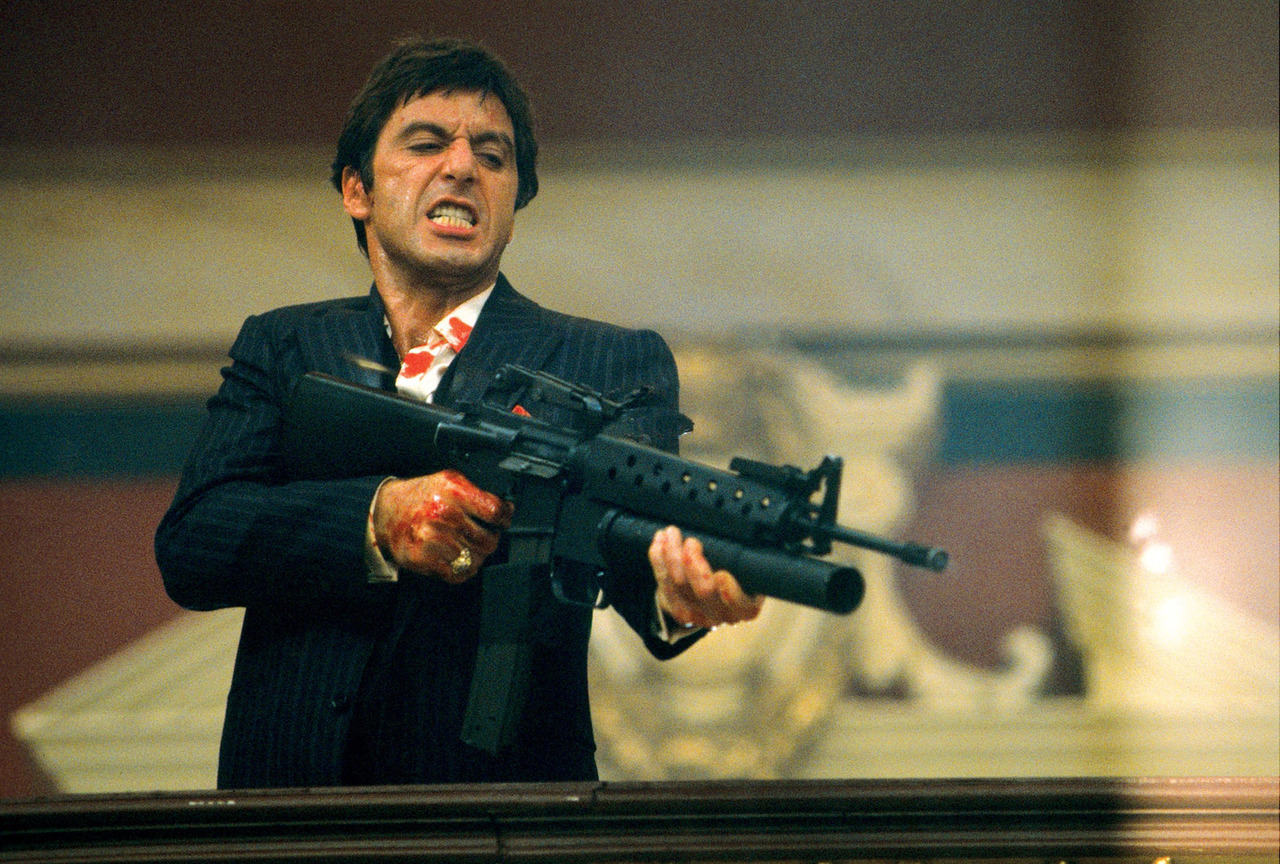
In the end, the film makes a literal comment about Tony's all-consuming selfishness and over-sized ego: Montana is shot and killed in his extravagant upstairs foyer because there is literally no one left to watch his back. 

His murderer -- a shadowy assassin in sun-glasses -- sneaks up behind him, unnoticed, undetected. The Mannys, the Elviras, the Ginas, the Angels, etc., are all long gone and can't warn him of the danger. Montana's desire to be the one on top has, in fact, left him dangerously vulnerable and alone.

De Palma's film, as critic Vincent Canby noted in The New York Times, "is a relentlessly bitter, satirical tale of greed, in which all supposedly decent emotions are sent up for the possible ways in which they can be perverted." 

Indeed, Tony's ego is the great destroyer here: ripping apart friendships; forever paranoid; always bullying and out-sized. He thinks highly of himself and lowly of everybody else. All that matters is his self-glorification (and here, that glorification takes the form of material wealth). 


"The Biggest Problem? What To Do With All The Fucking Cash

Scarface is dominated by allusions and references to capitalism. First, Montana is introduced as a militant political refugee who fought against Castro in Cuba. 

But in fact, he boasts no real political beliefs except he doesn't want "anyone" telling him "what to do," a quality of a communist state, he perceives. Tony even says he would "kill a communist for fun," when offered an "opportunity" to rise through the ranks while incarcerated in "Freedom town," a make-shift community for detainees from the Mariel Boat Lift in 1980. 

But again, Montana's views are convenient: he's against communism because it restricts his personal freedom to rise to the top. He wants to be rich, so it's a personal not ideological thing. After leaving the camp, Montana takes a job as a dish-washer at a small food stand in Miami (underneath a sign for a fancy restaurant called Little Havana). From his perch at the kitchen sink, Tony watches gorgeous women and well-dressed men line up in expensive cars and attend a ritzy club. Right there and then, he settles on a life of crime. He wants the proverbial American Dream and he doesn't want to wait for it

He and Manny thus leave their "honest" but low-paying jobs to work for a cocaine dealer named Omar Suarez (F. Murray Abraham). In the world of drug dealing, says Omar's Boss, Frankie, the biggest problem is what to do with all the cash. And he's right. Once ensconced as a thug for Frank Lopez, Montana graduates to the glitzy world of 550 dollar suits ("so you can look real sharp") and 40,000 dollar Porsches. His appetites only grow and grow. In particular, Montana has his eye on Elvira, Frankie's girlfriend. But Tony knows he is not yet ready to claim his golden-haired trophy wife. "In this country, you gotta make the money first," he tells Manny. "Then when you get the money, you get the power. Then when you get the power, then you get the women." 

That's as terse and bitter a description, perhaps, of the the pathway to success in the contemporary U.S. as has yet been written. 

At one point, Montana -- now a murderer for money and a purveyor of soul-stealing drugs -- makes a pilgrimage to the modest home of his honest, work-a-day mother. He brags to her "You son made it, Mama. He's a success." 

What's important to Tony is clear: his image: the car he drives, the suits he wears, the cash he can throw around (he gives Gina a thousand dollars...); even the fear he can engender in enemies and underlings. Tony knows he is a murderer, but lies to his mother and claims to be a political "organizer." Montana's mom sees through him quickly: "He's a bum. He was a bum then, and he's a bum now." 

Also illuminating is the scene in which Tony and Elvira discuss what will be the terms of their marital union. It's a cold-hearted negotiation, not a romantic proposal. "You like children?" Tony asks. "As long as there's a nurse," she replies." It might as well be spelled out in contract boilerplate. There's no romance, no love, no joy in the courting: just an agreement for a mutually beneficial material partnership.

But Scarface finds its most critical voice of crony capitalism in the quick advancement by Tony to drug lord through --- essentially -- murderous attrition. Omar gets killed, and Tony moves up. Then Tony kills Frank, and he moves up again. All the while, Tony says things like "we gotta expand. The whole operation. Distribution." Or "Here's the Land of Opportunity." 

He's thus talking legitimate "business jargon" in an illegitimate, murderous business, but that's okay: America gives Tony its tacit permission to keep on climbing the business ladder. After killing Frank, Tony spies the Goodyear Blimp in the sky above. Emblazoned on the side, in huge letters is the legend "The World is Yours." This becomes Tony's mantra; his permission to take his personal quest for power and wealth far beyond "the limits" that most Americans observe. The slogan later appears in Tony's extravagant hall entrance, on a statue.

Amusingly, De Palma even stages a montage of Tony's monetary extravagance to the Paul Engemann-performed tune "Push it to the Limit." Again, that might as well be the mission statement of crony capitalism. Grab whatever you can get now, while the gettin's good. 

Or, as sung in the lyrics: "Hit the wheel and double the stakes; throttle wide open like a bat out of hell and you crash the gates." 

Interestingly, the police do almost nab Montana. Not on murder charges. Not on conspiracy to commit murder. And not on drug running. Nope, they nearly catch him on charges of tax evasion. What is it with some wealthy capitalists that they can't pay their fair share of taxes? It's laughable: the super rich complaining about paying taxes which benefit the community at large. Taxes pay for libraries, roads, social services, unemployment benefits, utilities, schools for children, firefighters and policemen...and for our standing army (support the troops, but not with your wallet!). Yet the super rich like Tony -- who may have acted unscrupulously to get his money-- behave like they earned it merely by "hard work." That's one of the biggest unchallenged lies in the on-going argument for crony capitalism in this country. that rich got there honestly; and that the poor are somehow lazy or undeserving simply because they didn't "push it to the limit."

In an essay entitled "The American Dream in Film," author Ray Jones writes: "De Palma presents America as a corrupt and mercenary land in which opportunity is available to those who are prepared to go further for success Go further in the sense that they, like Montana, are prepared to kill and literally dispose of the competition. De Palma was critical of America and presented the view that to be successful in a corrupt world, to fulfil their goals and manifest destiny, characters would have to become corrupt as well. This theme was presented to some extent in Hawks’ 1932 version of Scarface, which had the tagline “Shame of a Nation”. Yet, De Palma went further in his criticism and the tagline to the video of Scarface tellingly claims “He loved the American Dream with a vengeance.”


Don't Underestimate The Other Guy's Greed: Tony the Tiger 

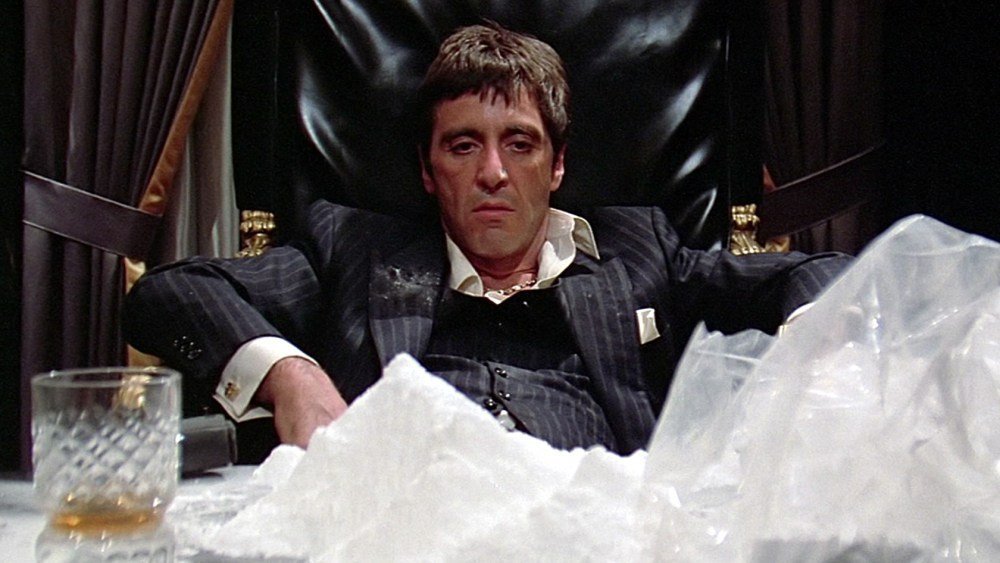
So what does "the limit" look like when you're in the drug-dealing/100-billion-dollar-a-year business? De Palma's Scarface shows us in gaudy, lurid detail. In the neon and pastel pink Miami of the 1980s, it's a world of golden-plated bedrooms (with bubble baths built right into the floor), monogrammed leather chairs, wall-sized portraits of the happy Montanas...and piles and piles of snow white cocaine on demand.

Why, Tony has even captured a tiger and leashed it on his estate. The ultimate decadence. An animal leashed and trapped merely to prove a visual reminder of Tony's wealth and dominance. The tiger is an important symbol in Scarface. Historically, a tiger is s symbol of strength and power, inspiring respect and fear. That's what Tony is...a tiger. That's how he sees himself: Tony the Tiger. Unlike his pet, however, he is not caged or leashed by society's rules. He is the predator loosed in America, free to roam, to feed, to sate his material appetites. He doesn't believe he'll ever go down, but of course, he does. He makes enemies with people who are higher up the ladder than he is. 

I don't know how well this comparison will hold up for you, but in the past I often found it illuminating. I sometimes term Scarface the Dawn of the Dead of gangster movies. 

By that I mean that both Dawn of the Dead and Scarface are epic master-works (clocking in at over two-hours, each), both are critical of the changes in the American pop culture -- towards overt, unbridled materialism in the late 1970s-early 1980s -- and both are extremely violent; though intelligently so. 

The violence in Scarface, like that featured in Dawn of the Dead, is brutal, gruesome, and hard-to-stomach in its first half, and then just rather numbing and de-sensitizing in the second half. In both films, the audience comes to view violence and death as part of the inevitable landscape of the characters, whether they are fighting zombies or drug dealers. Both are genre films that overturn genre conventions to make socially valuable points. 

And there's one shot in Scarface, I believe, that best represents or symbolizes the film: a Colombian drug dealer opens a suitcase, and stashed inside are two bags of coke...next to a chain saw. Drugs and violence, side-by-side.

I think that perhaps the saddest thing about Scarface is that much of today's culture has taken on Tony Montana as some kind of hero or role model. 

Like the weirdos who get off on owning the shopping mall in Dawn of the Dead, these people seem to think that Tony's immoral quest for the American dream is something to be emulated and championed. They will tell you, in all sincerity, that it was the breaking of Tony's second rule ("don't get high on your own supply") that resulted in his downfall.

That's kind of ignoring the whole murdering-to-get-rich-quick thing, isn't it?

Watching Scarface 40 years later,I can't help but wonder if maybe it's time we got a new American Dream.

Thursday, November 23, 2023

Doctor Who 60th Anniversary: "The Doctor's Wife" (Smith)


The TARDIS intercepts a Time Lord “communication cube” (first seen in “The War Games”), and the Doctor (Matt Smith) is jubilant because it means another survivor of his race could be alive out there somewhere.
With Amy (Karen Gillan) and Rory (Arthur Darvill) in tow, The Doctor follows the cube’s trail outside the universe itself, to a pocket universe.
There, unfortunately, a trap awaits them all. 
A dark force that consumes TARDISes has been luring Time Lords to a junkyard planet for generations.  The same dark force assumes control of the Doctor’s TARDIS, but deposits the ship’s soul (or consciousness) inside a humanoid woman, Idris.  
Then, the beast strands the Doctor on the planet, and heads back into the proper universe…to wreak havoc.
Now, the Doctor must team with Idris (Suranne Jones) -- the very soul of the TARDIS -- to build a “junk” TARDIS, escape from the pocket universe, and rescue Amy and Rory from the sinister and sadistic alien intelligence now controlling their every breath…


With over two-hundred stories already in its roster, Doctor Who continues to surprise and delight with the remarkable, emotionally-affecting, and unexpected “The Doctor’s Wife.”  Here, in the modern days of Matt Smith’s Era, the series turns every standing franchise precept upside-down and provides an entirely fresh perspective on the Whoniverse.  

The tale’s premise, in brief, is that the TARDIS Matrix gets put inside a human body and can suddenly tell the Doctor’s story from its own unique perspective.

The TARDIS stole the Doctor, not vice-versa, for example. 

And she doesn’t like the strays (the companions…) the Doctor brings home, except perhaps for the pretty one…Rory. 

The greatest revelation of all, however, is that the TARDIS never takes the Doctor where he wants to go. She takes him where he needs to go (hence the title, “The Doctor’s Wife,” no doubt).  

This one throwaway comment puts the entirety of the Doctor’s history in a new and illuminating perspective  The Doctor needed to go to Skaro and that creepy petrified forest and dead city in the original “The Daleks,” in other words.  It wasn’t some mistake of fate…it was the knowing, guiding hand of the TARDIS.

Given this revelation, I would be fascinated to learn how the TARDIS feels about the Doctor’s span in the Time War, as the War Doctor. How would the Doctor’s wife parse that service, I wonder?  Did the TARDIS also serve the cause?

"The Doctor's Wife" is also heart-breaking because the Doctor finally meets his match -- in terms of intellect, intelligence, stubbornness, and knowledge of the universe at large -- and then realizes he can’t be with Idris.  She must return to the TARDIS's "body," and, once more, the Doctor is alone.

After the Doctor himself, the TARDIS may be the most beloved “figure” in all of Doctor Who history, and to feature an episode that explains the universe -- and the Doctor’s own history -- from the ship’s perspective is nothing less than a brilliant conceit.  But to further parse the TARDIS as the Doctor’s wife -- his true north, whether he knows it or not -- is even more audacious.  

But what I truly love about this story is that it fits in beautifully with the Matt Smith Era's overriding theme: renewal of spirit.  

The Doctor is very old now -- perhaps senile, even -- and yet in the era of the Eleventh Doctor, he is constantly learning something new about himself and the universe.  

He hasn’t seen it all.  

He is no longer quite so world-weary.  

The universe still has the capacity to surprise him (and in turn, surprise us).  

What the Doctor really knows now is that he knows almost nothing at all.    

The TARDIS isn’t just a machine (even an intelligent machine…), it’s his wife, and so forth.

The old dog -- and, yes, the Eleventh Doctor often acknowledges his age -- can still learn new tricks (like how to be a husband), and still be changed (positively) during his travels.  I love that concept, and I love that it has been applied to Doctor Who. Smith's exuberant, manic, mile-a-minute approach to the character represents a consistent tour-de-force. Like Patrick Troughton, he is a brilliant physical comedian, but also an actor who can handle the dramatic scenes with unrelenting, heart-breaking honesty.

I was not expecting to like Matt Smith as The Doctor. But I have been won over.

Indeed, I have friends that are long time Doctor Who fans who actually refuse to watch the series because of his casting in the role.  

Well, it’s their loss. 

And what a loss.  

Matt Smith demonstrates beautifully the principle exemplified by William Hartnell: that the Doctor is an an individual -- and an alien -- of incomprehensible contradictions. If Hartnell is the young one, with the physicality of an old man, then Matt Smith is the book-end Doctor: the old soul in the young body. And the actor pulls off this conceit so beautifully.  He makes it look easy, but it must be exhausting.


I realize it is a controversial thing to say, but Doctor Who has never been better -- never more magical or more heartfelt -- than it has been during the span of this Eleventh Doctor (especially during the Amy Pond, Rory era..) 

Something new and remarkable has been added to this old show's creative mix: a sense of wonder.  Yes, that sense of was implied in the old stories, but the production design could never fully or adequately depict it.   

Here, we have the perfect blend of magical worlds -- well-visualized -- with a magical character.

The Doctor is not supposed to be magical, you say? 

Well, the Doctor has been a cranky old man on the run, a Loki-like force of disorder, a physically-athletic “Venusian karate” expert, a master chess-man, a war veteran, and an emotionally-isolated sensitive. He has been seen as senile, arrogant, cunning, deceitful, and sad.  

Why can’t he be a vehicle for wonder too?  

Abnormal Fixation Now Streaming on TUBI

  Watch episode 1 now!