Tuesday, July 21, 2020

Hitchcock Binge: Strangers on a Train (1951)


Lives and deaths "crisscross" in master-of-suspense Alfred Hitchcock's taut Strangers on a Train (1951), a classic black-and-white thriller that unfolds like an extended tennis match between evenly matched and opposite contenders.

On one side of the court, we have Guy Haines (Farley Granger), a likable if deadly-serious up-and-coming tennis star. He's unhappily married, and his cheating wife, Miriam (Kasey Rogers) is pregnant with another man's child. Guy wants a divorce so he can escape Miriam, as well as his unhappy life in small-town Metcalf; but also so he can be with his beautiful Washington D.C. girlfriend, Anne Morton (Ruth Roman). She's a Senator's eldest daughter, and Guy wants a career in politics.

On the other side of the court, we have Guy's nemesis, Bruno Anthony (Robert Walker), a flamboyant playboy-type who "sometimes goes too far" in his obsessions (according to his dithering, clueless mother.) Bruno dreams of murdering his overbearing, disapproving father, a wealthy local aristocrat. Anthony is everything Guy is not: frivolous, un-serious, and deeply, deeply unstable. He's also brash, and seemingly unafraid of legal or social consequences for his actions. Life (and death) seems like nothing but a game to Bruno.


The "court" on which these diametrically opposed strangers first meet is, as the film's title announces, a train. To set up the ensuing "match" between these players, Hitchcock determinedly cuts (after views of "crisscrossing" railroad tracks), to opposing shots of the players' feet heading in clashing directions. In fact, it is their feet that make the inaugural contact between the two men, a would-be Larry Craig moment with homo-erotic undertones. The somewhat antiquated British term "cottaging" concerns foot signals among gay or bisexual men indicating sexual desire (often in public places like train stations), so Hitchcock's choice to focus on feet touching in public on a train as mode of initial contact between Guy and Anthony is significant and provocative.

After their feet collide in a train passenger car, Bruno strikes up a probing, flirtatious conversation with Guy. "I have a theory. You should do everything before you die," he says. 

Then - aware of Guy's problem with Miriam from the newspaper gossip pages - Bruno offers his theory of the perfect murder. It comes down to this simple plan: two fellows -- with no connection -- meet and swap something...intimate. No, not fluids, but rather murders. It is specifically, as Bruno describes the strategy, a "crisscross." Bruno will murder Miriam for Guy, thus leaving no trail back to Guy for the police to follow. And Guy will murder Anthony's father, doing the same for him. This makes sense because, as Anthony points out, it's always "the motive" that trips up a murderer. In this case, there is no motive.

Weirded out by this overly friendly stranger, Guy excuses himself from Bruno's presence, but Bruno manages to pocket Guy's engraved lighter, which reads: "From A to G." (Meaning from Anne to Guy). As many critics have also pointed out, this inscription might also mean, sub-textually, from Anthony to Guy, another indicator of the under-the-surface, homosexual relationship between the men. Also branded on the cigarette lighter is a significant image: two tennis racquets are "criss-crossed." Just like the lives of these two players.

Bruno then takes it upon himself, without any encouragement from Guy whatsoever, to go forward with his plan; to kill Miriam. Bruno hops a train to Metcalf, and stalks Miriam at a local amusement park. In one clever scene, Bruno boards a boat called "Pluto" and pilots it through the tunnel of love, following Miriam out to an isolated island with her two-would-be-suitors/lovers. The name of the boat, Pluto, is significant since in Roman lore, Pluto was the god of the underworld, one technically associated with the grave or with death. The name of his boat thus associates Bruno with the act of murder. Similarly, the Pluto of myth was a son of the child-eating Saturn/Cronus, a character who symbolizes a domineering father. Again, this is a perfect connection to Bruno, since he desires to purge himself of his father. Like mythic Pluto, Bruno is a vengeful son.
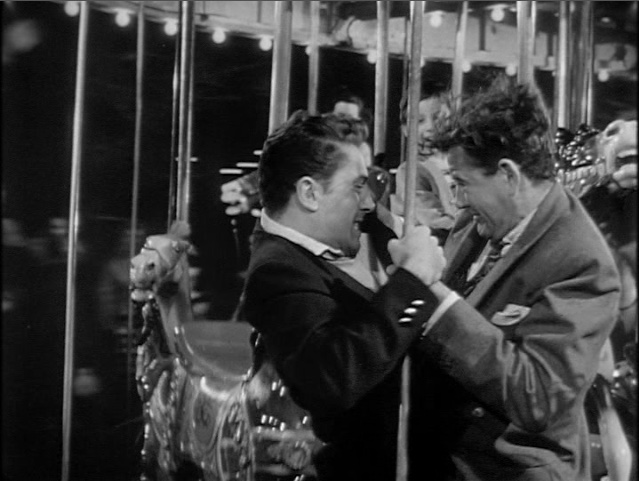


Throughout the scene at the carnival, leading up to the violent strangulation of Miriam, the sexual imagery crafted by Hitchcock proves quite potent. The "loose" Miriam immediately sends non-verbal signals to Bruno that she wants to have sex with him. She seductively licks an ice cream cone, her eyes never leaving Bruno's. In return, he reveals his strength and prowess, wielding a hammer to pound a weight all the way to the top of a marker tower (a clear phallic symbol). Then, in a wickedly edited series of shots equaling foreplay, Hitchcock's camera equates the riding of horses on a merry-go-round with the riding act of intercourse. Bruno, atop one horse, is leaning forward aggressively, in the superior or dominant position. In the very next shot, Miriam (who is shot slightly from behind), seems to be presenting or receiving. These two shots -- in combination -- indicate the desire Miriam and Bruno apparently share.

Finally, as Bruno strangles Miriam, we watch the murder through one lens of Miriam's fallen glasses. Why just one?

Because Strangers on a Train is a story vetted through two perspectives, two worldviews, two lenses. Guy's and Bruno's. Here, in the case of the choking death of Miriam, we are seeing exclusively through Bruno's eyes. It's a view (or vision...) that also comes to haunt him, as he equates eye-glasses with the murderous act he conducted in lover's lane.


Bruno soon ends up at Guy's house in Arlington, and tells him what he's done. Throughout the scene, Guy and Bruno are both positioned (physically) behind the bars of a gate, a visual cue to the possibly consequences of their relationship (prison bars), and an indicator that Guy has become trapped by his "chance" encounter on the train with Bruno. He cannot simply report Bruno to the police for Miriam's murder, because Bruno promises he will name Guy as a co-conspirator. Finally, Bruno gives Guy an ultimatum: kill Bruno's father, or face the consequences. In this section of the film, with Bruno stalking Guy, Hitchcock utilizes another great visual touch that lends new meaning to the tale.

Bruno, in essence, becomes an immovable object. And as we see, an immovable object holds all the power (just like Bruno does). Watch how Bruno is carefully positioned in the frame of several shots. He is absolutely still, unmoving, like a statue. In one extreme long shot, we see Bruno standing silently on the steps of a Federal-style building (between pillars), just watching Guy...from an extreme distance. He is a menace at a distance; a storm-cloud on the horizon. Threatening...

In another shot, Bruno is positioned amongst a large audience watching a tennis match. Everyone in the audience is following the match, except Bruno...who is looking right at Guy. Making eye contact. The "heads" of the audience members ping-pong back and forth comically (left to right; left to right;) avidly tracking the back-and-forth of the tennis match, but Guy is totally and completely still. By keeping Bruno immobile, centered, Hitchcock visually expresses the notion that he is strong, unaffected by what is around him; a singular force to be reckoned with.

And that's exactly the right approach to take, because it is indeed Bruno who now holds all the power in the relationship with Guy. One word from Bruno and Guy is "outed." Fingered. Guy, like Bruno will be labeled a deviant, a criminal. And again, it doesn't take much to understand the sexual or social subtext here. How Guy wants to keep his "relationship" with Bruno a secret, in terms of 1950's social mores and culture.

In the climactic portion of the film, Bruno realizes that Guy will never "follow through" with their relationship (!) and complete the crisscross, killing his father. So, Bruno decides to drop Guy's monogrammed lighter at the scene of the crime (the lover's lane where he killed Miriam) to implicate him. As Bruno hops a train to Metcalf, Hitchcock cuts to an increasingly tense, increasingly fast-cut tennis match between Guy and an opponent. Guy wants to finish off his competitor quickly so he can get to Metcalf and stop Bruno, but there are reverses, surprises and delays.

The entire scene becomes an exercise in generating suspense. Hitchcock perfectly deploys the art of cross-cutting here, and there is one brilliant moment - a surprise - that finds Bruno accidentally dropping the lighter down a grate under a sidewalk. Almost immediately after this stunning accident, the film cuts back to Guy and we hear the words "game, set, match." We think it's over. Fate has intervened on Guy's behalf. But then there's another reverse...a physical feat from Bruno as impressive in dexterity as Guy's tennis. And it's here - watching the ball go from Guy's court to Bruno's and back - that you fully realize how Hitchcock has structured the entire film as a visual tennis match, a fierce competition in which Guy and Bruno hurl the initiative back and forth at one another. 

From the tennis match and cross-cutting to the stirring denouement of the film (culminating with an exploding merry-go-round) you will find yourself riveted, unable to look away, unable to disengage or even truly intellectualize what you are seeing. This scene serves as a remarkable example of Hitchcock's oft-noted capacity to play the audience like a piano. The characters have gone from crisscross to deadly, fast-moving circle (as represented by the runaway merry-go-round, spinning in fast motion). That too seems appropriate. At this point the dance between Guy and Bruno (a battle of opposites; a battle of lovers; a battle of doppelgangers, a battle of reflections) is so intricate, so complex, that it can't be untangled. So the two men spin and spin, locked in combat, until the spinning itself can't be sustained either and there's a massive...er...explosion.

Strangers on a Train more than lives up to its reputation as a compelling thriller. Robert Walker is the stand-out in the cast here, portraying an early screen stalker who diabolically straddles the line of charming-obnoxious-creepy without missing a beat. Yet -- as is universally the case when Hitchcock is involved -- the director is the real star of the picture. Hitchcock has cleverly taken the story of two strangers "criss-crossing" and transformed it into something much deeper; and much more disturbing. Murder is the game Anthony plays, one suspects, when he'd rather be playing...something else. After his last bluff, the lighter with those letters on it slips out of Bruno's clutched hand, finally, and the contest of wills is over.

From Anthony to Guy. Game. Set. Match.

Monday, July 20, 2020

Hitchcock Binge: Dial M for Murder (1954)


Director Alfred Hitchcock is up to his trademark diabolical tricks in Dial M For Murder (1954), a restless, yet highly-focused adaptation of Frederick Knott's hit stage play. The movie shares something in common with Rope (1948) in that the action is confined primarily to one claustrophobic location: an apartment suite in London.

As in Knott's original work, Hitchcock's film follows anti-hero Tony Wendice (Ray Milland) as he plots to murder his beautiful wife, Margot (Grace Kelly). Although the charming, erudite Wendice hardly seems perturbed -- let alone enraged -- with his wife over the moral trespass he discovered (an extra-marital affair), he nonetheless commissions (or rather, blackmails...) a shady college acquaintance, Swann (Anthony Dawson) into performing the terrible deed. The end game: Tony wants the money in Margot's will.

Wendice recruits Swann, I might add, by applying inescapable, virtually Aristotelian logic. And his entire attitude with Swann is unswervingly dispassionate, .but firm. He lets the facts speak for him, in other words. Wendice is thus revealed to be an exceedingly clever tactician, one with a clockwork mind and total understanding of all angles of the crime. He puts the screws of manipulation to Swann with a relentlessness - and charm - that is shocking, yet also strangely fun.

Watching the scene involving Wendice's manipulation of Swann, you will find yourself absolutely entranced by the writing, not to mention the performances. The scene misses nothing -- leaving no stone unturned -- and the dialogue and delivery are unerringly sharp. And when the film arrives at the specifics of the murder plot, Hitchcock cuts to and then remains with a high angle shot for an uncomfortably long duration. This selection of camera angles boasts two primary meanings. First, it distances us, in a sense, from the two men plotting evil. Secondly, the high angle (always a cinematic indicator of doom or entrapment), indicates that this plan will be the undoing for both men. Ultimately, that is indeed the case.


Th
e lovely Margot, it turns out, was unfaithful to Tony with an American crime writer named Mark Halliday (Robert Cummings), and the real motive behind the murder, I suggest is not merely the money in the will, but the fact that Margot is -- literally -- a different woman with Mark than she is with Tony. And yes, I mean that in the Biblical sense. With Tony, Margot is demure, virginal, (and to establish this, Hitchcock has her dress primarily in white).


By contrast, In the clutches of passion with Mark, Margot is more overtly sexual and passionate, a personality change made clear by her decision to adorn a fiery red dress. I get the feeling that Tony is murderous not so much because his wife cheated, but because Mark brings out the lustful, sexual side of Margot. Tony is intellectual, cunning, but Mark is macho and hot blooded. He can't stand that Margot would gravitate to Tony.

On the night of the planned murder, Tony has arranged the perfect alibi. He's going to be with Mark (yes, Margot's lover!) at a stag party, while Swann -- using Margot's front door key -- sneaks into the apartment and strangles her with a stocking. Tony telephones at the very moment of Swann's ambush (hence the "dial M" aspect of the title), and hears the vicious scuffle. But Swann bungles the attack, and Margot manages to stab her attacker in the back with a very sharp pair of scissors. In a terrific (and macabre moment), Swann lands on the floor, back first, and the scissors - pressured by the floor - push deeply into his back, all the way up to the hilt.

And I must say, this is the moment in which Dial M For Murder goes from being an involving thriller to an experience you can't take your eyes off of. Realizing that his plan has gone horribly awry, Tony -- using that unnatural calm and icy intellect -- begins to adjust to the situation on the fly. When he realizes Swann has failed in murder, Tony switches strategy and sets up Margot as Swann's murderer. She is arrested by Inspector Hubbard (John Williams) and charged with murder. Margot goes on trial (in a frugal but expressionistic sequence), is found guilty, and is promptly slated for execution.

The final scenes of the film heap irony upon irony, and Dial M For Murder successfully balances one cunning mind (Tony's) against another (Inspector Hubbard). On the former front, there's a grin-inducing scene in which Mark goes to Tony and -- desperate to save Margot from execution -- begs him to confess to Swann's murder. Mark -- the crime writer -- has even concocted a crazy story about how and why Tony would have killed Swann. What's amusing is that Mark has creatively (and with no inside knowledge) guessed correctly about almost everything. On the latter front, we have a battle between two brilliant minds. It's like a game of chess, and you sit on the edge of your seat waiting to see how and when the worm will finally turn, and Tony will be exposed.

Oddly, and perhaps counterintuitively, Milland plays the character in Dial M For Murder that we most easily sympathize with. He's a murderer, a cold fish and a cad, and yet somehow we simultaneously want him to get caught and get away with the perfect crime. Milland is ideal in this part, his eyes constantly processing -- not unlike a computer -- every new development, assimilating it, and taking it in stride. Even when he is exposed at the end, Tony seems oddly jolly and charismatic.

I don't believe that Dial M For Murder evidences the moral depth and philosophical heft of a Hitchcock film like Rope. Nor does it shatter the rules of cinematic decorum like Psycho. Nor have I pinpointed a deep and meaningful sub-text here, as is most assuredly present in a film such as The Birds (which had the attacking birds carrying out the subconscious, murderous desires of a particular character).

Considering this, Dial M For Murder feels a tad lighter than some Hitchcock efforts. Yet by the same token, it may also play as more widely accessible. Make no mistake: this is a brilliantly-written, effectively shot, wonderfully performed effort. I just don't know that it's in the top tier of Hitchcock's canon. Yet even lower-rung Hitchcock is unerringly brilliant (and better than about 95% of other thrillers). So Dial M For Murder could be exactly what the doctor ordered: a finely-balanced ballet in which a murderous man dances his way out of being caught, while others pirouette around him, attempting to discern the truth.

Wednesday, July 15, 2020

Pod People Binge: Invasion of the Body Snatchers (1978)


The late great movie critic Pauline Kael once wrote that the 1978 remake of Invasion of the Body Snatchers was “the American movie of the year – a new classic…the best movie of its kind ever made.” 

Even at this late date, I can find no reason to quibble with that assessment.

In particular, Invasion of the Body Snatchers craftily updates the 1950s context of the original Jack Finney novel, as well as the Don Siegel film adaptation.  It does so in order to deliberately comment on the contentious 1970s: the decade of “The Me Generation” and the Watergate conspiracy and cover-up.  

Accordingly, the film’s conclusion seems to be that human life in the decade of “self-realization” seems to hamper, not encourage, real connection between people, while an overt, even paranoid lack of trust in society’s institutions and hierarchies makes that disconnect exponentially worse.  

In the absence of real connection and real love, a seed grows, and terror blossoms.  

Invasion of the Body Snatchers thus concerns, as film scholar Michael Dempsey noted in Film Quarterly (February 1979, page 120), “the manifold pressures which life brings upon people to abandon that ambiguous blessing, humanity.”


In San Francisco, lab tech Elizabeth Driscoll (Brooke Adams) grows increasingly convinced that her boyfriend Geoffrey (Art Hindle) is not himself.  When she brings her worries to her boss, Matthew Bennell (Sutherland), he recommends she see his friend, pop psychologist and relationship guru, Dr. David Kibner (Leonard Nimoy).  Kibner promptly reports that he has seen six similar cases in just one week, and suspects that the cause is the fast-moving 1970s life-style, in which people move in and out of relationships too fast, without really getting to know each other.

But as Matthew, Elizabeth, and their fiends Nancy (Veronica Cartwright) and Jack (Jeff Goldblum) soon discover, the problem in San Francisco is much graver than that.  Alien plants from a dying solar system have arrived on Earth and are rapidly producing emotionless doppelgangers of the human race.  They desire a world of peace, with no hate…but also no love.  

Matthew, Elizabeth, Nancy and Jack attempt to escape San Francisco, but the conspiracy has grown too big, and the human race stands on the brink…


The 1970s remake of Invasion of the Body Snatchers by director Philip Kaufman primarily concerns shape and form, and the myriad ways that human beings misperceive shape and form, and thus make unwarranted assumptions that fit pre-conceived notions about those qualities. The film itself depicts an invasion of alien “pod people” -- essentially sentient plants -- who secretly  replace human beings (while they sleep…) in a vast 1970s liberal metropolis, San Francisco. 

But unlike its 1950s predecessor, which was either an indictment of communism or an indictment of McCarthyism depending on your personal Rorschach, the remake plays meaningfully against the unmistakable backdrop of an increasing divorce rate in the United States and the ascent of the so-called “Me Generation.”  

Or, as the psychiatrist in the film, Kibner (Leonard Nimoy) trenchantly notes: “people are moving in and out of relationships too quickly,” and therefore never really getting to know people they presumably love. Accordingly, when individuals make discoveries about their intended loves ones that they don’t like, it is easier to disassociate from them, to blame the “other” for being “different” and then just move on.

But if you are so focused on self and can’t get to really know other people, how can you tell if they are even human at all?  They may look and act human -- their shape and form could be human -- but they could be…pods.

In terms of background context, the Me Generation famously consists of Baby Boomers (born 1946 – 1964, generally-speaking) who, because of rising disposable income in the 1970s and perhaps as a direct response to the ethos of the World War II generation, began to place a new importance on “the self” over the well-being, necessarily, of the community. 

In fact, the 1970s was determinedly the decade of the “self,” a fact reflected in the hedonism of disco music, and the blazing ascent in popularity of the “self-help” book genre.  Popular buzz-words of the day included “self-realization” and “self-fulfillment,” yet as the movement of “self” grew, many people saw the new age as merely one of “self-involvement.  The consumption-oriented life-style of immediate gratification soon gave rise to President Carter’s notorious 1979 “Crisis of Confidence” speech, which warned against judging success on material wealth rather than intrinsic human qualities of character and morality.  Meanwhile, we kept building more shopping malls, and imagined worlds futuristic (Logan’s Run) and apocalyptic (Dawn of the Dead) set at them.

Kaufman’s Invasion of the Body Snatchers plays meaningfully with the idea of form and shape in its visuals by depicting a world where “disconnected” people can’t distinguish between genuine humanity and invading, emotionless aliens.  This tension between form and reality occurs almost immediately in the film when a health inspector -- the film’s protagonist, Bennell (Sutherland) -- starts a fight in a restaurant kitchen, arguing over whether a small black object is actually a caper or a rat turd.  This debate is actually a metaphor for the entire film.

The only way to know for sure about the caper/rat turd is to eat it…and by then it’s too late, isn’t it?  By then, what you fear is actually inside you, doing you harm…

Forecasting its bleak, terrifying, and legitimately unforgettable finale, Kaufman’s camera proves deeply ambivalent even about Bennell -- the hero -- and his “true” human nature.   For example, when Bennell first appears in the film, he is seen through the restaurant’s door, through a peep-hole, and the audience gazes at him through the filter of what seems like a fish-eye.  Bennell appears distorted and strange, and not fully human.  

Later, at a book party for Dr. Kibner, we see a distorted visual representation of Bennell again.  As he talks on the telephone to the police, he stands before what seems to be a funhouse mirror, and it corrupts his features once more.  

And when Bennell goes to rescue Elizabeth from her boyfriend’s house, he is deliberately lit from below, a visual selection which casts shadows upon his features and makes him look diabolical or sinister. 

All these visualizations of the good guy prove a point in Invasion of the Body Snatchers:  You can’t trust appearances.

That lesson is learned the hard way by Veronica Cartwright’s character, Nancy, in the film’s last moment.


To approach this facet of Invasion of the Body Snatchers another way, the aliens are creatures who do understand, mimic and manipulate form and shape to their advantage.  Late in the film, a pod merges the body of a dog with the head of a homeless man because the host’s genetic materials were damaged during the duplication process.  What emerges is nothing less than an abomination (and one my earliest movie-going experiences with a jump scare, at that).  But that’s okay to the aliens because they don’t possess emotions. They don’t know fear, disgust or horror.


The protagonists further misunderstand the pods because of their “familiar”-seeming forms.  First, the pods are accepted as harmless plants and brought into human homes, where they commence the invasion. Secondly, these plants are not considered a viable “host” for aliens, as Nancy observantly points out.   Why do we expect UFOS to be metal ships?

And thirdly, the heroes operate on incorrect assumptions about plants, and those assumptions prove deadly.  Even though Nancy notes that plants do respond to music, Bennell leaves Elizabeth for a time because he hears music playing nearby, on a boat.  The song he hears is “Amazing Grace,” one of the most moving compositions ever written, and he assumes it must be sign or symbol of emotional, feeling mankind. 

On the contrary, however, the tune emanates from a cargo ship transporting pods.  There is no hope here, no “grace” to speak of.  The pods, though emotionless, listen to music as well, though it is doubtful they would ever compose new music.

Again, we believe that music is unique to us, but this scene proves that it isn’t, and that mistake costs Bennell the love of his life.  He should know better. When he breaks into Geoffrey's house, the pod Geoffrey is also listening to music.


Over and over, Kaufman’s film attempts to trick us or mislead with its visuals, making the case that in this day and age, we can’t really know anyone else.  Sometimes, the director throws the audience a bone and offers up a visual composition that makes the point we need to learn, or provides an important clue, even before the dialogue tells us.  In one scene set at Matthew’s apartment, for instance, a tower bisects the frame vertically, separating Matthew and Kibner on opposite sides of rectangle, a visual representation of the fact that they aren’t working towards a common end.  We get verbal verification of that fact in the very next scene, but the visuals tell us first, and that’s a remarkable and deft achievement.


The 1978 Invasion of the Body Snatchers also plays deliberately with the lack of confidence Americans felt in their government following the Watergate Scandal.  President Nixon authorized criminal activities from the Oval Office and resigned from office in disgrace, and then his successor, President Ford immediately pardoned him.  Citizens, to a certain extent, were left out of the loop, and Nixon didn’t seem to pay much for betraying the public trust.  So there was a sense that government, and government bureaucracy was not working for the good of the people, but rather to corrupt ends.  Government (Ford) took care of its own (Nixon).  I don’t necessarily agree with that reading, and I believe Ford did what was necessary to begin the healing process in America.  But others felt differently, and throughout this movie, the paranoia of Watergate proves quite pronounced as shadowy figures rendezvous and talk in hushed tones about plots and strategies.  

At one point, the specter of Watergate is directly referenced, when Matthew realizes that he and all his friends are being watched, and their phones are being tapped.  A telephone operator calls him by name before he gives it. This is, perhaps, the most chilling moment in the movie.

To Philip Kaufman’s credit, he orchestrates the conspiracy in Invasion of the Body Snatchers right under our (unaware) noses, much as President Nixon managed to do for a time.  If Watergate had its “plumbers,” then Invasion has its “garbage men.”  Throughout the film, unobserved and unremarked upon, garbage trucks enter the frame and cart off this weird organic-looking soot or fluff.  

The conspiracy's garbage men are here.

Notice the dumpster behind Leonard Nimoy.

Could that body have disappeared into the garbage truck sitting outside the window?
We don’t learn until the end of the film that this grotesque material is all that remains of the human body after the duplication process.  But at four or five different junctures in the film -- starting in the first shots after the opening credits finish – anonymous-looking garbage trucks, garbage men and dumpsters are captured in the frame, along with this mystery substance.  Only in the film’s final moments does the full breadth of the conspiracy -- and its duration -- become plain.  Invasion of the Body Snatchers also makes literal that old proverb “you can’t fight City Hall.” Here Matthew realizes that the invaders (garbage men and aliens) “control the whole city,” just as we learned they ran the country in Watergate.

Between extreme paranoia about the motives of trusted officials, and the lack of connection between citizens in a permissive utopia of “self,” Invasion of the Body Snatchers fosters deep uneasiness about how easily our natures might be mimicked or mocked.  The final scene, which sees Bennell revealed as a “pod person,” is the ultimate exclamation point on that theme.  He does everything that he did before he was an alien, and so we hope, like Nancy, that he could be “hiding” around the other aliens.  But instead we’ve missed the truth again.  We have mistaken form for substance.  He’s been “born again” into an untroubled world that has no need of hate, and no need of love, either.

TellinglyInvasion of the Body Snatchers proposes that the alien duplication occurs while the original human sleeps.  Sleep is a universal must and biological need among human beings, so the process is both inescapable and inevitable.  Furthermore, how often have we heard from friends and family that that they “just woke up one day” and felt different about someone important in their lives. This Invasion of the Body Snatchers lives in paranoid suspicion of such a revelation.

Tuesday, July 14, 2020

Pod People Binge: Invasion of the Body Snatchers (1956)


It was a turbulent, post-war world that saw the release of director Don Siegel's Invasion of the Body Snatchers in 1956. Nazism had long been defeated in Europe, but the Red Menace (communism) represented by the Soviet Union and Red China was growing. In January of 1955, the United States Congress authorized President Eisenhower to defend Formosa from China. On May 14 of the the same year, the Soviet Union and seven other communist nations joined forces under the Warsaw Pact. But these were only the most recent developments. At home, on the domestic front, there was a virtual red hysteria roiling.

Going back a few years to 1950, Republican Senator Joseph McCarthy launched his campaign to unearth Communists in the American government. McCarthy, later known to be an alcoholic, imagined "Reds" everywhere, from inside the upper echelons of the Truman Administration, to the U.S. Army to the State Department. Another, earlier (and arguably easier) target of the Communist witch hunt was the liberal entertainment industry itself. Specifically, the House of Representatives' investigative arm, called HUAC (House Committee on Un-American Activities) sought to root out communists inside the film industry.

Ironically, membership in the American Communist Party was not (and is not) a crime in the United States. Membership in various political parties is part and parcel of our democratic liberty, and yet here - with no sanction from the Constitution and no evidence of any actual crime committed, the American government began to oppress citizens.  Actors, actresses, writers, producers and directors were regularly summoned to testify in Washington D.C. and name "names" in the hunt for commies and communist associations. Those who didn't submit to the will of HUAC were blacklisted and named in a pamphlet called "Red Channels."


Among those black-listed was a left-leaning writer and novelist named Daniel Mainwaring. He was the man who adapted Jack Finney's science-fiction novel, Invasion of the Body Snatchers, to the screen. Given this background, one can begin to detect how an anti-McCarthyite message or sub-text runs through the science fiction film. 

Consider, for example, that those who join the alien pod "herd" develop a kind of mob mentality. Their first course of action, as we see in the film with the example of Becky (transformed in the last moments of the film), is to "out" or testify against those who are still human. This pointing of the finger is the equivalent of naming names to the Committee. Pointing out someone who is "different" alerts the boiling mob to their presence. The mob then seeks to stamp out those individuals who think differently.

Furthermore, the specific characters in the film are ones who may carry untrustworthy (communist?) backgrounds according to inquisitors like Joseph McCarthy. For example, Becky has just returned to the United States after five years in Europe (an invention of the screenplay, not the novel), and therefore her loyalties are suspect -- who knows how she's been influenced by the socialists of Old Europe?

Becky and Miles have both rejected the patriotic bedrock of marriage: they are divorcees, so they are outside social norms in 1950's America as well. And the other "targeted" character in the film is Jack Belicec, a writer. It is his occupation that's of paramount importance here: he is a representative, in a sense, of the under-siege entertainment industry. One of those damned, dreamy-eyed writers who might fall under the spell of socialists and communists, and begin spreading his godless ideas to innocent Americans who don't know better.

And really, that was the essence of McCarthy's argument: that Communism was Godless and should not be spread in the Christian States of America. Consider, it was on June 14th, 1956 that the words "under God" were officially added to the Pledge of Allegiance by law. It was on July 30th of 1956 that "In God We Trust" became the National Motto by law. Politicians - fearful of being labeled communists by Red Hunters bent over backwards to prove they were patriotic, Christian Americans.The message here, spawned by the red baiting inquisitors: conform! conform! conform!

Given Daniel Mainwaring's background and history, as well as proclamations from the cast (including Dana Wynter) it is easy to see how Invasion of the Body Snatchers might be interpreted as an anti-McCarthy film. One railing against the right-wing machine urging conformity of religion and ideology.

However, there is another side to this story too, one that is the polar opposite of what I've just described above. It is entirely possible to read Invasion of the Body Snatchers in a contrary way. That the film is -- in fact -- not about McCarthyism at all, but rather about the deadly dangers of the encroaching Red Menace. 


Let's gaze at Don Siegel for a moment, the director of the film. He was widely-known to be an ardent right-winger in terms of his politics, and his career began under the bailiwick of pro-government propaganda films like 1946's Hitler Lives! His films, including 1971's Dirty Harry, have often been interpreted as right-wing. Considering this background, and the fact that film in general is not - alas - primarily a writer's venue -- one can make the argument with some confidence that Invasion of the Body Snatchers '56 is an aggressively anti-communist diatribe.

Notice, for example, how late in the film, Miles Bennell (Kevin McCarthy) is on the run and seeks help from his nurse and secretary, Sally. He goes to her house, peers in the window, and finds that she is hosting a gathering of the pod people. It is a secret meeting, a secret meeting not unlike the kind McCarthy imagined: communists and communist sympathizers working under closed door against the common good of patriotic Americans. 

Secondly, Invasion of the Body Snatchers in this incarnation, though extremely faithful in dialogue to Finney's novel adds a new word to Miles' diatribe against the aliens' emotionless gestalt. In the book, Miles complains that without emotions there is no ambition and no love. In the film, he tellingly adds "faith" to that list. Again, the fear of "godless" communism is apparent in the film, and the addition of the word "faith" to those qualities lost under pod-ism ties back directly to those acts of Congress I mentioned above, the ones re-establishing a Christian God as America's sponsor.

Also, the idea of being re-born into an "untroubled world" where "everyone is the same" seems to smack of an attack against Communism, not McCarthyism, no? 

A little more digging, and you can discern how this Invasion of the Body Snatcher views "collectivism," the group -think of the emotionless pods. It can't be a coincidence that the Grimaldi vegetable stand - once a very successful and thriving enterprise (under human ownership) - goes under when managed by the emotionless, communist pod people. In a world of collectivism, the film seems to be saying, capitalism dies.

So the question for us, as intrepid and questioning interpreters of this cinematic art, is, simply: what is this Invasion of the Body Snatchers attempting to say to us, or rather to the intended audience of mid-1950's middle America? 

Is it vehemently anti-McCarthy, or willfully anti-Communist? 

I submit that the film is likely railing against both "evils"; that it is actually a movie about resisting group think or the mob mentality under any guise. After all, what is inherently the difference between rabid communists and rabid anti-communists? Both factions are extreme, and seek to impose their will, ideology, and philosophy on the unaligned. 

Extremism, in any form, is oppressive and undesirable. 

I don't know if it's worse to live under a fascist dictatorship or a communist one, and in the end I don't think it matters. Whether you a far leftist or a far rightist, your ultimate goal is to push your dogmatic set of beliefs on those in small town America who just want to be free: free to work; free to love; free to be free from such rancorous divisions.

Miles' warning at the end of the film fits both interpretations of the material. It is delivered directly to the camera, in extreme close-up, and thus directly to us, the audience. "They're after all of us! You're next!" I submit that's a warning that skews in both directions. If allowed, unabated, the HUAC hearings would continue the witch hunt into small towns and middle America. Contrarily, it could be a warning that the Soviet Union was not about to let freedom reign in America, and that subversive communists were already here, corrupting our country.

It is undeniable that this Invasion of the Body Snatchers is extremely faithful to the novel by Finney and so in seeking answers about the intent of this art, we must return to the source material. Entire passages of dialogue and narration have been lifted from the book for the film, and so the concept of personal alienation is also critically important to the film. That idea of personal alienation finds its greatest expression in a beautifully-staged moment that is absolutely and totally inconsistent with everything the film has told us. However, it is so important, I believe, that the filmmakers let it go.

Let me explain. Throughout Invasion of the Body Snatchers, the filmmakers carefully explain the life-cycle of the alien invaders to us. A pod, in close proximity to a human, expels a human-sized "blank" (an impression, the film calls it...). That blank then absorbs the mind and appearance of the nearby human while he or she sleeps. The original human body itself is then destroyed, reduced to "grey filth" and the pod body takes over without missing a step. The distinction I am trying to make is that the pods don't take over the human body. They inhabit duplicate bodies. The original body is...disposed of.

And yet, at the climax of this film, Miles returns to Becky after leaving her briefly to investigate the sound of music nearby (where the hills are alive, he hopes). In his absence, she has fallen asleep - the kiss of death, the period of duplication. Yet, in the same body, her eyes open, showing coldness and iciness. She says "I fell asleep and it happened, Miles," or some such thing, and that is absolutely inconsistent with the duplication process the film describes. She fell asleep, and the pods took over HER body. What should have happened, had the film been true to its own internal logic, is that her body should have dissolved away into dust, and another Becky should have sprung up nearby (wherever the pod was...). This is precisely what happens in the remake of the 1970's. Someone saw the inconsistency there and fixed it.

Yet, going out on a limb here, I would suggest that Siegel, Mainwaring and the producers were smart enough to know this, but that they wanted to get across the message of romantic alienation, the fear of "my wife isn't my wife anymore." How can I claim such a thing? Consider how, visually, this scene plays out as dramatized. Miles returns to Becky and she falls asleep right there on him. They fall over together, and he lands on top of her. They end up in an embrace in the mud.

Essentially, looking at them - this man and this woman are ensconced in the missionary position. Miles kisses Becky desperately and passionately, trying to wake her up, trying to rouse or stimulate her. This is the 1950's equivalent of making love on screen (you couldn't show much else.) Then, the film cuts to a first-person perspective, Miles' point of view, looking down qt Becky, his love. He expects her to return his affection, but this is not to be. It is from that first-person angle that we see Becky slowly open her eyes...and we know just from Wynter's performance that she is no longer Becky. This choice of angles, of mise-en-scene determinedly reveals to us the fear of romantic alienation. That the woman we love might one morning..suddenly not be that woman anymore. That romantic love can...slip away like a thief in the night, and we are left with something...cold, affection-less.

Critically, this message of alienation could not have carried across in this fashion if the filmmakers had stuck strictly to the "rules" of the pod people. We could not have been afforded - literally - an eye-to-eye look at romantic alienation. So yes, there is a huge inconsistency here, but this is one of those occasions, I submit, when breaking the rules is acceptable because there is an artistic purpose underlining it. If the message of the film is alienation, then you the film needs this shot.

Much has been made over the years over the "framing" story of this Invasion of the Body Snatchers. If you've seen the film, you know it begins and ends with a raving, lunatic Miles in a hospital, trying to make a psychiatrist and a doctor believe his crazy tale of an alien invasion in Santa Mira (not the Mill Valley of the book). For years and years, I have read from genre reviewers how this framing device and the subsequent optimistic ending (the fight is joined!) sullies the message and intent of the film. It's received wisdom however, and I'm all for questioning received wisdom.

For one thing, the book-end framing of Invasion of the Body Snatchers allows us to hear Miles' recount the adventure in his own words and expressions, in voice-over. This is the film equivalent of the book's first person voice. Hence, it is true to the spirit of the book

Secondly, had the film ended merely with Miles screaming in traffic "they're here! they're coming after you!" it would have been a deliberately downbeat climax directly in contradiction to the upbeat ending of the book (which saw the pods head off into space). The book-ends, with the doctors believing Miles after the discovery of the pods - is actually closer in spirit to the novel than the more downbeat ending that many critics have argued for over the years. Maybe they didn't read the book. My point is that the story frame doesn't diminish the film; but actually brings the film in closer alignment to the source material.

One of the most enjoyable aspects of Invasion of the Body Snatchers, beyond the search for cultural subtext and meaning, is the visualization of the material, the careful staging. For instance, Siegel arranges numerous shots with an eye towards visually expressing entrapment. There are shots through staircase posts (bars of a sort), shots through grills in doors (another jail-like visual), even through wooden floorboards in an abandoned mine. The upshot is that we often view our on-the-run protagonists (Miles and Becky) through some kind of visual barrier...something preventing their escape. I believe that this approach helps to enhance the mood of hysteria and paranoia the film is so famous for generating. I hadn't watched the film in a good long while, perhaps eight or nine years, so I wasn't prepared either for the fact that Invasion of the Body Snatchers boasts two jump-out-of-your seat jolts in the first five minutes. This film was made over fifty years ago and those stingers still work. That's a testament to the technical skill of the film-making.

There seems to be a great deal to discuss about this film, its message and its implications, but I hope to leave some of that to you, my intelligent and curious readers. I was thinking about writing about how, in some sense, this film is about the age of small towns in America (an age that has passed in history; I submit we're now in the Wal-Mart Age). And that in some fashion, this Invasion is about how foreign ideas can poison or an infect a small town.

Is Invasion of the Body Snatchers 1956 an anti-communist film? Or is it Anti-McCarthy? Or do you agree with me: is it simply a warning against extremism on either pole? 

Monday, July 13, 2020

Pod People Binge: The Body Snatchers (1954)


In 1954, Dell published a science fiction novel,The Body Snatchers by Jack Finney. Finney's landmark work has been translated to film a whopping four times, in 1956, 1978, in 1993 and in 2007 (as The Invasion). Some of the terminology associated with the Invasion of the Body Snatchers franchise, including the descriptor "pod people" has landed in the pop culture firmament of our country and remained there for decades. We have seen variations of the paranoid tale in efforts such as The Stepford Wives (1975), and even on Buffy the Vampire Slayer ("Bad Eggs"). There have also been entire TV series titled The Invaders and Invasion which grapple with some of the same core concepts as Finney's story.

Finney's novel (which was first appeared serialized in Colliers Magazine) commences with this paragraph, and one might consider it a mission statement for the book, and also for the film adaptations :

"I warn you that what you're starting to read is full of loose ends and unanswered questions. It will not be neatly tied up at the end, everything resolved and satisfactorily explained. Not by me, it won't anyway. Because I can't say I really know exactly what happened, or why, or just how it began, how it ended, or if it has ended; and I've been right in the thick of it. Now if you don't like that kind of story, I'm sorry and you'd better not read it. All I can do is tell what I know."


After this disclaimer of sorts, Finney escorts the reader to the evening of October 28, 1976 in a small-town in southern California called Mill Valley. It's a Thursday around 5:00, and the book's main character, Dr. Miles Bennell narrates the story in the first person. He's a young family practitioner, having inherited the local medical practice from his father, and is well-known and well-liked by the locals. Miles is an effective literary protagonist because his style of narration is crisp and at times it feels as though readers are actually reading doctors notes, narrated directly into a tape recorder. The voice is intelligent, the language smart, but there's nothing too flowery, too knowledgeable, too over-the-top or melodramatic to break the spell. And Miles never gets to see the whole picture...he just reports what he sees. A kind of literary Cloverfield, in a sense. Readers aren't privy to the big picture, only on how the events impact Miles and the town of Mill Valley.

In short order, the divorced 28-year old Miles is met at his office by his old flame, the recently divorced Becky Driscoll. She wants to talk business not pleasure, however. Her aunt, Wilma Lentz, has begun acting...strangely. She claims that her uncle Ira is not her Uncle Ira at all. Oh he looks like Uncle Ira, sounds like Uncle Ira, moves like Uncle Ira and has all of Uncle Ira's memories...but Wilma is sure -- just sure -- he is not the same man. 


Hot for Becky but also genuinely concerned for his patient, Miles goes to see Ms. Lentz and question her about this. "Miles, there is no difference you can actually see," asserts Wilma to the town doctor. She won't be moved from her position, and Miles attempts to talk some sense to her in what is the first of the novel's many comments on psychology and psychiatry, which in the 1950s were moving rapidly into the American mainstream."Now listen to me," says Miles..."I don't expect you to stop feeling emotionally that this isn't your uncle. But I do want you to realize that he's your uncle, no matter what you feel, and that the trouble is inside you. It's absolutely impossible for two people to look exactly alike, no matter what you've read in stories or seen in the movies. Even identical twins can always be told apart - always - by their intimates. No one could possibly impersonate your Uncle Ira for more than a moment without you, Becky or even me seeing a million little differences. Realize that, Wilma, think about it, and get it into your head, and you'll know the trouble is inside you. And then we'll be able to do something about it."

The preceding paragraph is critical to an informed reading of Finney's novel because it lays down the underlying subtext and dynamic of Finney's novel: the idea that psychology/psychiatry and rationality has in essence - by exploring the human mind - killed God, faith and belief and most significantly, imagination. 


Wilma Lentz just knows that her Uncle isn't the same man that he was, but she can't prove it, and there is no scientific rationale - no acceptable scientific rationale, for her beliefs. Therefore, she must be sick. Right?

 If you know the story of the Body Snatchers, you know that Uncle Ira is indeed not himself, but a "snatched man," a replicated man, an alien invader who duplicated Ira but who lacks the emotionality of mankind. This new being, one who looks and sounds like us, is the ultimate triumph of the rational age, the age of such sciences as psychology, one might assert. The aliens have not merely sublimated emotion (as Miles has asked Wilma Lentz to do), but have eliminated it from the gene pool.

Miles is torn between two competing belief systems in the book. On one hand is the intelligent, rational, steadfast psychology of his friend Mannie Kaufman, a local psychiatrist. Mannie suggests that Wilma and the others who begin to suspect that their loved ones are not their loved ones, are actually delusional. That the madness is all within their sick minds, not in reality. He lays out a convincing case that this strange belief is merely a "contagious neurosis." In compelling terms, he describes case histories of mob hysteria (including the Mattoon Maniac of Illinois...) to prove his point. You want to believe him, he makes the case so powerfully and so logically.

But the other voice in Miles' head, the voice that ultimately allows him to believe in the alien invasion, belongs to an imaginative writer named Jack Belicec. As a hobby, Jack collects newspaper clippings that involve inexplicable happenings around America. Like the time frogs fell from the sky in Edgeville Alabama. Or that story in Idaho, about a man who spontaneously combusted...but his clothes were unharmed. Jack is the opposite side of the human equation from Kaufman, the side that can conceive of things beyond science, beyond psychosis. There are more things in Heaven and Earth than are dreamed of in Kaufman's philosophy (or in the DSM V), and Jack is the character who gives voice in the novel to that aspect of "us."

Ultimately, the novel serves a as a rejection of "cold" science and also as plea for humanity to hold fast to the sometimes strange beliefs he holds. From the valedictory passage in the book, as expressed by Miles:


"But...showers of small frogs, tiny fish and mysterious rains of pebbles sometimes fall from out of the skies. Here and there, with no possible explanation, men are burned to death inside their clothes. And once in a while, the orderly, immutable sequences of time itself are inexplicably shifted and altered. You read these occasional queer little stories, humorously-written, tongue-in-cheek, most of the time - or you hear vague distorted rumours of them. And this much I know. Some of them - some of them - are true."


Besides the battle between science and belief, Finney's The Body Snatchers treads primarily on the idea of relationship "alienation" made literal. Those alienated from their families are actually dealing with alien life forms. That's pretty clever, actually. But if one gazes at the characters in the book, many are also coping with the fall-out of bad relationships. It can't be a coincidence that the two main characters - Becky and Miles - are both divorced. And that's the ultimate form of human alienation, isn't? You live with a person you love for years and years and then you wake up one day and suddenly don't feel the same way about that person anymore. Without warning, something has changed. Overnight, you "don't know" that other person anymore, that husband, that wife, that uncle, aunt, parent or child. Alienation of affection is what I'm talking about here, and it happens all the time in normal, mundane relationships. 

The alien invaders of Invasion of the Body Snatchers symbolize this strangeness in human interactions. I don't believe it a coincidence either that the changeover from human to alien comes like a thief in the night, during sleep. Alienation of affection can go on for months or years but when grappling with it, it seems to have come all at once. You don't recognize the person in bed beside you anymore. They feel like a stranger. They look like your mate; they have your mate's memories...but they feel like an interloper, a changeling.


What the aliens in Invasion of the Body Snatchers lack is the core of humanity and the human experience: emotions. They can pretend to have feelings and they can skillfully mimic emotions, but they don't feel anything at all. Without emotions, there is no excitement. Without excitement there is no ambition, no love. Without ambition, nobody writes books anymore...imagination vanishes. Kaufman - now an alien - will never finish the textbook about Psychiatry he began as a human being. That is the fate mankind is doomed to in the novel if the aliens win; if we abandon the imaginative side of ourselves.

Late in The Body Snatchers, Miles confers with Kaufman as well as with a "converted" professor. They explain to Miles the end game of the aliens, beings who have arrived on Earth in giant seeds, pods for lack of a better word:

"What do you do and for what reason? Why do you breathe, eat, sleep, make love and reproduce your kind? Because it's your function, your reason for being. There's no other reason, and none needed...You look shocked, actually sick, and yet what has the human race done except spread over this planet till it swarms the globe several billion strong? What have you done with this very continent but expand till you fill it? And where are the buffalo who roamed the land before you? Gone. Where is the passenger pigeon who once literally darkened the skies of America in flocks of billions? The last one died in a Philadelphia zoo in 1913. Doctor, the function of life is to live if it can and no other motive can ever be allowed to interfere with that. There is no malice involved; did you hate the buffalo? We must continue because we must..."

You have to admit, there's a cold logic to the alien motive for their takeover of Earth, but the difference is that we still feel pity for the buffalo or the passenger pigeon. If we could change their fates, I submit we likely would. With cold science, there's no need for pity, no need for remorse, no need for compassion.

Some other interesting notations about the book and how it differs from the film versions. 


First, the ending. The climax of Finney's Body Snatchers is not inherently nihilistic, bleak, depressing or dark, as some have claimed over the years. In fact, at least two film versions feature abundantly darker endings than what is featured here. In the novel, the pods flee Earth when they realize how irrational human beings are (again, human emotions!), after Miles and Becky wage a hopeless war burning fields of the alien pods.

Secondly, the alien countenance: In this novel, the aliens are not easily detectable. They lack strong emotions, but as I wrote above, they have the capacity to mimic human emotions. It isn't so easy to spot them in the novel as it is in all the film versions.

Thirdly, Finney goes to great lengths to describe the science behind the "body snatching" procedure and why that procedure occurs during sleep. The explanation involves "tiny electrical force-lines that hold together the very atoms that constitute" human beings. These force-lines are in constant flux, constant change, but they change less, according to Finney, during sleep. And during sleep, that "pattern can be taken from you, absorbed like static electricity, from one body to another." Only the 2007 version of the material came this close to offering a scientific explanation for why the changeover occurs during sleep.


Also, Finney reveals what the future is for planet Earth should the aliens win: all organisms on the planet will die within five years and the the pods will seek another world to duplicate. The novel indicates that there was once life on Mars and even on our Moon, but that the pods duplicated - and then destroyed - all life there. Not one of the four films have picked up on this element, to my recollection.