


Subscribe To JKM

 Posts
All Comments
Posts
All Comments
Wednesday, February 20, 2019
Jigsaw Puzzle of the Week: Ultraman

 award-winning creator of the web series Abnormal Fixation (2024), the audio drama Enter the House Between (2023) and author of 35 books including Horror Films FAQ (2013), Horror Films of the 1990s (2011), Horror Films of the 1980s (2007), TV Year (2007), The Rock and Roll Film Encyclopedia (2007), Mercy in Her Eyes: The Films of Mira Nair (2006),, Best in Show: The Films of Christopher Guest and Company (2004), The Unseen Force: The Films of Sam Raimi (2004), An Askew View: The Films of Kevin Smith (2002), The Encyclopedia of Superheroes on Film & Television (2004), Exploring Space:1999 (1997), An Analytical Guide to TV's Battlestar Galactica (1998), Terror Television (2001), Space:1999 - The Forsaken (2003) and Horror Films of the 1970s (2002).
Ultraman Wind-up Toy (Bullmark)
 award-winning creator of the web series Abnormal Fixation (2024), the audio drama Enter the House Between (2023) and author of 35 books including Horror Films FAQ (2013), Horror Films of the 1990s (2011), Horror Films of the 1980s (2007), TV Year (2007), The Rock and Roll Film Encyclopedia (2007), Mercy in Her Eyes: The Films of Mira Nair (2006),, Best in Show: The Films of Christopher Guest and Company (2004), The Unseen Force: The Films of Sam Raimi (2004), An Askew View: The Films of Kevin Smith (2002), The Encyclopedia of Superheroes on Film & Television (2004), Exploring Space:1999 (1997), An Analytical Guide to TV's Battlestar Galactica (1998), Terror Television (2001), Space:1999 - The Forsaken (2003) and Horror Films of the 1970s (2002).
Model Kit of the Week: Ultraman (UPC)
 award-winning creator of the web series Abnormal Fixation (2024), the audio drama Enter the House Between (2023) and author of 35 books including Horror Films FAQ (2013), Horror Films of the 1990s (2011), Horror Films of the 1980s (2007), TV Year (2007), The Rock and Roll Film Encyclopedia (2007), Mercy in Her Eyes: The Films of Mira Nair (2006),, Best in Show: The Films of Christopher Guest and Company (2004), The Unseen Force: The Films of Sam Raimi (2004), An Askew View: The Films of Kevin Smith (2002), The Encyclopedia of Superheroes on Film & Television (2004), Exploring Space:1999 (1997), An Analytical Guide to TV's Battlestar Galactica (1998), Terror Television (2001), Space:1999 - The Forsaken (2003) and Horror Films of the 1970s (2002).
Trading Cards of the Week: Ultraman (Menko)

 award-winning creator of the web series Abnormal Fixation (2024), the audio drama Enter the House Between (2023) and author of 35 books including Horror Films FAQ (2013), Horror Films of the 1990s (2011), Horror Films of the 1980s (2007), TV Year (2007), The Rock and Roll Film Encyclopedia (2007), Mercy in Her Eyes: The Films of Mira Nair (2006),, Best in Show: The Films of Christopher Guest and Company (2004), The Unseen Force: The Films of Sam Raimi (2004), An Askew View: The Films of Kevin Smith (2002), The Encyclopedia of Superheroes on Film & Television (2004), Exploring Space:1999 (1997), An Analytical Guide to TV's Battlestar Galactica (1998), Terror Television (2001), Space:1999 - The Forsaken (2003) and Horror Films of the 1970s (2002).
Board Game of the Week: Ultraman (Nintendo)
 award-winning creator of the web series Abnormal Fixation (2024), the audio drama Enter the House Between (2023) and author of 35 books including Horror Films FAQ (2013), Horror Films of the 1990s (2011), Horror Films of the 1980s (2007), TV Year (2007), The Rock and Roll Film Encyclopedia (2007), Mercy in Her Eyes: The Films of Mira Nair (2006),, Best in Show: The Films of Christopher Guest and Company (2004), The Unseen Force: The Films of Sam Raimi (2004), An Askew View: The Films of Kevin Smith (2002), The Encyclopedia of Superheroes on Film & Television (2004), Exploring Space:1999 (1997), An Analytical Guide to TV's Battlestar Galactica (1998), Terror Television (2001), Space:1999 - The Forsaken (2003) and Horror Films of the 1970s (2002).
Theme Song of the Week: Ultraman (1967)
award-winning creator of the web series Abnormal Fixation (2024), the audio drama Enter the House Between (2023) and author of 35 books including Horror Films FAQ (2013), Horror Films of the 1990s (2011), Horror Films of the 1980s (2007), TV Year (2007), The Rock and Roll Film Encyclopedia (2007), Mercy in Her Eyes: The Films of Mira Nair (2006),, Best in Show: The Films of Christopher Guest and Company (2004), The Unseen Force: The Films of Sam Raimi (2004), An Askew View: The Films of Kevin Smith (2002), The Encyclopedia of Superheroes on Film & Television (2004), Exploring Space:1999 (1997), An Analytical Guide to TV's Battlestar Galactica (1998), Terror Television (2001), Space:1999 - The Forsaken (2003) and Horror Films of the 1970s (2002).
Tuesday, February 19, 2019
UFO: "The Dalotek Affair"

In "The Dalotek Affair," Colonel Paul Foster (Michael Billington) and Colonel Alec Freeman (George Sewell) spy a beautiful woman in a restaurant, Jane Carson (Tracy Reed), and her presence reminds Paul of a recent mission. He remembers the events from six months ago...
...During that span, SHADO's Moonbase began experiencing unexpected scanner and equipment malfunctions, and Commander Straker (Ed Bishop) came to believe these abnormalities were a result of a private operation functioning on the moon: the Dalotek Unit.
Although executives and employees affiliated with the Dalotek company, including Jane Carson, categorically denied any connection to the malfunctions, or interference with Moonbase equipment, the malfunctions continued to occur.
As Paul, in command of Moonbase at the time, grew increasingly close to Jane during the investigation, he came to learn of an alien jamming device in a nearby lunar crater. It was soon destroyed, foiling another alien plan to sneak past the eyes of Moonbase and reach Earth.
After the incident, Jane's memory of Paul had to be erased, for matters of security, but now, in the restaurant, Paul sees an opportunity to rekindle the romantic relationship.

"The Dalotek Affair" is another intriguing, if not entirely successful, episode of Gerry and Sylvia Anderson's UFO (1970).This installment offers some fascinating observations about the UFO phenomenon in real life, even as it paints a bizarre, slightly-creepy picture of relationships in the future year of 1980.
In this tale, Robert Kennedy, Gerald Ford and General Douglas MacArthur are all name-checked as believers in UFOs. The selection of these individuals is especially noteworthy because years after "The Dalotek Affair," Ford went on to become the U.S. President. Although Straker doesn't refer to him as such in the episode, the fact that he names Ford as an important individual who believes in UFOs actually adds to his point, now, in 2019. In other words, a person as powerful as the U.S. President believes in aliens. As for MacArthur, on several occasions he alluded to the fact that mankind may one day face a common enemy from space, though as Snopes points out, he didn't actually state that it would be our next war we face.

Another individual featured in archival footage in "The Dalotek Affair" is Frank Stranges (1927 - 2008), the founder of NICUFO, in 1967. It is odd, but also pretty bold, for the fictional world of UFO to make such a concerted attempt to connect its premise to realty, and to real, contemporary figures in politics and the pop culture of its era. Stranges was a unique personality (and author), and that's probably the best place to leave any descriptions of the man, and his beliefs.
By name-dropping Gerald Ford (before he was President), UFO indeed seems very forward-thinking today, as if, The Simpsons-style, it was making a (correct) prediction about the man and his importance to the country.
But contrarily, Paul Foster's behavior in this episode dates "The Dalotek Affair" very quickly as an artifact of the late 1960's. While perched in the command chair on Moonbase, in front of all his staff and support people, Paul asks Jane Carson out on a date. He flirts with her while everyone is listening. It's true that Paul may have had an ulterior motive, hoping to learn more about Jane's work on the Moon, it's still inappropriate behavior.
Then, after Jane Carson's memory is wiped, Paul basically stalks her, locating her in the restaurant so he can ask her out again. Paul is a bit of a horn-dog, the audience understands, but his pursuit of Jane seems to cross lines of appropriateness in "The Dalotek Affair."

Also, it is not clear in this episode if the SHADO "amnesia procedure" is used on everyone who comes in contact with aliens. Is this something new? Because Paul and Carlin clearly did not undergo the amnesia procedure, or they wouldn't be working for the organization. The morality -- or immorality -- of an unwanted medical operation (the amnesia procedure) is also not debated at all in "The Dalotek Affair." It's fascinating, again, to compare the ethos pre-Watergate, with that of the post-Watergate world. In UFO, it is accepted that lies and cover-ups must occur, to protect the people of Earth from danger. By the time of The X-Files in the 1990's, these activities are seen as invasive procedures used by a lying, over-controlling government attempting to hide its complicity in alien activity.
Overall, "The Dalotek Affair" is a stylishly rendered episode of the series, framed in book-end moments at the restaurant, with black-and-white interstitial moments leading up to the flashback, but the overall story itself, of an alien jamming device, is not particularly original or interesting. And Paul's behavior towards Jane just makes the episode feel woefully outdated.


One final observation: Dalotek? Dal(ot)ek? Dalek? The name of the company in this episode seems like an homage to Doctor Who's most famous alien nemesis. And the Daleks, like the aliens of this series, are known to fly in saucer-shaped vehicles.
Next week: "Conflict."
award-winning creator of the web series Abnormal Fixation (2024), the audio drama Enter the House Between (2023) and author of 35 books including Horror Films FAQ (2013), Horror Films of the 1990s (2011), Horror Films of the 1980s (2007), TV Year (2007), The Rock and Roll Film Encyclopedia (2007), Mercy in Her Eyes: The Films of Mira Nair (2006),, Best in Show: The Films of Christopher Guest and Company (2004), The Unseen Force: The Films of Sam Raimi (2004), An Askew View: The Films of Kevin Smith (2002), The Encyclopedia of Superheroes on Film & Television (2004), Exploring Space:1999 (1997), An Analytical Guide to TV's Battlestar Galactica (1998), Terror Television (2001), Space:1999 - The Forsaken (2003) and Horror Films of the 1970s (2002).
Monday, February 18, 2019
The Cult-TV Faces of: Lightning
 |
| 1 |
 |
| 2 |
 |
| 3 |
 |
| 4 |
 |
| 5 |
 |
| 6 |
 |
| 7 |
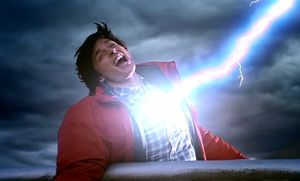 |
| 8 |
 |
| 9 |
 |
| 10 |
award-winning creator of the web series Abnormal Fixation (2024), the audio drama Enter the House Between (2023) and author of 35 books including Horror Films FAQ (2013), Horror Films of the 1990s (2011), Horror Films of the 1980s (2007), TV Year (2007), The Rock and Roll Film Encyclopedia (2007), Mercy in Her Eyes: The Films of Mira Nair (2006),, Best in Show: The Films of Christopher Guest and Company (2004), The Unseen Force: The Films of Sam Raimi (2004), An Askew View: The Films of Kevin Smith (2002), The Encyclopedia of Superheroes on Film & Television (2004), Exploring Space:1999 (1997), An Analytical Guide to TV's Battlestar Galactica (1998), Terror Television (2001), Space:1999 - The Forsaken (2003) and Horror Films of the 1970s (2002).
Sunday, February 17, 2019
30 Years Ago Today: Bill and Ted's Excellent Adventure (1989)

I
first saw Bill and Ted’s Excellent Adventure (1989) when I was in
college. In fact, I saw the film with a trio of friends, and if memory serves, my
film professor at the time….who had to be dragged to the theater kicking and
screaming.
At
the time, I thought then that the movie was a sort of sweet, dopey take on time
travel that didn’t necessarily provoke deeper thought.
And
Bill
and Ted’s Excellent Adventure certainly fit in with its historical
context: of teenage-based science fiction comedies made in the aftermath of Back
to the Future (1985). My
Science Project, Weird Science,
and Real
Genius all emerge from the same cultural ripple created by the Zemeckis
film.
And, in a way, Bill and Ted’s adventures also forecast the adventures of
Wayne and Garth in Wayne’s World (1992) and Wayne’s World 2 (1993), at least to
some extent.
Critics
at the time -- including my professor -- were not amused.
Hal
Hinson at The Washington Post called the film “paltry” and “undernourished.”
And Variety’s staff reviewer noted that
“Each [historical] encounter is so brief and utterly cliched that history
has little chance to contribute anything to this pic’s two dimensions.”
On
a re-watch this week, I found a few more points of interest in Bill
and Ted’s Excellent Adventure.
The film’s philosophical approach to time travel is intriguing,
especially as it relates to the gimmick of the telephone switchboard, only with
time circuits not phone circuits.
Also,
I enjoyed the film’s sense of fun about time travel, and the idea that anything
you can think of can be instantly produced, assuming you remember, later in
the day, to travel back in time and provide what you needed at that juncture in
the past.
This
is precisely the way that Bill and Ted get out of their worst scrapes.
Probably
the most significant thing to recall about Bill and Ted’s Excellent Adventure
is that it is a comedy film first, a science fiction film second. Accordingly,
I can’t really quibble with the success of the scenes involving Napoleon eating
an ice cream sundae, or enjoying a San Dimas water slide.
Those
moments are pure silliness, and yet still garner big laughs. Napoleon is the
film’s break-out character, in part, perhaps, because he is granted the luxury
of the most screen time.
I
prefer Bill and Ted’s Bogus Journey (1991) to this film by a wide
margin, in part because it throws about a billion silly ideas at the wall to
see what sticks and consequently never has a dull moment. But also because this
inaugural effort doesn’t treat school (or school teachers) with much
verisimilitude.
In
other words, I can buy that Bill and Ted go time traveling in a TARDIS-like phone booth.
I
can even buy that these two slightly dopey kids become the foundation of a
future utopia. Party on dudes!
But
I simply don’t believe a teacher would allow them to pass their history classed based
on the final project as it appears in the movie, or even that all the world’s
great figures of history and philosophy would agree to participate in it.
Genghis
Khan wasn’t known for going along to get along.
Yet,
in a sense, that last joke reflects on the magical spell cast by Bill and Ted
themselves. They are such amiable losers, I guess, that the future and the past
bows before them without complaint.
They’re
not worthy.
At
least not until the sequel…

“We’re
destined to flunk most egregiously.”
In
San Dimas, CA, in 1988, Bill Preston, Esq. (Alex Winter) and Theodore Logan
(Keanu Reeves), are in danger of flunking their final history project. If they do fail, Ted’s father plans to ship
him off to military school in Alaska.
Fortunately,
a life-line arrives from seven hundred years in the future.
A man named Rufus (George Carlin) provides
the boys a time traveling phone booth that will allow them to experience history
first-hand, so they can prep the greatest school project ever.
For
Rufus, this is a vital matter. If Bill and Ted don’t pass this test -- and their
history class too -- a future utopia in 2688 will fail to come into existence…and
that is the very culture Rufus hails from.
Bill
and Ted head back in time to round-up historical figures including Napoleon
(Terry Camilleri), Billy the Kid (Dan Shor), Genghis Kan (Al Leong), Joan of
Arc (Jane Wiedlin) and Abraham Lincoln (Robert Barron).
But
will they get back to San Dimas in time to deliver their report, and can they
manage to police an unruly crop of historical figures?

“Be
excellent to each other.”
The
undeniable magic of Bill and Ted’s Excellent Adventure arrives in the central
characters’ atypical mode of expression. In particular, the boys are (unknowing) masters
of the malapropism, not to mention (as Vincent Canby did…), superlatives.
In
short, Bill and Ted’s Southern California mode of expression is horrific to
grammarians but hysterical to audiences. Most of the laughs in the film arise
from the conjunction of their very modern Surfer-type speech with characters we
remember from history books and thus deserving of a modicum, at least, of
respectful discourse.
So
Joan of Arc is described here by the dudes as “Noah’s
wife,” and Napoleon is referred to as a “short dead dude.”
When
angered, Bill is prompted to say things like “You medieval dick weed!”
The
film repeats the same joke over and over again (whereas the sequel parodies
modern expression, Star Trek, views of the afterlife, Ingmar Bergman films, board
games, and about a dozen other topics…). But for most of the first film's running time, this joke about expression and vocabulary is
pretty damned funny, or at least chuckle-worthy.
In
terms of sci-fi concepts, the time travel angle of the film is intriguing,
and unique. Most films concerning time
travel don’t postulate that the present “continues” moving while time travelers are away in other epochs. But that’s the logical conclusion to be drawn from Bill and Ted’s
Excellent Adventure.
Even while they are
in other eras, the clock keeps counting-down in San Dimas towards their
history project dead line. In other words, because they are of that present, they move with it, even while they are in the past.
The corridors
of time themselves, are depicted visually as vast cords or cables in an old fashioned
telephone switchboard. You can dial into
any time period you want and make a connection to it, but the “present” keeps
on trekking.
In a sense, then, the present is a moving target. This idea is seen the prologue as well, as a Trio of future Elders/leaders check their watches and realize that a major test is coming up for Bill and Ted, the so-called "The Great Ones." Yet of course, that test occurred, chronologically-speaking, seven hundred years earlier.


More
significantly, I appreciate the film’s comic discourse on paradox. Early in Bill and Ted's Excellent Adventure, our heroes get bogged down
in one. Their band, Wyld Stallyns, needs
a “triumphant video” to succeed, but it also needs “Eddie Van Halen” on guitar.
Yet he
will not join the band unless they have a triumphant video.
And they can’t have a triumphant video
without his participation.
Voila, a paradox!
This
idea is reflected in the film’s last act, when Bill and Ted realize that they
can -- while in the past – devise a plan to carry the day (like getting the police
chief’s prison keys…) and have it happen instantaneously.
They do so by traveling back in time, and
planting those items when they are needed.
Of course, this is a paradox too.
If the boys don’t get out of their present predicament, they can’t
return to the future to execute their plan of escape.
But they have executed their plan of escape,
because the items show up when and where desired, suggesting they were successful.
This joke goes right back to the debate over
which comes first, the chicken or the egg. Or in this case, Eddie Van Halen or
the triumphant video.
Where
Bill
and Ted’s Excellent Adventure proves markedly less than enthralling are in the terrains of production design and production values. The future looks cool
enough, but the visits to the past are spliced with old movie stock footage
(for the Napoleon segment), familiar back-lot Western towns, and other cheap
expedients. The movie looks more like a cut-rate time-travel TV series of the 1960s –
1980s (Time Tunnel, or Voyagers! maybe) than it resembles a full-fledged
motion picture.
And
because so many historical figures are brought into the present of 1988, they
come off as one-note jokes instead of characters, with the exception of the
aforementioned Napoleon.
Joan of Arc
gets into aerobics, Sigmund Freud fondles a corn dog (sometimes a corn dog is
just a corn dog…) and Beethoven plays a modern synthesizer. None of this behavior is terribly surprising or original.
In other words, the jokes are okay, if obvious, and don’t
lead into any deeper or more humorous material. Similarly, George Carlin -- quite possibly one of the funniest human beings ever to inhabit the Earth -- is not given funny material in the movie.


In
the end, Bill and Ted’s Excellent Adventure seems a meditation on the concept that
there are some of us who go through life working hard, barely making it. While
others, like Bill and Ted, seem to glide through life with no real obstacles or
anxiety, only to find all their non-effort rewarded by history, and society at
large.
They are dopes, it is true, but
harmless, good-hearted dopes. The sequel
is much better, in my opinion, because it puts them up against greater odds,
and against more ferocious villains (including the Devil, and De Nomolos). They must earn their future in that film,
rather than just sort or surf a wave to it, as they do -- metaphorically-speaking -- in this film.
award-winning creator of the web series Abnormal Fixation (2024), the audio drama Enter the House Between (2023) and author of 35 books including Horror Films FAQ (2013), Horror Films of the 1990s (2011), Horror Films of the 1980s (2007), TV Year (2007), The Rock and Roll Film Encyclopedia (2007), Mercy in Her Eyes: The Films of Mira Nair (2006),, Best in Show: The Films of Christopher Guest and Company (2004), The Unseen Force: The Films of Sam Raimi (2004), An Askew View: The Films of Kevin Smith (2002), The Encyclopedia of Superheroes on Film & Television (2004), Exploring Space:1999 (1997), An Analytical Guide to TV's Battlestar Galactica (1998), Terror Television (2001), Space:1999 - The Forsaken (2003) and Horror Films of the 1970s (2002).
Friday, February 15, 2019
Horror Lexicon #17: Useless (Police) Authority

In real life, I have great respect for the police force, and for the men and women who patrol our streets, and protect and serve our communities. But the same cannot always be stated for horror movie policemen, who tend to represent what I term "useless authority."
One of the core approaches of the horror genre involves making people feel alone and therefore vulnerable. In the horror lexicon, the police force represents society, and society's attempt to enforce the law to keep people safe. Therefore, in horror movies, the police are often dangerously ineffectual so that greater terror can be generated, and feelings of vulnerability can be enhanced.

Going back as far as The Blob in 1958, the police always seemed slow on the uptake. There, a gelatinous invader from another planet oozed its way through the population of a small American town, and the local police could only pin the blame on teenager Steve McQueen and his buddies.
One cop, in particular, held a grudge against teenagers because his wife had been killed by a teen driver, and so concocted all kinds of reasons why McQueen must by lying, or culpable. The result was that by the time the town police marshaled a response to the Blob, many folks had already unnecessarily died. In the end, it was up to McQueen's character, also named Steve, to save the day with some quick thinking regarding fire extinguishers. In fact, he had to create a civil disturbance (by getting his teenage friends to honk their car horns...) to even get the police force's attention.
One cop, in particular, held a grudge against teenagers because his wife had been killed by a teen driver, and so concocted all kinds of reasons why McQueen must by lying, or culpable. The result was that by the time the town police marshaled a response to the Blob, many folks had already unnecessarily died. In the end, it was up to McQueen's character, also named Steve, to save the day with some quick thinking regarding fire extinguishers. In fact, he had to create a civil disturbance (by getting his teenage friends to honk their car horns...) to even get the police force's attention.

Over the years and decades, the face of useless (police) authority didn't much change. In Gremlins (1984), for instance, the police were also slow to respond to Billy Peltzer's (Zach Galligans) warnings about the dangerous Mogwai. Finally, even when faced with the monsters themselves, the police were unable to mount a meaningful defense against the critters.
Policemen in horror films also regularly fail to recognize the dangers posed by vampires (Fright Night), serial killers (Halloween, Friday the 13th Part VI) and other monsters. The idea underlining each of these examples is that the bad guy cannot be neutralized by the law. That's the Final Girl's job, right?

Sometimes horror movies play wickedly with the tropes of the police and useless authority. In Wrong Turn (2003), for instance, a trooper shows up just in time for the climax, and audience hopes are raised that he will save the day. But the in-bred hill-billies quickly kill him in cold blood, dashing those hopes. So much for law enforcement...
In other films, such as Cabin Fever (2002) and the remake of The Texas Chainsaw Massacre (2003), the police not only fail to prove helpful, but are actually complicit in the evil that seems to be running amok in their districts. Once more, the notion is that you must trust yourself, not the safeguards of society, if you hope to survive a horror film.
Many horror films of the police procedural variety have featured heroic policemen, it is true, including Se7en (1995), The Bone Collector (1999), and Resurrection (1999).Semi-heroic policemen (Dewey in the Scream films) also appear regularly, but in the slasher films in particular, you must reasonably expect that help is most decidedly not on the way.

My favorite hapless, useless policemen in the slasher milieu has to be Deputy Charlie (Troy Evans) in Halloween V: The Revenge of Michael Myers. Charlie has been tasked with protecting young Jamie Lloyd (Danielle Harris) in the Myers House. Sheriff Meeker and Dr. Loomis are using the child as bait, hoping that Michael will return to the original scene of the crime to go after his niece. In a nice, well-shot scene, Deputy Charlie speaks encouragingly and lovingly to Jamie, telling her to stay strong. He's there to protect her. What could go wrong? What a nice guy...
But when Michael Myers shows up at the door, Charlie proves utterly hapless with a gun. With Michael bursting in, Charlie gets Jamie to safety (which is something, anyway...) but can't get a clean hit on the guy. We actually see all the bullets go astray against the door-frame. The explicit message: Charlie can't even shoot straight. Jeez, we already know how hard it is to kill Michael when you actually hit him, but this guy is way out of his league. Dirty Harry he ain't.
Accordingly, Michael offs poor deputy Charlie in short order...and the last we see of him he's swinging from the second floor of the Myers house on a rope.

If Charlie is my favorite example of useless authority, the most infuriating ones must come from Last House on the Left (1972). In that violent but socially valuable Wes Craven classic, two policemen played by Martin Kove and Marshall Anker actually run out of gas on the way to the Collingwood house, where lives are in jeopardy. After walking on a country road for a longtime, they must hitch a ride on a slow-moving chicken truck...
By the time the police finally do arrive, some lives have been ended (brutally) and other lives have been permanently shattered. The police in this film absolutely boil my blood because of their incompetence, and indeed that's part of director Craven's point He builds-up an escalating sense of blood-lust in the film and then defuses it all at the end with the worthwhile realization that violence solves nothing. The road leads to nowhere. The castle stays the same...
But gee whiz, the accumulated message of all this useless authority is this: If you're living in a horror movie, you better not wait for the cavalry to ride in. Instead of relying on law enforcement, save yourself!
award-winning creator of the web series Abnormal Fixation (2024), the audio drama Enter the House Between (2023) and author of 35 books including Horror Films FAQ (2013), Horror Films of the 1990s (2011), Horror Films of the 1980s (2007), TV Year (2007), The Rock and Roll Film Encyclopedia (2007), Mercy in Her Eyes: The Films of Mira Nair (2006),, Best in Show: The Films of Christopher Guest and Company (2004), The Unseen Force: The Films of Sam Raimi (2004), An Askew View: The Films of Kevin Smith (2002), The Encyclopedia of Superheroes on Film & Television (2004), Exploring Space:1999 (1997), An Analytical Guide to TV's Battlestar Galactica (1998), Terror Television (2001), Space:1999 - The Forsaken (2003) and Horror Films of the 1970s (2002).
Thursday, February 14, 2019
Television's Creepiest Clowns

Coulrophobia
is the acute fear of…clowns.
But
why be afraid of clowns at all?
After
all, clowns are merely slapstick circus performers garbed in ridiculous accouterments
(zany wigs, over-sized shoes, red noses, and pale white pancake-make-up faces…). They are designed to appeal, through their outrageous
behavior, to delighted kids.
Right?
Yet
children -- perhaps more than any of us -- often detect something dark and sinister
in the clown aesthetic.
Is
it the inhuman skin palette?
The desperate desire
to please, or to garner a laugh?
The
unavoidable perception that -- underneath that painted, gigantic smile
-- the performer isn’t really smiling at all?
Certainly,
horror movies such as Killer Clowns from Outer Space
(1988), Out of the Dark (1989), and Vulgar (2000), among
others, have exploited the seemingly universal human fear of clowns.
But
movies are not alone in spot-lighting this monster or “boogeyman.” In cult-television history, scary clowns have
also long been a staple of storytelling.
The circus or carnival is a frequent setting of popular genre series
(including The Evil Touch, The Fantastic Journey, and Tales from the Crypt),
and clowns have appeared again and again to terrorize our slumber.
Below
are my personal selections for the five creepiest cult-television clowns. Your mileage may vary.

5. The Servants
of the Gods of Ragnarok
(“The Greatest Show in the Galaxy,” Doctor Who [1988 – 1989])
This
story during the era of the Seventh incarnation of the famous Time Lord
(Sylvester McCoy), overtly involves
coulrophobia. In particular, the Doctor’s young companion, Ace (Sophie Aldred)
is terrified of clowns. This is a fear the Doctor -- in his unofficial and
ongoing role as her therapist -- hopes to disabuse her of. Together, the duo decides to visit the
Psychic Circus on the planet Segonax.
The
truth behind the strange circus, however, is that the malevolent chief clown
and his mechanical clowns actually serve the Gods of Ragnarok, beings who feed
off of entertainment.
After
encountering these terrifying clowns and defeating the Gods, the Doctor
determines that he doesn’t like clowns very much, either…and who can blame him?

4. The Ceiling
Clown (“Dead
Letters,” Millennium [1996 – 1999])
Chris
Carter’s Millennium is a series rife with horror imagery of all
varieties, and all of it artistically and beautifully wrought. In the third
ever episode of the series, young Jordan Black (Brittany Tiplady) experiences a
terrifying nightmare involving a clown.
But this being Millennium, it isn’t your normal, garden-variety
clown.
On
the contrary, the briefly-seen clown is creepily perched -- like a hanging spider – from a ceiling in
the Black household. This clown is the
stuff of nightmare fodder because though its body is oriented downwards
(hanging from the ceiling), its head and face are upside down (or by our
perspective, right-side up…). This final
bizarre touch -- the clown head at odds
with the positioning of the clown body -- is just incredibly upsetting.
In
the case of “Dead Letters,” the clown is almost a throwaway character, and
separate entirely from the main story, which involves a serial killer. But the disturbing dream imagery of the clown
makes the viewer aware that there is something very dark and very menacing
stalking suburbia.
I
remember watching this episode on first run in 1996 (in my mid-twenties) and
having visions of that hanging clown before I went to sleep that night. I would love to see a Millennium movie with a
full-grown Jordan experiencing visions of that clown again, and requiring the
help of her father, Frank Black (Lance Henriksen) to exorcise them. Or imagine
if Jordan’s child suddenly began having a vision of that ceiling clown, and it summoned
up a memory in Jordan…

3. Pennywise the Clown (It [1990])
The
dreadful Pennywise emerges from the amazing imagination of horror icon Stephen
King and his novel It, and is performed in this TV-movie by the legendary and
incomparable Tim Curry.
Here,
the dreadful clown -- actually some kind
of hideous spider-creature -- feeds on the imagination of several
youngsters and friends, terrorizing their waking hours and their sleep. Curry is at his malevolent best in this role,
and internalizes the character of this monster to a truly frightening degree.
In
fact, when one thinks of evil clowns, Pennywise is perhaps the one name that
leaps to mind immediately.
Many would no
doubt place this beast first on this list, but I have reserved the top two
slots to TV clowns who disturbed me even more....

2. The Holographic Clown (“The Thaw,” Star Trek: Voyager
[1996])
It’s
one thing to be confronted with a scary clown in daylight, or even in
nighttime. It’s quite another thing, however, to face a clown that can control
reality, and re-shape the world to his bizarre, surreal, and disturbing
taste. That’s the very entity (Michael
McKean) encountered by The U.S.S. Voyager in this brilliantly-crafted second
season episode titled “The Thaw.”
Here,
several alien scientists are trapped in a holographic world run by this
malevolent clown...formerly but a figment of the computer system, but now sentient. While their consciousness visits the realm of
the clown, however, the scientists’ bodies slumber in suspended animation. But one “life” impacts the other, as the
clown learns, and he boasts the power, quite literally, to scare his victims to
death. Die in the hologram, and you die in reality…of
a massive coronary.
Before
long, this dark clown gets his hands on two Voyager crew-members -- Torres and
Harry Kim -- and Captain Janeway (Kate Mulgrew) must face him on his terrain,
where he possesses all the power and all the advantages. Janeway’s only weapon to fight back against
the the capricious, vengeful, monstrous creature is to show no fear whatsoever…no
matter what macabre sights he shows her.
If
there is such a thing as Hell -- a place
where your life is no longer your own and reality can be reshaped to terrify
you and make you suffer – then “The Thaw” does a creepy great job of
imagining it. Hard to believe this frightening tale is an episode of the family-friendly Star Trek franchise. It’s one of Voyager’s underrated
gems, and worth re-visiting.

1. Pippo the Clown (“The Clown,” One
Step Beyond [1960]).
I
hadn’t even been born yet when John Newland’s paranormal anthology was
broadcast for its original network run.
Instead -- as a teenage insomniac
in the mid-1980s -- I encountered reruns of the series at 2:00 am, in
syndication on a local channel.
I
remember watching the series during that twilight time -- when the rest of the
world slept -- and feeling (in admittedly paranoid fashion…), that I was the
only one watching; that somehow these stories were meant just for me.
One
of the most chilling and unnerving One Step Beyond stories was the
second season entry, “The Clown,” starring a very young Yvette Mimieux.
In
this tale, a mean, jealous husband, Tom Reagan (Christopher Dark) grew so
enraged at his wife’s kindness to a carnival clown that he murdered her…with
the clown’s own scissors. Although Pippo
the clown was then framed for his wife’s murder, Reagan faced a new and
unexpected terror. Every time he looked
in a mirror, he would see the clown -- still
in costume and turned implacably murderous -- looming nearer…
This
tale of vengeance and cosmic justice meted actually engenders sympathy for the
rotten Tom because his punishment is so terrifying. Pippo, the buck-toothed, silent clown, appears
in rear-view mirrors and the like, and finally threatens to drive the man to an
early death. “The Clown” is visualized
in moody black-and-white, expertly directed by Newland, and Pippo never speaks
or utters a word of explanation, anger or remorse for his campaign of terror.
Instead,
his rage-filled eyes -- seeking their quarry by blackest night -- convey his sinister
emotions. There’s a relentless, inevitable,
driving quality about Pippo’s
vengeance that, in my opinion, renders him the scariest clown to ever cross our
TV screens.
award-winning creator of the web series Abnormal Fixation (2024), the audio drama Enter the House Between (2023) and author of 35 books including Horror Films FAQ (2013), Horror Films of the 1990s (2011), Horror Films of the 1980s (2007), TV Year (2007), The Rock and Roll Film Encyclopedia (2007), Mercy in Her Eyes: The Films of Mira Nair (2006),, Best in Show: The Films of Christopher Guest and Company (2004), The Unseen Force: The Films of Sam Raimi (2004), An Askew View: The Films of Kevin Smith (2002), The Encyclopedia of Superheroes on Film & Television (2004), Exploring Space:1999 (1997), An Analytical Guide to TV's Battlestar Galactica (1998), Terror Television (2001), Space:1999 - The Forsaken (2003) and Horror Films of the 1970s (2002).
Subscribe to:
Posts (Atom)

-
 It is an indisputable fact that fan service and good drama don’t always go hand-in-hand in the cinema. In fact, sometimes these factors div...
 -
 It is quite difficult to believe, but in 2024, Ridley Scott’s Alien (1979) turns 45 years old. Perhaps the most amazing thing about Alie...