


Subscribe To JKM

 Posts
All Comments
Posts
All Comments
Wednesday, April 26, 2017
Planet of the Apes GAF Viewmaster

 award-winning creator of the web series Abnormal Fixation (2024), the audio drama Enter the House Between (2023) and author of 35 books including Horror Films FAQ (2013), Horror Films of the 1990s (2011), Horror Films of the 1980s (2007), TV Year (2007), The Rock and Roll Film Encyclopedia (2007), Mercy in Her Eyes: The Films of Mira Nair (2006),, Best in Show: The Films of Christopher Guest and Company (2004), The Unseen Force: The Films of Sam Raimi (2004), An Askew View: The Films of Kevin Smith (2002), The Encyclopedia of Superheroes on Film & Television (2004), Exploring Space:1999 (1997), An Analytical Guide to TV's Battlestar Galactica (1998), Terror Television (2001), Space:1999 - The Forsaken (2003) and Horror Films of the 1970s (2002).
Trading Cards of the Week: Planet of the Apes TV Series (Topps)


 award-winning creator of the web series Abnormal Fixation (2024), the audio drama Enter the House Between (2023) and author of 35 books including Horror Films FAQ (2013), Horror Films of the 1990s (2011), Horror Films of the 1980s (2007), TV Year (2007), The Rock and Roll Film Encyclopedia (2007), Mercy in Her Eyes: The Films of Mira Nair (2006),, Best in Show: The Films of Christopher Guest and Company (2004), The Unseen Force: The Films of Sam Raimi (2004), An Askew View: The Films of Kevin Smith (2002), The Encyclopedia of Superheroes on Film & Television (2004), Exploring Space:1999 (1997), An Analytical Guide to TV's Battlestar Galactica (1998), Terror Television (2001), Space:1999 - The Forsaken (2003) and Horror Films of the 1970s (2002).
Lunch Box of the Week: Planet of the Apes


 award-winning creator of the web series Abnormal Fixation (2024), the audio drama Enter the House Between (2023) and author of 35 books including Horror Films FAQ (2013), Horror Films of the 1990s (2011), Horror Films of the 1980s (2007), TV Year (2007), The Rock and Roll Film Encyclopedia (2007), Mercy in Her Eyes: The Films of Mira Nair (2006),, Best in Show: The Films of Christopher Guest and Company (2004), The Unseen Force: The Films of Sam Raimi (2004), An Askew View: The Films of Kevin Smith (2002), The Encyclopedia of Superheroes on Film & Television (2004), Exploring Space:1999 (1997), An Analytical Guide to TV's Battlestar Galactica (1998), Terror Television (2001), Space:1999 - The Forsaken (2003) and Horror Films of the 1970s (2002).
Theme Song of the Week: Planet of the Apes (1974)
award-winning creator of the web series Abnormal Fixation (2024), the audio drama Enter the House Between (2023) and author of 35 books including Horror Films FAQ (2013), Horror Films of the 1990s (2011), Horror Films of the 1980s (2007), TV Year (2007), The Rock and Roll Film Encyclopedia (2007), Mercy in Her Eyes: The Films of Mira Nair (2006),, Best in Show: The Films of Christopher Guest and Company (2004), The Unseen Force: The Films of Sam Raimi (2004), An Askew View: The Films of Kevin Smith (2002), The Encyclopedia of Superheroes on Film & Television (2004), Exploring Space:1999 (1997), An Analytical Guide to TV's Battlestar Galactica (1998), Terror Television (2001), Space:1999 - The Forsaken (2003) and Horror Films of the 1970s (2002).
Tuesday, April 25, 2017
Star Trek 50th Anniversary Blogging: "Is There in Truth No Beauty?" (October 18, 1968)

Stardate 5630.7
The
Enterprise is tasked with transporting Ambassador Kollos of Medusa to a
Federation summit. Kollos, and all Medusans are non-corporeal life-forms who
are renowned as the galaxy’s greatest navigators.
However,
if a human should ever gaze upon a Medusan, he or she would be driven
permanently insane. Fortunately, protective visors can prevent such
happenstance, and allow the races to co-exist and cooperate.
Two
other passengers beam aboard the Enterprise with Kollos.
The
first is Dr. Miranda Jones (Diana Muldaur) an accomplished telepath who has
been selected to undergo the first human/Medusan mind meld or link.
The
second is Larry Marvick (David Frankham), one of the designers of the
Enterprise. His job, if Dr. Jones is successful, is to incorporate
instrumentation aboard starships for linked Humans/Medusans.
Captain
Kirk (William Shatner) hosts Dr. Jones and Mr. Marvick at a dinner, but Miranda
feels threatened by Mr. Spock (Leonard Nimoy), who was the first choice to
undergo the mind-link process. He intends only to honor her at the affair by
wearing the Vulcan IDIC medallion, but Miranda is defensive and suspicious.
Things
go from bad to worse when Marvick -- in love with Miranda -- attempts to
assassinate Ambassador Kollos. Instead of succeeding, he views the Medusan
without protection, and goes insane. He visits Engineering and while there
seizes the controls, trapping the Enterprise in a strange, distant void.
Mr.
Spock realizes that only an expert navigator, like Kollos, can help the ship to
return to its proper place in the universe. To accomplish this task, however,
he must mind-link with the ambassador, and Dr. Jones will be quite unhappy at
the prospect.
Captain
Kirk distracts Miranda with a walk in the ship’s arboretum, while Spock makes
the link without her knowledge.
The
ship is rescued, and returns to its original point in time and space, but an
accident occurs after the transfer, which leaves a vulnerable Spock -- sans visor
-- to view Kollos with his own eyes. Now Miranda, who has been deceived, must
decide if she should help restore Spock’s mind.

“Is
There in Truth No Beauty” is a good reminder of just how ahead of its time Star
Trek (1966-1969) was when it first aired.
This
story features a brilliant, complex female character, Dr. Miranda Jones (Diana
Muldaur), who is dedicated to her own professional success and doesn’t require
or want the permission of a man to pursue her goals.

It’s
true that Kirk, Bones and Marvick fall all over themselves discussing her “beauty,”
but the episode’s teleplay is clear that Jones is an accomplished individual in
her chosen field. Sure, she possesses
foibles; just as Kirk, Spock and McCoy do, but Miranda is a three-dimensional
character, not merely “eye candy.” The episode’s symbolism suggests that all
roses possess thorns, and it’s easy to apply that ideal to Miranda and her fits
of rage and jealously. But the intriguing there is that the comparison applies,
in various ways, to Kollos, and even Marvick.
Kollos
is a good soul, of course, not meaning to do harm. But his “thorn” is the
damage his appearance can do to those around him.
Marvick
is clearly a genius -- the man who designed the Enterprise and is working on
instrumentation for Kollo -- but his thorn is also “jealousy.” He is in love
with Miranda, and covets her.
Incidentally,
Miranda is also blind, but she does not allow that so-called “disability” to
stop her from achieving her ambitions.
And, the sensor-dress that Jones wears in this episode is clearly a
precursor to Geordi’s visor in The Next Generation (1987-1994) as
well as a prime example of Roddenberry’s “Technology Unchained” theorem; the
idea that advances in technology will improve all facets of human life.
It
is easy, in 2017, to look at this episode and find it in sexist since Kirk,
McCoy and Marvick are so concerned with Miranda’s beauty, not her intellect, or
even her prerogative to decide her life for herself.
Marvick’s line to Miranda
to be a “woman” for a change is absolutely sexist too (just as the term “mansplaining”
or “man up” is also sexist, in today’s world), and Kirk and McCoy’s concern for
Miranda’s happiness is a bit overwrought. I think that’s to be expected in the
third season of Star Trek. Everyone seems to be falling in love, all the time,
at a far greater rate than in the previous two seasons.
But
right there, in the text of the episode, Miranda gives it right back to the men.
When McCoy toasts Miranda, he asks if those attending the dinner will allow so
beautiful a woman to be surrounded by ugliness her whole life. Miranda responds
with a sharp toast of her own, noting that those in attendance should also not
permit McCoy, so lively a personality, to surround himself by disease and
death.
Touché!
Miranda reserves for herself only the privilege
McCoy reserves for himself: the right to choose how she lives her life, and
pursues her dreams. That is what equality is; and that is what “Is There in
Truth No Beauty” is about.
The episode also presents, for the first time,
the Vulcan concept of IDIC. The story of the IDIC pendant is legendary, of
course, an opportunity for crass commercialism.

But the concept behind IDIC -- infinite diversity
in infinite combinations -- is beautiful in its thinking. In fact, it was one
of the key ideas that makes Star Trek so worthwhile: the concept
of people of different backgrounds, cultures, genders, beliefs, and attitudes
combining their efforts to do something great, or worthwhile, like explore the
galaxy. When one gazes at the various Star
Trek crews from 1966 to 2005, we see the practicality, the necessity,
and indeed, the beauty of the IDIC concept.

It is still amazing to me that this program
that aired in the mid-1960s was so forward thinking about diversity, and its
benefits to everyone.
During the Civil Rights movement, it brought us
an African-American female on the bridge of a starship. During the Cold War, it
brought us a Russian to the same bridge. And, when those with a long memory still
hated the United States’ previous enemy from another war, it also gave us a
Japanese helmsman. “Is There in Truth No Beauty” reminds us, additionally, that
those who face physical challenges (like blindness), can also be valuable,
productive members of society.
This was by no means a mainstream view in
1968-1969.
Even the idea that Kollos is accepted by
Starfleet and the Federation -- while still considered “ugly” -- speaks well of
Star
Trek’s commitment to the concept of IDIC. Kollos’ appearance causes madness and death in
humans, and yet he is nonetheless considered a valuable ally, one who, with the
right precautions, would also have a seat on the bridge of a starship.

This
episode is nearly never referenced when discussing Star Trek’s finest
episodes, and yet consider what it accomplishes. It sets out the foundation of
a beloved Vulcan philosophy (IDIC), and it forecasts the future of the
franchise, with the sensor web leading to La Forge’s visor in The Next
Generation.
It’s
true that some elements of the episode seem over-the-top -- each time Kirk and
McCoy are in the presence of Miranda, for instance -- and yet some moments are quite
beautiful too, particularly Leonard Nimoy’s performance as the Kollos/Spock
union. Muldaur, once more, is extraordinary in terms of crafting a fully-realized character who seems to have a history and background beyond what we see on the screen.
So, I suppose we can remember the
episode’s point: every rose has its thorns.

Despite
those thorns, I would still count this as a top-tier third season episode of Star
Trek.
Next week: "Spectre of the Gun."
award-winning creator of the web series Abnormal Fixation (2024), the audio drama Enter the House Between (2023) and author of 35 books including Horror Films FAQ (2013), Horror Films of the 1990s (2011), Horror Films of the 1980s (2007), TV Year (2007), The Rock and Roll Film Encyclopedia (2007), Mercy in Her Eyes: The Films of Mira Nair (2006),, Best in Show: The Films of Christopher Guest and Company (2004), The Unseen Force: The Films of Sam Raimi (2004), An Askew View: The Films of Kevin Smith (2002), The Encyclopedia of Superheroes on Film & Television (2004), Exploring Space:1999 (1997), An Analytical Guide to TV's Battlestar Galactica (1998), Terror Television (2001), Space:1999 - The Forsaken (2003) and Horror Films of the 1970s (2002).
Movie Trailer: The Void (2017)
award-winning creator of the web series Abnormal Fixation (2024), the audio drama Enter the House Between (2023) and author of 35 books including Horror Films FAQ (2013), Horror Films of the 1990s (2011), Horror Films of the 1980s (2007), TV Year (2007), The Rock and Roll Film Encyclopedia (2007), Mercy in Her Eyes: The Films of Mira Nair (2006),, Best in Show: The Films of Christopher Guest and Company (2004), The Unseen Force: The Films of Sam Raimi (2004), An Askew View: The Films of Kevin Smith (2002), The Encyclopedia of Superheroes on Film & Television (2004), Exploring Space:1999 (1997), An Analytical Guide to TV's Battlestar Galactica (1998), Terror Television (2001), Space:1999 - The Forsaken (2003) and Horror Films of the 1970s (2002).
Monday, April 24, 2017
Ask JKM a Question: Who is the Most Important Cinematic James Bond?

A
reader named Ben writes;
“Hello there. I am
really enjoying your writing. I read your Bond movie review last week and
wanted to ask you a question that you have not answered yet.
Historically, whose
interpretation of 007 is the most important to the franchise’s longevity?”

Ben,
thank you for the question. I actually have
a stock answer for this question, which is the same one I have used before, in
regards to the Doctor, on Doctor Who (1963-1969).
Before
I get to that stock answer, I’ll give a few options.
I
could write, quite persuasively, that the most important Bond interpretation is
Sean Connery’s, because he was the first actor to take on the role for the
movies. Had he not “clicked” as 007, the franchise would not have taken off.
So
from one viewpoint, Connery’s interpretation of the James Bond role is
certainly the most important, and the one most responsible for the film series’
longevity.
I
could also make arguments for other Bond performances.
Timothy Dalton
re-grounded the role, when audiences began to seek more realistic action,
during the late 1980s.
Pierce
Brosnan brought the character back to life after a six year absence from the
screen, and thus is responsible for “reviving” the franchise.
And Daniel Craig, of course, shepherded the film franchise “re-boot” of Bond to its most
successful financial incarnation.
So
you could probably make a plausible argument for any of those actors. Of course,
those arguments may not be very strong, because by the time of Dalton, everyone
was used to the idea of Bond changing actors.
But
if you read my blog regularly, you know I prefer to think unconventionally, or
at least outside conventional wisdom.
So
here is my official answer: the most important Bond actor is Roger Moore.

Why?
Allow
me to explain.
When
people ask me who the most important Doctor on Doctor Who is, I always
go with one answer: Patrick Troughton,
the second doctor.
Had
he not thoroughly made the role his own, Doctor Who -- while beloved during
the William Hartnell Era -- would never have lived to see a second decade on
air.

In
other words, the era of greatest jeopardy for Doctor Who occurred when
Hartnell, the First Doctor, wished to leave the role, and a new actor had to
assume the mantle of the Time Lord.
If
that actor had failed, we would likely have had no Doctor 3 – 12.
So,
Troughton nailed the role at the time of greatest danger for the franchise, and
the franchise endured. Hence, his
importance.
I
would make the same argument for Roger Moore.
George Lazenby’s brief tenure as Bond -- just one film appearance in
1969 -- likewise hints at the importance of the second actor to catch-fire in a
beloved role.
After
Lazenby’s only film (which I love, by the way), the producers went running back
to Connery for Diamonds are Forever.
It
was not a certain thing, at all, at that point, that the James Bond movie
series could endure in the seventies, and outlive Connery’s star presence.
But
then along came Roger Moore, the Bond actor I grew up with, and one I think very
highly of. His take on Bond -- while undeniably different from Connery’s -- re-popularized
the character, and proved that the 007 film series could transcend one
well-loved performer.
Like
Patrick Troughton in Doctor Who, Moore came along at the
time of greatest danger for the franchise, and gave it the second life 007
needed. Moore was the first talent who
proved that Bond could survive the passing of the torch in terms of actors.
If
Moore had failed to catch fire, as Lazenby had failed, we would likely never
have gotten the Dalton, Brosnan, or Craig eras.
James Bond in the cinema would have been remembered as a product of the
1960’s, not as an iconic character who has transcended his original cinematic
context.
So
I think you can clearly make a case for Connery as the most important 007. If
he had failed to make Bond so appealing, the movie-going world might never have
known the name Bond, James Bond.
On
the other hand, Moore came in after Lazenby’s failure to succeed -- at the
point of greatest jeopardy for the franchise -- and had to deliver a popular
interpretation of the role when everyone already pictured 007 as Sean Connery.
He
did, and the rest is history.
Don’t
forget to ask me your questions at Muirbusiness@yahoo.com
award-winning creator of the web series Abnormal Fixation (2024), the audio drama Enter the House Between (2023) and author of 35 books including Horror Films FAQ (2013), Horror Films of the 1990s (2011), Horror Films of the 1980s (2007), TV Year (2007), The Rock and Roll Film Encyclopedia (2007), Mercy in Her Eyes: The Films of Mira Nair (2006),, Best in Show: The Films of Christopher Guest and Company (2004), The Unseen Force: The Films of Sam Raimi (2004), An Askew View: The Films of Kevin Smith (2002), The Encyclopedia of Superheroes on Film & Television (2004), Exploring Space:1999 (1997), An Analytical Guide to TV's Battlestar Galactica (1998), Terror Television (2001), Space:1999 - The Forsaken (2003) and Horror Films of the 1970s (2002).
Cult-TV Theme Watch: Giant Hands

In cult-TV history, many great heroes have been grabbed and held by...giant hands.
What does the symbol of a giant hand (or hands) mean? Well, typically when something is colossal in size, it represents some sort of insurmountable challenge. And hands, of course, are used for grabbing, holding, and perhaps even restraining
So the giant hand trope probably involves our fear of being grabbed and held by something monstrous, or invincible. When in the hand of a giant, we are helpless, at the whim of something that could mean us great harm.

Sometimes the giant hands that grab protagonists in cult-TV are gentle, and protective. Think about the Mighty Kong in The King Kong Show (1966), or Godzilla in the Hanna Barbera Godzilla cartoon (1978). Both of these over-sized beasts can unleash destruction, and yet they choose to (carefully) hold human beings in their over-sized hands.
Less friendly giant hands have appeared quite frequently however in TV history, however. In The Twilight Zone (1959-1964) episode, "Stopover in a Quiet Town," for instance, a bickering couple finds itself in a toy town, victimized and "grabbed" by a giant child. We see, mostly, that child's hand, reaching for them. The child is impulsive and dangerous, and the couple doesn't stand a chance.

In Star Trek (1966-1969), the U.S.S. Enterprise is stopped in space by a giant green space hand in the second season episode "Who Mourns for Adonais." In this case, the hand is made of energy, but belongs to the Greek God Apollo.
For some reason, viewers (or producers) are also fascinated with the idea of giant hands grabbing submarines at sea and shaking them. The trope has appeared in both Voyage to the Bottom of the Sea (1964-1968) and SeaQuest DSV (1993-1996).

Finally, Irwin Allen's Land of the Giants (1968-1970) regularly featured stories in which giant hands darted into the frame, capturing and restraining the puny Earthlings.
award-winning creator of the web series Abnormal Fixation (2024), the audio drama Enter the House Between (2023) and author of 35 books including Horror Films FAQ (2013), Horror Films of the 1990s (2011), Horror Films of the 1980s (2007), TV Year (2007), The Rock and Roll Film Encyclopedia (2007), Mercy in Her Eyes: The Films of Mira Nair (2006),, Best in Show: The Films of Christopher Guest and Company (2004), The Unseen Force: The Films of Sam Raimi (2004), An Askew View: The Films of Kevin Smith (2002), The Encyclopedia of Superheroes on Film & Television (2004), Exploring Space:1999 (1997), An Analytical Guide to TV's Battlestar Galactica (1998), Terror Television (2001), Space:1999 - The Forsaken (2003) and Horror Films of the 1970s (2002).
The Cult-TV Faces of: Giant Hands
 |
| Identified by SGB: The Twilight Zone |
 |
| Identified by Hugh: Voyage to the Bottom of the Sea |
 |
| Identified by Hugh: The King Kong Show |
 |
| Identified by Hugh: Star Trek: "Who Mourns for Adonais." |
 |
| Identified by Hugh: Star Trek: The Animated Series: "The Infinite Vulcan." |
 |
| Identified by Hugh: Doctor Who: "Robot." |
 |
| Not Identified (Ultraman) |
 |
| Identified by SGB: Land of the Giants. |
 |
| Identified by Hugh: Godzilla. |
 |
| Identified by Hugh: SeaQuest DSV |
 |
| Identified by Hugh: Torchwood |
award-winning creator of the web series Abnormal Fixation (2024), the audio drama Enter the House Between (2023) and author of 35 books including Horror Films FAQ (2013), Horror Films of the 1990s (2011), Horror Films of the 1980s (2007), TV Year (2007), The Rock and Roll Film Encyclopedia (2007), Mercy in Her Eyes: The Films of Mira Nair (2006),, Best in Show: The Films of Christopher Guest and Company (2004), The Unseen Force: The Films of Sam Raimi (2004), An Askew View: The Films of Kevin Smith (2002), The Encyclopedia of Superheroes on Film & Television (2004), Exploring Space:1999 (1997), An Analytical Guide to TV's Battlestar Galactica (1998), Terror Television (2001), Space:1999 - The Forsaken (2003) and Horror Films of the 1970s (2002).
Sunday, April 23, 2017
Advert Artwork: Planet of the Apes TV Series
 award-winning creator of the web series Abnormal Fixation (2024), the audio drama Enter the House Between (2023) and author of 35 books including Horror Films FAQ (2013), Horror Films of the 1990s (2011), Horror Films of the 1980s (2007), TV Year (2007), The Rock and Roll Film Encyclopedia (2007), Mercy in Her Eyes: The Films of Mira Nair (2006),, Best in Show: The Films of Christopher Guest and Company (2004), The Unseen Force: The Films of Sam Raimi (2004), An Askew View: The Films of Kevin Smith (2002), The Encyclopedia of Superheroes on Film & Television (2004), Exploring Space:1999 (1997), An Analytical Guide to TV's Battlestar Galactica (1998), Terror Television (2001), Space:1999 - The Forsaken (2003) and Horror Films of the 1970s (2002).
Planet of the Apes TV Series Blogging: Introductory Sequence

The Planet of the Apes feature film franchise tackles a number of significant issues.
The films gaze at the ways that theocratic states suppress the truth (Planet [1968], Beneath [1970]) and punish truth-sayers, for instance. They also look intently at race relations (Conquest [1972], Battle [1973]).
And virtually all of the films tackle an anti-nukes, anti-war theme.
The TV series -- which ran for just one season in 1974 -- perhaps wisely chose to narrow the franchise focus some.
Planet of the Apes, the series, primarily concerns two human astronauts and their chimpanzee friend, Galen, interfacing with the Ape Society and contemplating, essentially, class or race differences.
In this universe, humans are second-class citizens with no wealth, no rights, and no equality. The apes, by contrast, control all of the society's assets. The apes believe and disseminate propaganda about humans, and consider them an inferior species.
The introductory montage dynamically sets-up the premise for the series (astronauts traveling to a future Earth ruled by apes), but more than it, it dramatically visualizes the startling gap in power between races.
In the opening montage, humans are on the run and constantly imperiled, and the Apes are un-moving avatars of force, power, and strength.
The Planet of the Apes montage commences with a view of a star in space. We get some lens flare to suggest the impact or power of the star, and then find ourselves ensconced in a spaceship control room.

On the upper-right hand side of the screen, we get two legends.
One marks Earth-time; the other ship-time.
These two numbers will begin to diverge dramatically as the spaceship experiences turbulence (a result of its proximity to the star?), and the crew experiences a time warp.

As the astronauts grow concerned at the wild turbulence their ship experiences and as ship-time and Earth-time begin to diverge, we get a new legend on-screen in red: "Abort Mission."
The extreme close-ups of the astronauts, Alan Virdon (Ron Harper) and Peter Burke (James Naughton) signal the extreme danger.


The ship's (computer...) warnings grow more plaintive in the next series of shots, as the spaceship is flung through the time warp.
Ship-time and Earth-time are continuing to diverge, but the "ABORT MISSION" red alert signal is larger in the frame. The danger is growing exponentially.
Ship-time and Earth-time are continuing to diverge, but the "ABORT MISSION" red alert signal is larger in the frame. The danger is growing exponentially.

The next several frames represent a light show of sorts, as the crew experiences the strobing, bright lights of the time warp. Once more, the time differential grows.


At the outer edge of the time warp, the time differential is now huge. It is August 1980 by the astronauts' reckoning, but May 23, 3000 by Earth time.
A ghost in space appears, shadowy and indistinct at first...
A ghost in space appears, shadowy and indistinct at first...


In the next shot, twin dangers are linked.
The star we saw at the beginning of the montage appears again, but captured in its lens flare this time s the recognizable image of an intelligent ape.
The time warp has brought these unlucky astronauts to the Age of the Ape...and accordingly, we get the series title over a view of beautiful Earth: Planet of the Apes.
The star we saw at the beginning of the montage appears again, but captured in its lens flare this time s the recognizable image of an intelligent ape.
The time warp has brought these unlucky astronauts to the Age of the Ape...and accordingly, we get the series title over a view of beautiful Earth: Planet of the Apes.


The next shot reveals the spaceship's dizzying descent into Earth's atmosphere. But Earth is a new world. It is now 3084.

To signify the "law" of that new world, we get an extreme close-up of a gorilla soldier.
He is centered in the frame and un-moving, a position and pose suggesting unyielding, constant power. From this angle, the ape is literally looking down his nose at us, as all apes look down at all humans in this world.

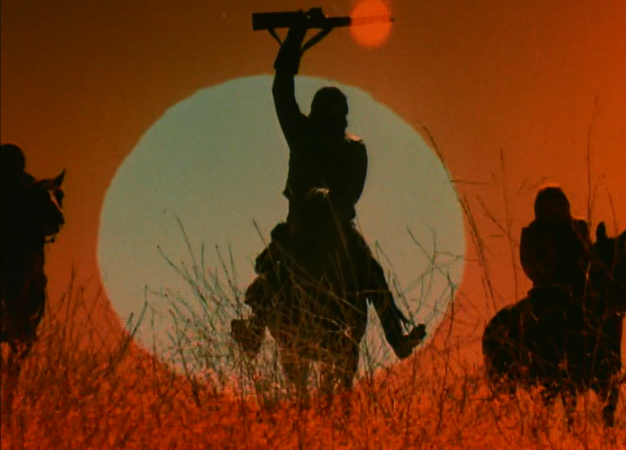
Next, we get a wider shot of the ape soldier. He is seated on a horse, with one arm jutting up into the air in a pose of victory. He is holding a tool of power as well: a rifle.
Once more, he does not move, but remains frozen in the frame. Behind him -- in a double-exposure effect -- the sun seems to be going down.
The orange-colored sky suggests autumn, and the sunset suggests an end to the age of man. This image means that ape is triumphant, and man is sinking...fast. The ape has eclipsed man.


Next, we meet our heroes on the run. In the first shot, Galen flees the ape regime.

The blocking is significant in the next few shots.
Three apes sit perched atop a hill (another position of dominance), while the astronauts run for their lives.
Again, the apes are perfectly still -- suggesting permanence -- while the humans are on the move, fleeing. It is no accident that the apes don't move in this intro, but the fugitives, the humans, move constantly. This is a metaphor for the power structure of Ape Society.


Next, the real power on the Planet of the Apes comes into focus. An ape rifle coalesces as, behind it, the day of humanity recedes.


The last several shots of the montage continue in the same vein. They reveal the gorilla soldier -- and his weaponry -- dominant in an orange, autumnal sky.
The Age of Man has passed. Welcome to the Planet of the Apes!


Below, the Planet of the Apes montage in living color:
award-winning creator of the web series Abnormal Fixation (2024), the audio drama Enter the House Between (2023) and author of 35 books including Horror Films FAQ (2013), Horror Films of the 1990s (2011), Horror Films of the 1980s (2007), TV Year (2007), The Rock and Roll Film Encyclopedia (2007), Mercy in Her Eyes: The Films of Mira Nair (2006),, Best in Show: The Films of Christopher Guest and Company (2004), The Unseen Force: The Films of Sam Raimi (2004), An Askew View: The Films of Kevin Smith (2002), The Encyclopedia of Superheroes on Film & Television (2004), Exploring Space:1999 (1997), An Analytical Guide to TV's Battlestar Galactica (1998), Terror Television (2001), Space:1999 - The Forsaken (2003) and Horror Films of the 1970s (2002).
Subscribe to:
Posts (Atom)

-
 It is an indisputable fact that fan service and good drama don’t always go hand-in-hand in the cinema. In fact, sometimes these factors div...
 -
 It is quite difficult to believe, but in 2024, Ridley Scott’s Alien (1979) turns 45 years old. Perhaps the most amazing thing about Alie...