Monday, April 27, 2015

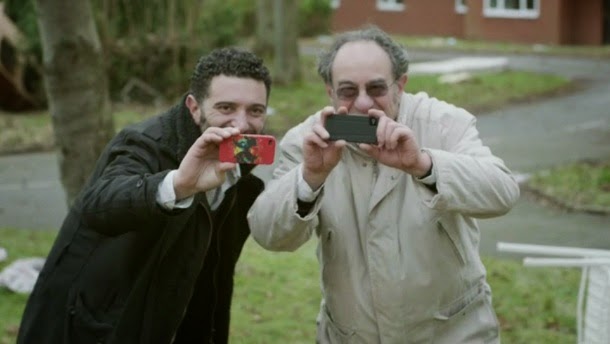
The Cult-TV Faces of: The Camera

Identified by Hugh: The Twilight Zone: "A Most Unusual Camera."

Identified by Hugh: Star Trek: "Patterns of Force"

Identified by Hugh: Kolchak: The Night Stalker

Identified by Hugh: Space:1999: "The Testament of Arkadia"

Identified by Hugh: V: The Original Miniseries (1983)

Identified by Hugh: ALF (first season opening credits)

Identified by Hugh: Lois and Clark: the New Adventures of Superman

Identified by Hugh: The X-Files: "Tithonus."

Identified by Mr. C: Buffy the Vampire Slayer: "Storyteller"

Identified by Hugh: The Walking Dead.

Identified by Hugh: Smallville.

Identified by Hugh: Doctor Who: "Hide"

Identified by Chris G: Black Mirror: "White Bear"

Sunday, April 26, 2015

Advert Artwork: Incredible Hulk Edition


At Flashbak: The Simpsons’ Top Five Movie Parodies of the 21st Century


The second article I wrote for Flashbak this week involves a piece of conventional wisdom that I truly dislike.  I know you've heard it, or read it.  It goes like this: The Simpsons used to be great; but now it sucks.

After watching the last seven or so seasons with my son, Joel, I can assert differently, I feel.  This article takes on that particular conventional wisdom.


"If you want to, you can read all the conventional wisdom that is available all over the Net.

The Simpsons (1989 to present) has -- for at least the last several years -- been a mere shadow of its former (great) self.

The truth is somewhat more complicated than that criticism, of course.

The Simpsons began its TV life during the First Bush presidency over a quarter century ago as a caustic cartoon satirizing American middle class families and their values. In that era, family comedies were everywhere (Family Ties, The Cosby Show, Roseanne, etc.) and The Simpsons was an alternative to the idealized programming.

After about a dozen years or so in that format -- not to mention over two-hundred episodes – the central premise, a cartoon family as real American family, was pretty adequately played out, and The Simpsons by necessity had to evolve.

And what it became is something truly wonderful and unexpected.

The Matt Groening-conceived series transformed from sitcom parody/corrective into an absurdist, gag-a-minute, post-modern, meta-commentary on all-things pop culture, from YA novels to iPhones, from politics to Internet etiquette.

Furthermore, the series took pride in focusing on its remarkable supporting cast -- Ned Flanders, Moe, Chief Wiggum, Mr. Burns, Smithers, Nelson, Skinner, Otto, Apu, Grampa, Krusty, Milhouse, Patty and Selma -- to such a degree that it thrives to this day, in many senses, as the best developed such ensemble on modern American television.

We hear all the time from the audience who started with the show back in the late 1980s.  They observe that the series is a shell of its former self, when the truth is that The Simpsons is a different animal than it once was. And in some ways, it’s a far more entertaining, far more inventive program.

Perhaps then, the series deserves to be judged based on what the program continues to be, not how it began twenty-seven years ago.  


One way to judge the conventional of declining quality is to look back over the last fifteen years -- the years of the twenty-first century -- and remember some of The Simpsons’ greatest movie parodies. These shorts (often featured on the Treehouse of Horror specials) remind us that the stories hasn’t missed a step, and remains the funniest series airing on network TV..."

At Flashbak: Fantastic Files: The Forgotten Genre Magazines of the Seventies and Eighties


This week at Flashbak, I looked back at some of the more obscure or forgotten genre magazines of the seventies and eighties.


"The 1970s and 1980s – the pre-Internet Age -- witnessed the rise of so many great genre magazines. Starlog and Fangoria were two favorites of mine, and publications widely read and appreciated by fans. Also popular at the time was the long-established (and beloved) Famous Monsters, and the scholarly Cinefantastique.

But the seventies and eighties also witnessed the rise and fall of many other great magazines that, today, don’t have the same recognition as these titles.

For example, one of Starlog’s primary competitors, at least for a time, was Fantastic Films, which was published by Irv Karhmar and the Blake Publishing Group.

This magazine featured amazing, in-depth interviews with the most important talents of the era (from Charlton Heston to Glen A. Larson) as well as a great reader’s page called “Reaction.”  The magazine sold for $2.00 an issue, sometimes featured “a giant color poster” inside, and often looked back at classic films and TV series. 

Fantastic Films was published from 1978 to 1985, before it went under, but I cherish my collection 
of issues today for the scholarly, wide-ranging interviews, and intriguing think-pieces, including an analysis of sexual imagery in Alien [1979] that completely opened up new and provocative readings of the Ridley Scott classic.  In some ways, Fantastic Films was every bit the equal of Starlog, except in terms of its longevity.

In the mid-1980s, the Psi-Fi Press and Movies Publishers Services, Inc., published a series of “spotlight” magazines on film and television, called “Files” Magazines.  There were Files magazines devoted to Star Trek (1966 – 1969), Doctor Who (1963 – 1989), The Man From U.N.C.L.E. (1964 – 1968) The Prisoner (1967), James Bond, The Avengers (1961 – 1969) and even V: The Series (1985).  Each issue featured an introduction, a part of an on-going episode guide, and interviews with on-screen talent and behind-the-scenes. I always felt that these magazines made a great point: that TV shows -- their artistry, storytelling, and production -- were worth writing about..."


The Incredible Hulk: "The Antowuk Horror" (September 29, 1978)


In “The Antowuk Horror” by Nicholas Corea, David Banner (Bill Bixby) is hiding out in a small resort town, and has taken a job in a local hardware shop.

There, he tutors a young girl, Sam (Debbie Lytton), and works for her temperamental and resentful father, Harlan (Bill Luckings). 

When Harlan treats David badly and makes him complete an inventory in a messy and dangeroius storage closet, David injures himself on a propane tank and crow bar, and transforms into the Hulk.

Harlan sees the Hulk, and realizes that a monster like him could revive Antowuk’s  ailing economy. 

He sets out to orchestrate a hoax involving “The Antowuk Horror,” unaware that an old friend of McGee’s (Jack Colvin) -- a hunter looking to make a name for himself again -- is hell-bent on shooting dead the Hulk and any other monster in his sites.


Perhaps the most intriguing aspect of this early Incredible Hulk (1978 – 1981) episode is the strong recession vibe it so dramatically expresses.

In one early shot in “The Antowuk Horror,” a young girl (Samantha) walks down a small-town street and behind and around here there are signs everywhere for stores going out of business or “fire sales.”  Some buildings are even boarded up.  It looks a lot, in other words, like America circa 1978-1979 (or, actually, 2008…).


Indeed, the central premise of the episode is that the economy of a resort town has failed to such an extent that only a myth like “Bigfoot” (name-checked in “The Antowuk Horror”) can resurrect its fortunes. You almost can’t blame the desperate Harlan for seizing on the inspiration the Hulk provides: his friends (including one played by Lance LeGault) are planning to leave town permanently.  Everyone is giving up.

In some ways, what’s much worse about Harlan than his hoax is his resentful, insecure, anti-intellectual attitude. He’s a bully, and acts abusively towards David.  In fact, he’s an arrogant, entitled redneck, and those qualities go some distance towards making him less-than-sympathetic, whatever his economic woes.  I mean, he basically beats David up, and David – unable to go to the authorities – stands for this behavior. 

In The Incredible Hulk, David is often the very definition of long-suffering.  He always attempts to control his anger, fear and rage, but those limits are severely tested (at a rate of twice per hour-long episode) all the time.  Here, he tolerates being pushed around, and gauging his palm with a crow-bar, but when a heavy gas tank falls on his foot…that’s it. 

The Hulk is in the building.


“The Antowuk Horror’s” other contextual subject (besides the Carter Era recession) is the nation’s fascination -- in the 1970s -- with the Bigfoot legend. 

Here, we see lemming-like news crews, recreational campers, tourists, and other folks storm into the resort town for a glimpse of a Sasquatch-like cryptid.  In the decade of the Bionic Bigfoot, Bigfoot and Wild Boy, and In Search Of, “The Antowuk Horror” is a not-unexpected our out-of-place addition to the Hulk canon.  


Unfortunately, the episode doesn’t feature the kind of final fight it might were the Hulk were actually to battle the real Bigfoot.  Harlan is a paper tiger a man masquerading as a werewolf-like beast.  The Hulk makes short work of him, but when Samantha is endangered, comes to his aid. 

I always loved this aspect of the TV rendition of the Marvel character. David’s goodness shines through, even when he’s mean and green.  Angry or not, if you've good character is good character, I guess you might say.

Outré Intro: The Incredible Hulk (1978 - 1981)


The Incredible Hulk (1978 - 1981) is a real rarity in cult-tv history. 

It is a comic-book adaptation that is completely unfaithful to the details of its literary source material, and yet remains beloved by fans. For example, the series presents a different origin for the Hulk, omits the comic's supporting characters, and features no comic-book villains whatsoever. 

Worse, the series adopts the tired, oft-recycled format of The Fugitive (1963 - 1967), about a man on the run from the law, with a hapless pursuer forever on his trail but never catching him.

Despite such obvious creative deficits, the stories on The Incredible Hulk, such as "Married" with Mariette Hartley, are enormously affecting and well-written. Similarly, the late Bill Bixby is remarkably good as David (Bruce) Banner, and Lou Ferrigno is the perfect living embodiment of the Hulk, no CGI required, thank you very much.

The carefully-crafted opening or introductory montage for The Incredible Hulk nicely reflects the series' virtues. At first blush, it may seem like an outright copy of the intro for its contemporary, The Six Million Dollar Man (1974 - 1978), since it features a voice-over narration explaining the main character's "accident" and then new predicament. 

Yet on close examination, one can see how adroitly and artistically The Incredible Hulk montage introduces the artistic and dramatic parameters of this revered superhero series.

The first shot is among the best and most critical of the entire montage. It is a close-up view of an indicator flashing red, reading in all-caps "DANGER." 

But, intriguingly, the framing of the word "DANGER" largely omits the "D" at the front of that word.  So, the first image we see is a red flashing indicator that says, basically "ANGER."  

And "ANGER," of course, remains a key concept for this interpretation of the Hulk mythos.  It is extreme anger, after all, that precipitates the transformation from mild-mannered scientist David Banner to gamma-ray-infused juggernaut, the Incredible Hulk.


Following a zoom back from the word "ANGER, we get a view of the high-tech scientific equipment being used in an experiment by Dr. David Banner.  The next several shots focus on the nature of the danger (an increase in "Gamma Units," and reveal that David is, himself, the test subject.

Two additional things to note in the following shots:  First, there is a frequent focus on hands throughout the montage.  

In this case, framing or featuring two hands in the shot represents or symbolizes "balance."  At this point, David's psyche is ordered and balanced, and so when we see both hands positioned are they are, we are to understand that this is, literally, Ground Zero, of the experiment.  David is starting from stability, and moving towards, alas, grave instability.

The second visual we see here is one of equipment being prepared for the dangerous experiment.


Several of the shots featured above generate suspense as they feature the "ticking clock," counting down towards the moment in which David will be rendered unstable, and changed forever.  

The next shot puts David in visual jeopardy, literally putting his brain in the cross-hairs of the experiment. Once again, we get an explicit shot reminding us of DANGER.


At this point, David is suffused with gamma rays during his experiment to "tap" the hidden strength he believes all humans possess, and the X-ray shot of a human skull suggests that his very body chemistry is altered.


In the next series of shots, we understand that the experiment has been carried out, and that David has been altered by the gamma rays.  We understand this from a view of his cells, which undergo transformation and change.

Next, we get a shot of lightning in the sky at night, an indication that David's experiment is unnatural. It has made God angry.

Together, the following shots juxtapose inner nature (David's changed psyche and physiology) and Outer Nature, or Mother Nature.


Next, the narrator reveals that, post-experiment, when David grows angry or outraged, the change to the Incredible Hulk involuntarily occurs.  

We see one example of this happening. David attempts to fix his car on a rainy night, and again, we see two hands, representing balance, undertaking repairs.

Then, we see just one hand, as David is injured during his attempt to change a tire. The focus on one hand at this juncture suggests his imbalance, and we get a close-up of him screaming in pain and rage. Once more we see the x-ray skull and his altered cells, to remind us of Banner's transformed nature.


Next, as the change from David Banner to The Hulk commences, we move into our first opening title card, indicating performer credits: "Bill Bixby in...."


As we wait for the title of the series (and are left hanging by the word "in..."), we get our first view of the titular character, the Incredible Hulk. Not surprisingly, it is an asymmetrical view: a view of one arm -- much like one hand -- indicating imbalance.  

Thus we understand, psychological and physical balance is lost as Banner's muscles grow, clothing rips, and the Hulk erupts.  The creature is revealed in all his glory, but not before demonstrating his strength by over-turning the damaged vehicle.


After the dramatic title card (above), it's onto the dramatic business of establishing The Hulk's back-story, and his hapless pursuer, reporter Jack McGee (Jack Colvin).


The following frames feature an intense conversation between prey and pursuer, McGee and Banner, that has become iconic, even a trademark of the series.  

David tells McGee not to make him angry, and, furthermore, that the reporter would not like him when he is angry.  

The word "angry" very clearly ties into the opening shot of the montage, which flashed "ANGER" at the audience.


In the next series of shots in the intro, we see fire and explosions, an indication that David has faked his own death, so he can look for a cure to his condition without being hounded by the police, or anyone else.  

Again, the visual of fire seems to symbolize the Hulk's nature too, the anger and rage burning inside. The creature represents a form of anger that burns out of control. 

Similarly, the scenes of fire seem to validate Banner's warning to the reporter.  Don't get too close to him -- or the flame -- or you''ll get burned.


Next we get our supporting performers credited...


The story continues below, as we see David visiting his own grave. 

His defiance of Mother Nature for the advancement of science and medicine has led not to glory or hope, but to the death of his life as it was, a death symbolized by the headstone and the locale.  

The inference? David cannot live a normal life so long as the monster boils and burns inside of him.  The man who he was is now dead.


Finally, a great split-screen shot that I absolutely love.  

In the graveyard, David looks up sadly from his own casket, and we see his face juxtaposed -- split in half, actually -- with the Hulk's face.  

This shot represents a different kind of balance than any we have seen in the montage thus far.  David has split himself, Jekyll-Hyde style, and he will know no peace until he is restored.


The Incredible Hulk opening montage does a terrific job, in 90 seconds or so, of establishing David's back-story, and the nature of the experiment that ruined his life.  

More than that, it highlights ANGER as the thing that he cannot contain, the quality that brings out the monster within. And again, that is a key concept of the series, going forward.

 Below, the montage in its entirety:

10 Years Ago: Star Trek Beyond (2016)

The world needed a good  Star Trek  movie in 2016. Why? As a reminder of who we are, who we have been, and who, I hope, we can be again. And...