Tuesday, December 30, 2014

Remembering 2014 on the Blog


The year 2014 has been a fantastic one for the Muir family, and also for this blog.  I hope it has been for you as well.

In terms of the blog, there have been more posts online than in any previous years in the blog’s history (1400+) and a number of special event weeks to boot.


In 2014, there was a Conan the Barbarian Week, a Godzilla Week, a Planet of the Apes week, and a Terminator Thirtieth Anniversary Week as well.


The blog also featured retrospectives of the David Twohy Riddick films, and the “V” or Visitor Saga, called “The Visitors Are Coming.”  There were also retrospectives of the horror themed works of directors William Girdler, Charles B. Pierce, and Richard Franklin.

In terms of Saturday morning programs, the blog remembered Hanna Barbera’s Godzilla (first season), Filmation’s BraveStarr, and we also started our look back at Korg 70,000 B.C. In early January, we’ll leave BraveStarr for a while and check out The Secrets of Isis starring Joanna Cameron.

And speaking of upcoming events, 2015 is a big year for genre film. 


We can all look forward to a new Mad Max film called Fury Road in May, a new Terminator film in July, Daniel Craig's fourth 007 film in November, and the arrival of Star Wars Episode VII - The Force Awakens in late December.  Rest assured, I will be covering all those films (and franchises) here on the blog.


But 2015 is also the 50th anniversary of…Irwin Allen’s Lost in Space (1965 – 1968), so I’ll be doing a weekly retrospective of that classic series as well, starting on Sunday, January 4th.

In much more personal terms, 2015 is the tenth anniversary of this blog.  I’ve completed, as of April 2015, ten full years of blogging, and so I’ll be looking back at some of the best (and angriest…) reader comments, and also the blog’s highlights and low-lights.

In short, 2015 promises to be a great year, so I hope you will stick around, and continue the ongoing conversation about classic television and cult film with me.

People always ask me when I’m going to give up blogging.  I have no plans to do so…I enjoy it too much. 

So I hope you’ll continue to visit the blog, and pass the days and weeks here with me.

Happy New Year to all!

Sincerely,

JKM

Monday, December 29, 2014

At Flashbak: Great Sci-fi Magazine TV Commercials of the 1970s and 1980s


My latest article at Flashbak remembers TV commercials...for genre magazines. I remember seeing many such commercials when I was a kid growing up in the New York/New Jersey area.


"So…anyone remember magazines?

That’s just a joke, of course. Printed magazines are still around in the year 2014, but since the arrival of the Internet many of the great one, long-lived ones (especially in the genre), like Cinescape and Starlog have completely disappeared from newsstands.

It wasn’t always this way. In the 1970s and 1980s, the genre witnessed a great magazine boom, so much so that magazine budgets were often flush enough to afford TV advertising.

Here are some TV commercials for genre magazines from that era..."

Cult-TV Theme Watch: The Hacker


A hacker is a person, female or male, who is studied in the using -- sometimes illicit -- of a computer. 

A hacker is not only a programmer, but one who uses those considerable skills to gain access to secure computer networks.

The hacker has been a staple of pop-culture and genre television since the 1980s. 

In 1983, the CBS series Whiz Kids (1983 -1984) concerned high-school students who were, essentially, hackers, and used their computer knowledge to solve mysteries, or bring criminals to justice. The lead hacker was Richie Adler (Matthew Laborteaux), who used his father’s computer equipment and re-assembled it into “Ralf,” his specialized system.


An episode of V: The Series (1985) also concerned a hacker.  In “War of Illusions,” a young man and arcade game player was able to hack the Visitor mothership in Los Angeles, and learn of the Leader’s secret battle plans, which were to be executed by computer.  Diana captured the hacker’s father (Conrad Janis), believing he was the hacker, rather than the teenage boy. The hacker enlisted the Resistance, including Mike Donovan and Kyle Bates, to get his father back, and scramble the computer battle plans.


On The X-Files (1993 – 2003), the Lone Gunmen trio consists of two hackers who are very competitive with one another, Melvin Frohike (Tom Braidwood) and Richard Langly (Dean Haglund). Each one thinks that he is the better programmer/hacker.

“Eyes Only” -- Logan Cale -- in Dark Angel (2000 – 2002) is also a hacker, one who creates exposes and streams them to the people of Seattle in the dystopian future world of Seattle.


In superhero series, in fact, the hacker has become a crucial member of the crime-solving team. Chloe Sullivan (Allison Mack) on Smallville (2001 – 2011) graduates from news reporter at The Torch to hacker and computer programmer in Metropolis, known as “Watch Tower.”


And on Arrow, Felicity Smoak (Emily Bett Rickards) is the IT expert at Oliver Queen’s company in Starling City, but she soon becomes a hacker, working for The Archer (Queen) and helping him right the wrongs of the city.

Many, many TV series have included hackers. On Millennium (1996 – 1999), the Millennium Group’s IT guy, Roedecker (Allan Zinyk) was a recurring character in the second season, and was of special help to Frank Black (Lance Henriksen) in the episode “The Mikado,” which involved a killer murdering people online, at a dedicated web site.


And Jack Bauer’s (Kiefer Sutherland) greatest resource  -- in the field and in CTU – is Chloe O’Brian (Mary Lynn Rajskub), on 24 (2001 – 2008).

The Cult-TV Faces of: The Hacker

Identified by Hugh: Whiz Kids

2

Identified by Hugh: Willow, on Buffy the Vampire Slayer

4

Identified by Ponch: Logan Cale on Dark Angel

6

Identified by Ponch: 24. 

8

9

10

11

Identified by Hugh: Clara (Jenna Coleman): Doctor Who

13

Identified by Hugh: Felicity Smoak, Arrow

Television and Cinema Verities: BraveStarr Edition


“…the one that I thought tremendously well was disappointing, and that was BraveStarr. I always wanted to do a space western, and it had all those qualities in there – except I think we got a plot placement in the wrong time slots, I don’t know.  My favorite, and more fun because I was a science fiction nut and I like westerns.”

- The late, great Lou Scheimer discusses BraveStarr, in an interview from 2007, at The Trades.

Sunday, December 28, 2014

From the Archive: Man from Atlantis (1977-1978)


The first American network series to be broadcast in China (and one immensely popular there to this day...), Man From Atlantis is a short-lived superhero series from the mid-1970s; one that fits in with the pop-culture trend I term the Age of "Nostalgia" or of "Americana."

Programs of this era included The Six Million Dollar ManThe Bionic WomanWonder Woman, The Amazing Spider-Man, and even a set of very poor Captain America TV-movies starring Reb Brown (!).


What these many disco decade superhero productions share is a sunshiny overall atmosphere and a total -- even will full -- denial of the vast cynicism of their time period.

Created post-Watergate and post-Vietnam War, these superheroes served as innocent, pure-hearted protectors who always fought for America, defending it from Soviets, space monsters, underwater monsters, robots...you name it. The angst and broodiness we have come to expect post-"Dark Age" (The Dark Knight, The Crow, Blade, etc.) did not yet exist. But the Americana shows -- while charming and good for curiosity viewing -- were also strangely childish and occasionally downright slipshod in terms of production values.


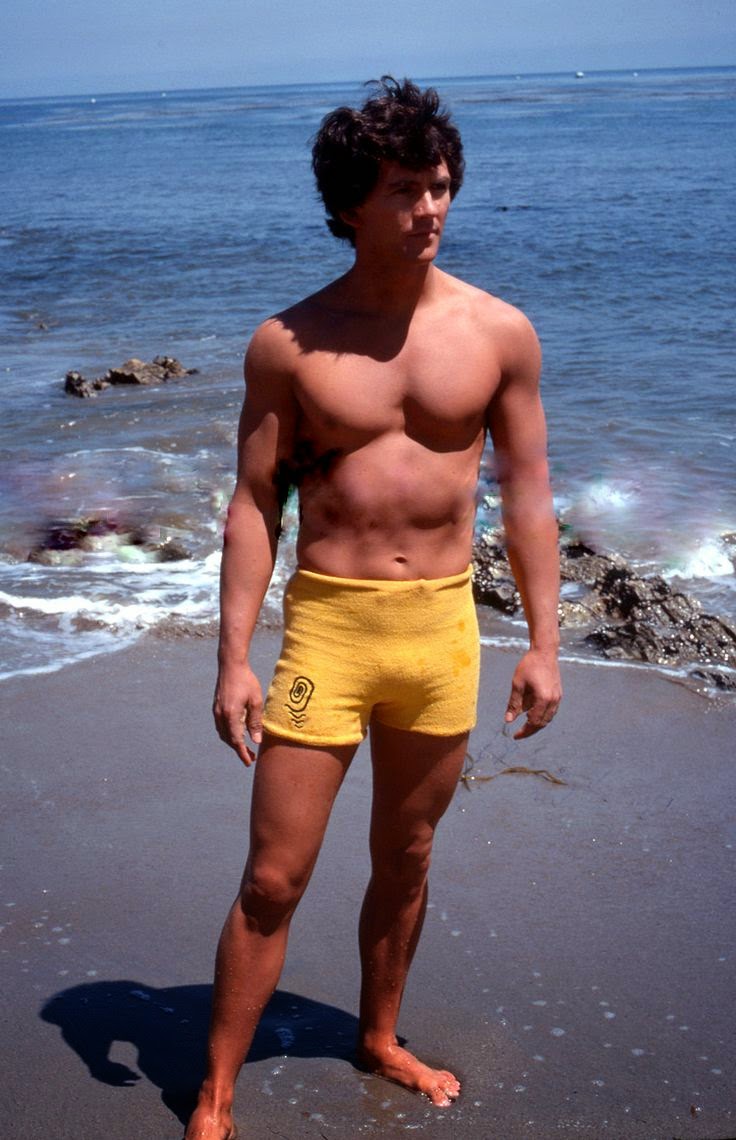
Man From Atlantis told the story of the last survivor of the lost continent of Atlantis, a web-fingered, young man named Mark Harris (Patrick Duffy). He quickly became a secret agent for the United States. I guess a lot of cases in U.S. intelligence circles occured underwater in the seventies, since Captain Nemo, once revived, also became an operative for our government (see 1978's The Return of Captain Nemo).

Now, as you may know, nearly forty years before The Man from Atlantis, Marvel Comics had already introduced its own Man from Atlantis–style character: Bill Everett’s Prince Namor, otherwise known as the Sub-Mariner.

That's a different guy.

Where Namor was the arrogant grandson of King Thakorr and alternately known as “the Avenging Son of Atlantis” or the “Prince of Blood," Mark Harris was a water-breather of a different stripe. He was a peaceful, even-tempered gentleman who more closely resembled Star Trek's popular Mr. Spock -- a friendly, peaceful resident alien -- than an angry avenger from under the sea. Spock had pointed ears; Harris had webbed fingers.

Patrick Duffy described his heroic character as "extremely, intelligently naive. He’s very quick. He’s unencumbered by hang-ups…. He has a total lack of that kind of ego that stops us from taking a different direction because we hate to admit that the one we took in the first place was wrong. He’s totally open to suggestion." (David Houston, Starlog # 9: "Patrick Duffy: TV's Man From Atlantis," October 1977, page 28).

No. Not exactly “the Prince of Blood” in concept.

Where Namor passionately hated mankind for polluting his home (the seas), Mark Harris was more forgiving. The last survivor of Atlantis, Harris had no memory of his background, and had gills instead of lungs, which meant he could remain above water for only twelve hours at a stretch. Harris could also swim incredibly fast, and in a unique dolphin-like motion as well. His signature gait became all the rage at American swimming pools for boys eleven years old and younger. I know...I was one of them.

On Man From Atlantis, Harris worked with a nice, attractive scientist, Dr. Elizabeth Merrill (Belinda Montgomery); and even joined the crew of the Cetacean, an advanced, experimental U.S. government submarine not unlike the starship Enterprise (where, again, Harris was the resident alien). Harris’s unofficial boss at the Foundation for Oceanic Research (the United Federation of Planets?) was C.W. Crawford (Alan Fudge).


Stories featured on The Man from Atlantis were the typical clichés of science fiction and superhero lore so popular at the time. 

Harris time-traveled to the Old West to take part in a shoot-out in “Shoot Out at Land’s End.” 

He battled a genie (Pat Morita) who could revert people to their childhood in “Imp.” 

In one truly bizarre outing, “The Naked Montague,” Harris traveled into the past to prevent the bloody demises of Shakespeare’s young lovers, Romeo and Juliet! 

Yep...they weren't fictional after all!

Villains on the series ranged from a deadly giant (Kareem Abdul-Jabbar) to a colossal jellyfish ("Man O 'War"), to the recurring “evil genius” Mr. Schubert (portrayed by the rotund Victor Buono -- King Tut on Batman). The tone of the series bordered on camp and director Michael O’Herlihy went on record noting that it was this lack of a consistent and serious tone that ultimately hurt The Man From Atlantis with audiences:

"I don’t know if Man from Atlantis was science fiction or what the hell it was..." (Edward Gross, Starlog # 131 "Michael O'Herlihy, Storyteller of Tomorrow and Yesterday," June 1988, page 72).

The first season of Man from Atlantis ran sporadically on NBC as a series of two-hour movies on Thursday nights. The second season settled down into a regular pattern, airing Tuesday nights in the fall of 1977 and spring of 1978 at 8:00 p.m., competing against the then-powerhouse combination of nostalgia sitcoms Happy Days and Laverne and Shirley on ABC.

Ultimately, The Man from Atlantis got flushed by NBC after the seventeenth and last episode, which aired on June 6, 1978. Star Patrick Duffy re-bounded with a starring role on the CBS soap opera Dallas starting in 1980.

Today, the sort-of-silly, sort-of-charming Man From Atlantis remains a nostalgic favorite for many Generation X-ers, and is finally available on DVD through the Warner Archive. Any day now, someone is certain to re-imagine the series...

Outré Intro: Man from Atlantis (1977)


Superheroes were quite the rage in the mid-1970s...at least in terms of cult-television.  In fact, Marvel superheroes appeared regularly in TV movies and series of the day, including Captain America (Reb Brown!), Doctor Strange (1978), The Amazing Spider-Man (1977 - 1979), and the most successful of the bunch: The Incredible Hulk (1978 - 1981).  

Meanwhile, D.C. had The New Adventures of Wonder Woman (1975 - 1979) on the air, and The Six Million Dollar Man (1973 - 1978) and The Bionic Woman (1976 - 1978) were also enormously popular too.

Following along this trend, Mark Harris -- the Man from Atlantis -- was a character who featured elements from both the Sub Mariner and Aqua Man comic-books: a water breathing hero who had a sometimes difficult relationship with the denizens of dry land.  

Man from Atlantis started out as a series of TV-movies that were highly rated, before it became a weekly series for one season.

Part of the reason Man from Atlantis "hit" at first with the general public, was its star, Patrick Duffy. The actor brought incredible sincerity and innocence to the role of amnesiac Harris, a man caught between the world he had lost (under the sea) and the world that fascinated him, on the surface.  In interviews during the run of the series, Duffy often compared the character explicitly to Star Trek's Mr. Spock.

Both beings were aliens in the worlds they lived in, and marked by enhanced abilities and physical differences. In the latter case, Spock had pointed ears, and Harris had webbed fingers. But like Spock, Harris was capable of commenting on the follies of humanity at the same time that he worked to preserve and protect it.  He was an outsider, in other words, but not a threatening one.

The series' introductory montage expresses the idea of Harris's wonder and innocence, as well as the dangerous or at least adventurous world of human beings.  As the short intro commences, we see Harris breathing underwater, observing the beautiful and strange sea life all around him. These shots explicitly suggest the wonder and mystery of the sea, and position Harris himself as being a part of them; as one with them.  The soundtrack here is gentle, mysterious.


Next, we get a view of the character's trademark swimming style, which mimics the movements of a dolphin. Mark heads up and up, towards the surface, and towards man's world above.  These shots again suggest Harris's non-human nature and ability to bridge worlds.


Mark Harris breaks the surface of the sea -- the barrier separating universes -- and we get the title card for the series.  At this point, Harris has left one world for the other, and the music changes from wondrous, sensitive and innocent, to a more driving, aggressive beat.  

We are about to enter the dangerous world of human concerns.


As the more hard-driving theme continues, we start to see emblems of that world, as well as series primary settings.  

First, we encounter the Cetacean, the government submarine that will house the Man from Atlantis and be the starting point for our weekly adventures.


Next, we get a shot that perfectly symbolizes the joining or melding of the two worlds: Mark's webbed fingers hover over a sonar/radar device, an emblem of man's technological world.  Again, this shot signifies the core idea or conceit of the series of Mark Harris as the bridge between two worlds.


Next, we meet our cast.


As the series' creative, behind-the-scenes personnel are introduced on screen, the audience sees the Cetacean on its journeys, manned by humans and by the Man from Atlantis. 

The last shot of the montage is a familiar and iconic one: the hero and his steed riding off into the sunset.  Only this time, the setting is underwater, and the "steed" is a submarine, a high-tech ship exploring the oceans of Earth.


Below, you can see Man from Atlantis's opening montage in live-action:

Guest Post: "Teenage Sex and Death at Camp Miasma"

As Sondheim wrote, "Every Day a Little Death." By Jonas Schwartz-Owen   Two worlds run through Jane Schoenbrun's  Teenage Sex ...