Subscribe To JKM


 Posts
All Comments
Posts
All Comments
Thursday, April 25, 2013
The X-Files Promo: "3"

 award-winning creator of the web series Abnormal Fixation (2024), the audio drama Enter the House Between (2023) and author of 35 books including Horror Films FAQ (2013), Horror Films of the 1990s (2011), Horror Films of the 1980s (2007), TV Year (2007), The Rock and Roll Film Encyclopedia (2007), Mercy in Her Eyes: The Films of Mira Nair (2006),, Best in Show: The Films of Christopher Guest and Company (2004), The Unseen Force: The Films of Sam Raimi (2004), An Askew View: The Films of Kevin Smith (2002), The Encyclopedia of Superheroes on Film & Television (2004), Exploring Space:1999 (1997), An Analytical Guide to TV's Battlestar Galactica (1998), Terror Television (2001), Space:1999 - The Forsaken (2003) and Horror Films of the 1970s (2002).
Wednesday, April 24, 2013
Collectible of the Week: Terminator 2 Playset: Bio-Flesh Regenerator (Kenner; 1991)


The
year 1991 brought a whole line of new Kenner toys -- including vehicles and
action figures -- based on James Cameron’s blockbuster Terminator 2: Judgment Day. One of the neatest of these toys was the
Bio-Flesh Regenerator Playset which offered kids the opportunity to “Mold and Destroy your own Terminator!”
As
the box describes the set, “The Bio-Flesh
Regenerator was created in the year 2030. This awesome unit is used to
completely cover the metal skeleton of the TERMINATOR with real skin to make
him totally undetectable to humans.”
The
Bio-Flesh Regenerator “Molds Ten Figures,”
“Comes with six battle weapons,” and “Skin
actually comes off in Battles.” The
box also notes that the set includes: one playset, two Endoskeleton Action
Figures, two Cans of Non-Toxic Bio-Flesh Refills, one Trim Knife, and six
Weapons.”
“Create your own
Terminator…then tear him apart in battle!”


I
recently bought a Bio-Flesh Regenerator for Joel, still in its original
box. Amazingly, the flesh “powder” is
still intact. We tried using the regenerator,
but the play set kept leaking, which disappointed Joel tremendously, as he
wanted tear apart his fleshy terminator in battle. Instead, the Terminator just kind of cameo
out goopy. Also, it should be noted that
the endoskeletons are not pose-able and feature no articulated parts
whatsoever, which is also a bit of a bummer.
I
understand that the idea of the Bio-Flesh Regenerator was updated for
Terminator: Salvation (2009), with a “Cyber Skin” playset. I wonder if it worked any better…
award-winning creator of the web series Abnormal Fixation (2024), the audio drama Enter the House Between (2023) and author of 35 books including Horror Films FAQ (2013), Horror Films of the 1990s (2011), Horror Films of the 1980s (2007), TV Year (2007), The Rock and Roll Film Encyclopedia (2007), Mercy in Her Eyes: The Films of Mira Nair (2006),, Best in Show: The Films of Christopher Guest and Company (2004), The Unseen Force: The Films of Sam Raimi (2004), An Askew View: The Films of Kevin Smith (2002), The Encyclopedia of Superheroes on Film & Television (2004), Exploring Space:1999 (1997), An Analytical Guide to TV's Battlestar Galactica (1998), Terror Television (2001), Space:1999 - The Forsaken (2003) and Horror Films of the 1970s (2002).
Model Kits of the Week: SeaQuest DSV (1993)


 award-winning creator of the web series Abnormal Fixation (2024), the audio drama Enter the House Between (2023) and author of 35 books including Horror Films FAQ (2013), Horror Films of the 1990s (2011), Horror Films of the 1980s (2007), TV Year (2007), The Rock and Roll Film Encyclopedia (2007), Mercy in Her Eyes: The Films of Mira Nair (2006),, Best in Show: The Films of Christopher Guest and Company (2004), The Unseen Force: The Films of Sam Raimi (2004), An Askew View: The Films of Kevin Smith (2002), The Encyclopedia of Superheroes on Film & Television (2004), Exploring Space:1999 (1997), An Analytical Guide to TV's Battlestar Galactica (1998), Terror Television (2001), Space:1999 - The Forsaken (2003) and Horror Films of the 1970s (2002).
Tuesday, April 23, 2013
Cult Movie Review: Oblivion (2013)

[Note:
Spoilers ahead. Swim at your own risk.]
In
imagining Earth’s future, Oblivion (2013) reaches back to the
sci-fi cinema’s past.
This
big-budget summer film stars Tom Cruise as a heroic character, Jack Harper,
caught in a corrupt “future” establishment and coming to learn that reality isn’t
quite what it appears.
Jack
is a drone repairman, or Tech 49, precisely, working out of a luxurious sky-base
over the ruins of Earth following a great war with unseen aliens called “Scavs”
or “Scavengers.” If Jack doesn’t keep
several drones operating constantly, these aliens will return and pulp the giant
fusion reactors which are sucking the world’s oceans dry, and are desperately needed
by man if he is to make an exodus to Titan, Saturn’s moon and begin anew.

Students
of the sci-fi movies of yesteryear will immediately recognize many of the
creative touches in Oblivion. Jack is a hero
not entirely unlike Zed (Sean Connery) in Zardoz (1974) or Logan 5 (Michael
York) in Logan’s Run (1976). He’s
smart and curious enough to recognize the things “wrong” at the edge of his
periphery on 2077A.D post-war Earth, but not quite smart and curious enough to
buck the system…until pushed to do so.
In
diagramming Jack’s journey of self-discovery, Oblivion quotes extensively
from many other films of the same historical period as the examples I noted
above.
Early
in the film, for instance, Jack finds a dark hole leading down into the ruins
of the New York Library, and -- if you’re
old enough -- you may recall James Franciscus making a similar trek into
Under New York in Beneath the Planet of the Apes (1970).
There’s a subplot, too, involving cloning that
reminded me of The Clonus Horror (1978).
But
frankly, Oblivion is an equal opportunity “borrower.” It cribs images and themes from the 1980s and
1990s as well as the 1970s. The finale
replays the climactic moments of Independence Day (1996), for
instance, while featuring a subplot about human memory and an “artificial”
romantic relationship that harks back to Total Recall (1990). One
aspect of the plot’s resolution involves a “surprise” straight out of 2009’s Moon.
And
last but not least, Oblivion’s final, explosive confrontation pits Cruise’s Jack
against, essentially, a large-scale version of HAL from Kubrick’s
2001: A Space Odyssey (1968), right down to the dulcet mimicry of a “comforting”
human voice recreated by machine, and that famous, glowing red eye.
Thus
the burning question regarding Oblivion remains this one: Does the
film earn all these appropriations, and weave them into something worthy and
meaningful? Does it transform itself
beyond pastiche, and stretch instead…towards transcendence?
Or
is just a collection of ingredients in search of coherence?
The
answers are decidedly mixed.

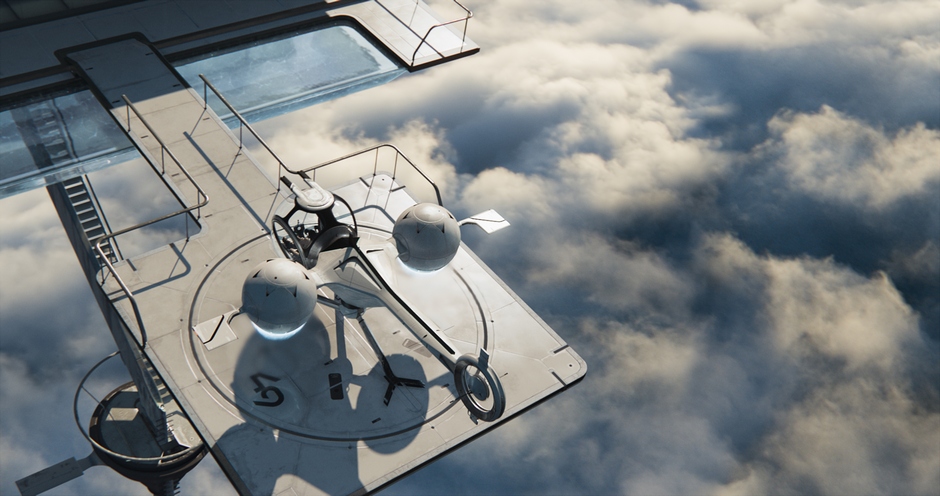
Certainly,
Oblivion
is dazzling to behold. The vast
majority of the visuals featured here are absolutely astonishing, from the
Mount Olympus-like Station 49 perch with it bubble-like swimming pool, to the “monument(al)destruction” of Earth landmarks like the Empire State Building, and the Statue
of Liberty.
Earth’s
“new,” post-apocalyptic terrain is legitimately incredible to behold and there
is not a moment or instant of phoniness to be pinpointed. I especially enjoyed the shots of a shattered
moon hanging in orbit, a constant reminder of the planet’s devastation.
But
to its detriment, Oblivion doesn’t really trust its audience that much, which -- in fairness -- has probably grown out of
the habit of watching such 1970s dystopian/anti-hero fare. Accordingly, Oblivion spends an
inordinate amount of time focusing on aerial dogfights between Jack’s fighter
plane and automated attack drones instead of its hero’s existential angst. The climactic battle in an abandoned
industrial factory/headquarters that is apparently also a section of the New York
Metropolitan Library (!) is so pro-forma and dull I checked my watch twice
during it.
By
this point in the story, such “action” pyrotechnics are not only unnecessary
and distracting, but an insult to the intelligence. A quick third-act rewrite could have immediately
established that a nuke had to be flown up
manually to the orbiting “Tet” or HAL device, thus necessitating Jack’s
sacrifice. Fifteen minutes of running
time could have been saved, and as I like to remind film students from time to
time, the trick to making a good film -- as simple as it sounds -- is to put
the good stuff closer together, and cut out the stuff that doesn’t work, even
if the stuff that doesn’t work happens to be an expensive action scene.

Similarly,
Oblivion
involves a love story, one that spotlights flashes of Jack’s “wiped” memory
resurfacing in dreams and nightmares. At
the ruined Empire State Building with his true love, Julia (Olga Kurylenko),
Jack recounts his wedding proposal to her there…in another lifetime. The two characters recite the
emotionally-resonant dialogue of that rendezvous, accompanied by evocative
black-and-white images of New York City As
It Once Was. It’s touching and well-done,
no question.
But
then the very next scene shows us the
exact same sequence of events at the Empire State Building except in color,
with the same two characters – and the
audience too – experiencing the proposal a second time.
This
interlude -- conveying a message already laboriously explained and completely
understood -- brings the movie to a grinding halt. Again, a third act rewrite, or even a
judicious post-production edit, would have left the movie with just one of
those proposal scenes, not two in immediate succession.
I wonder, is there anyone out there who didn’t “get it” after the first scene?
I
don’t have anything personal against Tom Cruise and I have certainly enjoyed
his performances over the years in legitimately great sci-fi movies such as Minority
Report (2002) or War of the Worlds (2005)., but his
impressive ripped physique, chiseled good looks and stolid demeanor all tend to
work against Oblivion and the character he plays.
Cruise
is so taciturn and physically dominant a presence that he doesn’t often seem in
real danger, and never seems genuinely surprised or shocked by the revelation
that his life is not what he thinks it is.
This is where I must hark back to Moon (2009), and Sam Rockwell’s
performance.
There,
Rockwell also played a “tech guy” working a boring but mysterious routine for
unseen overlords, and coming to terms with a surprise about his nature…and his
destiny. But he was able to invest the
role with a deeper sense of humanity and surprise. In his eyes, the audience registered disbelief,
regret, anger, and finally defiance.
This
is where “blockbuster” thinking tends to spoil a good science fiction film, and
Oblivion
is truly only a few degrees away from being a good science fiction film.
A
more introspective, more thoughtful, less Adonis-like -- and probably less bankable -- lead actor might have been able to
invest the film with genuine pathos, personality and humanity, and provide the
audience more to hold onto at each step of the journey. With Cruise in the lead role, projecting
little interior personality, the audience simply spends Oblivion’s first hour
waiting for the other shoe to drop, for the narrative’s (predictable) surprise to
be extruded on cue, as though from the auspices of The Industrial Screenwriter-a-tron 3000.(TM)
The
film’s final act, and thus its ultimate meaning, also gets muddled because of
Jack’s true nature. I admire Oblivion
for making the argument that a clone with the same memories can be,
essentially, the same person as the original article. That’s an argument that would not have found
traction, say, in a run-of-the-mill genre actioner like The Sixth Day
(2000).
But
the same clone gambit takes away the magnificence and impact of Jack’s self-sacrifice
to provide -- in another instance of
summer blockbuster-style thinking -- an unreservedly happy ending. This is the Star Trek: Nemesis (2002)
ending all over again.
Sad
that Data died in a blaze of glory to save the Enterprise one last time? Well, we’ve got a ready-made replacement for Data
right here -- down to all his memories -- so you don’t have to grapple with any
sad feelings while you leave the theater.
One
key aspect of the 1970s sci-fi cinema that Oblivion hopes to emulate is,
indeed, downbeat endings. Beneath
the Planet of the Apes wasn’t afraid to kill Taylor (Charlton Heston)
or destroy the Earth. The
Omega Man (1971) also ended with a heroic self-sacrifice. Soylent Green (1973) was even more
down-beat in its final, notorious ending.
Oblivion
wants to nod
and pay tribute to all these dark gems of these 1970s classics, but it doesn’t
earn the same respect because it wants, simultaneously -- and more than
anything else -- to relentlessly crowd-please.
The desire for a successful commercial outcome overpowers the desire to
make real art, or make a real storytelling statement.
What
truly seems missing from the science fiction cinema today is, alas, this idea of
transcendence.

Folks
can pick on and dismiss Star Trek: The Motion Picture (1979)
all they want, but that was a film that didn’t end with an act of destruction
as the saving grace of mankind, by point of contrast. The aforementioned The Omega Man, too,
concerned the idea of a man transcending
his limitations and experience to achieve something truly timeless and noble
for the planet…even if he couldn’t live to enjoy the fruits of his act.
Oblivion is a movie about a guy doing the
impossible, making that sacrifice and then, miraculously, still getting the
girl of his dreams, a child, and a beautiful house by the lake.
And
by the way, there’s a truly great scene at that house by the lake. Julia tells Jack about the time he told her
about their future together. They would
live in that house, fight and quarrel, grow fat and old…and then die
together. The world would eventually forget
them, but they would be together for a time, and that would be enough.
After
explaining so poignantly and naturally the reality of our human life, it’s a
shame that Oblivion must resort to relentless drone battles and a canned
happy ending. It thus bows to the
exigencies of movie blockbuster nature, not human nature. To make a comparison, it’s as if if Romeo
and Juliet ended, and then suddenly Romeo and Juliet’s clones fell in
love, resumed up the romance, and bought a nice summer house in Verona.
I’ve
read many critics championing Oblivion by lauding the fact that it
isn’t a sequel, a remake or a reboot. In
my opinion, that’s a pretty low standard for praising a movie, even if it is a
great PR tactic. The fact is, the movie
is passable and enjoyable summer entertainment.
But its quality doesn’t go far beyond that threshold.
But
if
Oblivion isn’t a sequel, remake or reboot, is it actually an original…or
a “clone” instead?
award-winning creator of the web series Abnormal Fixation (2024), the audio drama Enter the House Between (2023) and author of 35 books including Horror Films FAQ (2013), Horror Films of the 1990s (2011), Horror Films of the 1980s (2007), TV Year (2007), The Rock and Roll Film Encyclopedia (2007), Mercy in Her Eyes: The Films of Mira Nair (2006),, Best in Show: The Films of Christopher Guest and Company (2004), The Unseen Force: The Films of Sam Raimi (2004), An Askew View: The Films of Kevin Smith (2002), The Encyclopedia of Superheroes on Film & Television (2004), Exploring Space:1999 (1997), An Analytical Guide to TV's Battlestar Galactica (1998), Terror Television (2001), Space:1999 - The Forsaken (2003) and Horror Films of the 1970s (2002).
Movie Trailer: Oblivion (2013)
award-winning creator of the web series Abnormal Fixation (2024), the audio drama Enter the House Between (2023) and author of 35 books including Horror Films FAQ (2013), Horror Films of the 1990s (2011), Horror Films of the 1980s (2007), TV Year (2007), The Rock and Roll Film Encyclopedia (2007), Mercy in Her Eyes: The Films of Mira Nair (2006),, Best in Show: The Films of Christopher Guest and Company (2004), The Unseen Force: The Films of Sam Raimi (2004), An Askew View: The Films of Kevin Smith (2002), The Encyclopedia of Superheroes on Film & Television (2004), Exploring Space:1999 (1997), An Analytical Guide to TV's Battlestar Galactica (1998), Terror Television (2001), Space:1999 - The Forsaken (2003) and Horror Films of the 1970s (2002).
Theme Song of the Week: Fireball XL5 (1962)
award-winning creator of the web series Abnormal Fixation (2024), the audio drama Enter the House Between (2023) and author of 35 books including Horror Films FAQ (2013), Horror Films of the 1990s (2011), Horror Films of the 1980s (2007), TV Year (2007), The Rock and Roll Film Encyclopedia (2007), Mercy in Her Eyes: The Films of Mira Nair (2006),, Best in Show: The Films of Christopher Guest and Company (2004), The Unseen Force: The Films of Sam Raimi (2004), An Askew View: The Films of Kevin Smith (2002), The Encyclopedia of Superheroes on Film & Television (2004), Exploring Space:1999 (1997), An Analytical Guide to TV's Battlestar Galactica (1998), Terror Television (2001), Space:1999 - The Forsaken (2003) and Horror Films of the 1970s (2002).
Monday, April 22, 2013
Late Night Blogging: The Exorcist Movie Trailers
award-winning creator of the web series Abnormal Fixation (2024), the audio drama Enter the House Between (2023) and author of 35 books including Horror Films FAQ (2013), Horror Films of the 1990s (2011), Horror Films of the 1980s (2007), TV Year (2007), The Rock and Roll Film Encyclopedia (2007), Mercy in Her Eyes: The Films of Mira Nair (2006),, Best in Show: The Films of Christopher Guest and Company (2004), The Unseen Force: The Films of Sam Raimi (2004), An Askew View: The Films of Kevin Smith (2002), The Encyclopedia of Superheroes on Film & Television (2004), Exploring Space:1999 (1997), An Analytical Guide to TV's Battlestar Galactica (1998), Terror Television (2001), Space:1999 - The Forsaken (2003) and Horror Films of the 1970s (2002).
Ask JKM a Question: Do You Dare Walk These Steps Again? (Exorcist III)

A reader named Chuck
writes:
“First, I am a huge fan
of your blog (as I write while reading it instead of doing work at my desk).
Second, I realize that the answer to my question my already exist in your book Horror
Films of the 1990s, which I confess I do not own (though 1970s sits
prominently on my shelf).
But, anyway, here goes:
I was having a conversation with a friend in my LCS, and I told him that, in my
opinion, The Exorcist III was
one of the best, scariest, movies no one ever talks about. This immediately led
down the road to “no, The
Exorcist was too good to ever need a sequel in the first
place” or “Exorcist 2 was
horrible, and the prequels were bad too”, etc., etc.
I am interested to know
what your feelings were/are regarding William Peter Blatty’s The Exorcist III (which
was based on his book “Legion” I believe).
But more importantly, I
am just curious as to why no one seems to have caught-up to how good it was (in
my opinion—I realize you may disagree) so many years later. Was it too long?
Was it that the previous sequel was just so bad? Or was it because it was so
different from the original film, people just don’t know what to make of it?
To me, you just have to
completely divorce yourself from the word “Exorcist” in the title, and look at
it as a distinct, original film. The
Exorcist is really just back-story here. I always loved how the
really scary elements were never actually shown on-screen. Instead, you were
more-or-less forced to imagine them in your own mind (although
the old lady crawling on the ceiling still makes me uneasy). Plus, the acting
quality is obvious. That initial dialogue scene where Detective Kinderman
(George C. Scott) “meets” The Gemini Killer (Brad Dourif) in Cell 11, was
something marvelous. In fact, I would love to hear your thoughts on that scene
in particular.”

Chuck, this is a great
question and a timely one indeed, since only recently I read (on The Huffington Post, I believe),
commentary from William Friedkin -- a director I deeply admire -- diminishing
the Exorcist
follow-ups, including Exorcist III.
I do review Exorcist
III (1990) in Horror Films of the 1990s, and it
probably won’t surprise you to learn that I agree with your contention that it
is a superb horror film, and, in fact, a worthy follow-up to The
Exorcist
(1973).
I write in Horror
Films of the 1990s the following about the film:
“Deliberately eschewing flash and hipness, this modest sequel embodies
the age-old cinema virtues of seriousness, good performances and spooky
atmospherics. When considered together, the elements forge an overriding sense
of doom and gloom, of autumn fast approaching, of judgment day on the horizon.
Close-ups of flickering lights, a clock that stops suddenly, and
disturbing Christian iconography may not sound like the ingredients of a
successful 1990s horror film, and yet such touches contribute mightily to Exorcist
III’s aesthetic gravitas, aptly voiced in the film’s exhortation that “the whole world is a homicide victim.”
Indeed, Exorcist III obsesses on an old,
aged world, one cracking and tearing at the seams because, once more to quote
the intelligent dialogue, “everything’s
relative” and there appears to be a worrisome numbing of the globe’s “moral sense.” As evidence for this assertion, we see the
Devil (or at least his minions) seep effortlessly into the ruined bodies of the
old and infirm at a grand, gothic Georgetown Hospital…”
I also point out in the same review that the line of dialogue “It’s very late” is repeated in the film
twice, and that it seems to be the core idea of the movie: there’s nothing new left on Earth but atrocity and more atrocity, and
accordingly, all the characters are grappling with ghosts; ghosts of the past;
ghosts of friends, and the ghost, of course, of the Gemini Killer.
For me, Exorcist III works for the very reasons I enumerate there.
It’s as if Kinderman (Scott) and the world itself are exhausted --
even crushed -- by the horrors they witness on a seemingly routine basis. That exhaustion is spiritual, but also
reflected in many characters’ physicality. Scott looks old and drained and
tired, as do other performers. The idea here
is that those who have lived a long life in this “rotten” world grow so weak and
vulnerable that the Devil uses their doubt…and slips inside them. It’s a great idea for a horror movie, and an
intriguing reflection of the “child possessed” that we see in the original Exorcist. Here, it’s not someone representing tomorrow
who suffers, but someone who has lived through all our (difficult) yesterdays.
The specific scene you discuss -- a lengthy back-and-forth between Kinderman and the Gemini Killer --rewards
patience and attention, and works on at least two levels. The first level is a policeman/suspect
interview, of course. The second level
is a spiritual one, involving a mortal and an immortal, a demon, hashing things
out. The performances are strong, as you
would expect from Dourif and Scott, but what few critics have mentioned is that
this very scene in essence paves the way for many similar sequences in horror
films and TV programs throughout the 1990s.
The lengthy sit-down interview between a law enforcement
professional and serial killer who seems more-than (and less-than) human is a dramatic,
narrative device that later dominated The Silence of the Lambs (1991), and
even one of my all-time favorite shows, Millennium (1996 – 1999). Sure, there are antecedents other than Exorcist
III -- like Michael Mann’s Manhunter in the late 1980s -- but
the exact dynamic of serial-killer-possible-demon-in-wait seems to emerge from
this particular film.
Why didn’t Exorcist III find more critical
acceptance then, in 1990? And why hasn’t
it now?
Back in the 1990s, the old critical guard was still in control of
mainstream media, and by-and-large this group treated every sequel as a
meritless cash-grab. The same critics
also treated virtually every horror film as “beneath contempt.”
Today, I suspect we’ve gone too far in the other direction, with
Internet-based critics bending over to welcome every fan-boy sequel without
thought or reflection as to its artistic merit or social value.
But Exorcist III fit into the pre-existing narrative of “sequels =
bad; horror film sequels = worse” and paid the price. The fact that Boorman’s The Heretic (1977) was
also poorly received made the narrative even more appealing, especially to
stressed-out reviewers on a deadline.
I also suspect that a core group of horror fans were also disappointed
that this sequel didn’t follow in line with more Exorcist-style head
spinning and pea soup vomit. Still, the
jolts in Exorcist III are considerable. You mention the old lady on the
ceiling, but there’s also that brilliant jump scare involving a distant,
cloaked figure emerging suddenly from a patient room to claim a victim. These jolts, however, are not exactly graphic
or gory in nature. I suspect a certain
contingent of Exorcist fans wanted buckets of puke and other nasty
manifestations of Old Scratch rather than a quiet, intelligent film about the
nature of evil.


I feel that Exorcist III is more appreciated
today than it was on release, but all films possess an historical context that
surrounds them like a bubble. Only few
films escape the shape and form of that bubble, or see a re-consideration,
after the fact, of their reputation. John Carpenter’s The Thing (1982) is
one such film, but so far, Exorcist III hasn’t been hauled out
and re-examined as fully. Writing Horror
Films of the 1990s, I also learned that some hardcore horror fans hate the
era 1990 – 1999 in film history, and don’t revisit it as frequently as the
1970s or 1980s…or even the 2000s.
Yet I would argue that The Exorcist and Exorcist
III actually work rather well in tandem. By my estimation, The Exorcist works so
well because of Friedkin’s documentary-style approach. The travel sequences in Iraq and the
(terrifying…) visit to a metropolitan hospital in 1970s New York enhance the
picture’s reality, which comes in handy for the final act, with its levitating
beds and other pyrotechnics.
Exorcist III, in a different way,
feels like a lengthy philosophical debate about man and mortality. To some extent, The Exorcist is a visceral experience as a realistic,
near-documentary/travelogue, and Exorcist III is a cerebral one, contextualizing the
earlier events and shading their meaning more deeply and thoroughly.
I admire both films, to tell you the truth, though for different
reasons.
Don’t forget to ask me your questions at Muirbusiness@yahoo.com
award-winning creator of the web series Abnormal Fixation (2024), the audio drama Enter the House Between (2023) and author of 35 books including Horror Films FAQ (2013), Horror Films of the 1990s (2011), Horror Films of the 1980s (2007), TV Year (2007), The Rock and Roll Film Encyclopedia (2007), Mercy in Her Eyes: The Films of Mira Nair (2006),, Best in Show: The Films of Christopher Guest and Company (2004), The Unseen Force: The Films of Sam Raimi (2004), An Askew View: The Films of Kevin Smith (2002), The Encyclopedia of Superheroes on Film & Television (2004), Exploring Space:1999 (1997), An Analytical Guide to TV's Battlestar Galactica (1998), Terror Television (2001), Space:1999 - The Forsaken (2003) and Horror Films of the 1970s (2002).
Cult-TV Theme Watch: The Birds and The Bees

I’m
calling this week’s entry “The Cult-TV Faces of The Birds and the Bees” because
if I simply used the term “Sex” I’m afraid that Facebook would classify my blog
as spam, or I’d get visited by Russian porn sites on a regular basis (which
already happens a lot, for some reason I
can’t fathom…).
Regardless,
America has always held a kind of puritanical attitude about the depiction of
sex in art. This approach contrasts
greatly with many honored works in Antiquity, including Lysistrata by
Aristophanes, for instance.
But
Cult Television -- at least over the last few decades -- has delved more fully
into the topic of the “birds and the bees,” and explored the role of sex in
American society, as well the sexual lives of series dramatis personae, on many occasions.

These
sexual stories haven’t always been direct or up-front to be certain. One of the most famous “birds and the bees”
shots in cult-TV history comes from the third season Star Trek (1966 – 1969) episode “Wink
of an Eye.”
The
scene commences with Captain Kirk (William Shatner), still in uniform,
wriggling back into his stylish black Starfleet boots, while sitting on the corner of his bed. Behind him, his lover, Deela
(Kathie Brown) combs her hair in front of a mirror. This is about as explicit as matters of “sex” ever got in 1960s genre television, though in fairness, “Amok Time” aired a year
earlier and it dealt with Pon Farr, or the Vulcan sex drive. Still, the upshot of that episode is that Spock
(Leonard Nimoy) did not have
sex. In “Wink of an Eye” it is pretty
clear precisely what Captain Kirk has been...up to.
By
the time of The Next Generation (1987 – 1994), sex was more accepted as a
topic for television programs, even in the genre. In the
third season episode “The Price,” Counselor Troi (Marina Sirtis) beds a
scoundrel named Devononi Ral (Matt McCoy), and comes to regret it. The episode shows the two frolicking in bed,
and there’s a heavy emphasis on Ral rubbing shiny lotion on Troi’s feet, but the
scene is still pretty tame by today’s standards.


In
1993, the first season episode of The X-Files titled “Gender Bender”
used sexual attraction as a key plot point. Here, a strange killer -- able to
be either male or female, depending on desire -- began picking up and seducing lovers at
clubs in Washington D.C. and Virginia. Unfortunately, to make love to this
being – part of an alien sect called “The Kindred” – was to die since
intercourse with humans caused extreme cardiac arrest. Also, in the course of the episode, we learn
that the aliens can attract humans by releasing human pheromones. At one point, Scully (Gillian
Anderson) is affected by the pheromones, and nearly suffers the same fate as
the murder/sex victims.


In the first season
of the 1995 Outer Limits remake, an episode called “Caught in the Act”
starred Alyssa Milano and also involved aliens…and sex. Here,
a college student, Hannah (Milano) is surprised when an alien object crashes
into her dorm room and possesses her…making her crave sexual intercourse. She feeds the beast within, seducing willing male partners, but those partners -- like the ones in “Gender Bender” -- die during the
act and are absorbed by Hannah. Finally,
only the power of true love is able to defeat the alien’s ravenous sexual
appetite.
The British sci-fi series Torchwood
(2006 – 2011) vetted a very similar story as its second episode, called
“Day One.” Here, Jack (John Barrowman),
Gwen (Eve Myles) and the rest of the team had to hunt down an invading alien in Cardiff that could
possess different humans, and “absorb” their forms through the act of sex. A first act assignation in a club bathroom and its...climax...demonstrates the kind of explosive sex depicted in the episode.


In its first
season, Millennium (1996 – 1999) dealt explicitly with sexual hang-ups
in the episode titled “Loin Like a Hunting Flame.” Here, a madman abducted young,
attractive couples at raves and clubs, and video-taped their sexual
intercourse. He was doing so, uniquely,
as practice or education, so he could finally have sex with his long-suffering wife,
following a disastrous honeymoon night years earlier.
These days, there's a sex scene or two, it seems, in every episode of True Blood or Game of Thrones.
These days, there's a sex scene or two, it seems, in every episode of True Blood or Game of Thrones.
award-winning creator of the web series Abnormal Fixation (2024), the audio drama Enter the House Between (2023) and author of 35 books including Horror Films FAQ (2013), Horror Films of the 1990s (2011), Horror Films of the 1980s (2007), TV Year (2007), The Rock and Roll Film Encyclopedia (2007), Mercy in Her Eyes: The Films of Mira Nair (2006),, Best in Show: The Films of Christopher Guest and Company (2004), The Unseen Force: The Films of Sam Raimi (2004), An Askew View: The Films of Kevin Smith (2002), The Encyclopedia of Superheroes on Film & Television (2004), Exploring Space:1999 (1997), An Analytical Guide to TV's Battlestar Galactica (1998), Terror Television (2001), Space:1999 - The Forsaken (2003) and Horror Films of the 1970s (2002).
The Cult-TV Faces of: The Birds and The Bees
 |
| Identified by SGB: Star Trek: "Wink of an Eye." |
 |
| Identified by BT: Kolchak: The Night Stalker: "Demon in Lace." |
 |
| Identified by SGB: Star Trek: The Next Generation: "The Price." |
 |
| Not Identified: The X-Files: "Gender Bender." |
 |
| Not Identified: The Outer Limits (New): "Caught in the Act." |
 |
| Identified by Josef Karl: Millennium: "Loin like a Hunting Flame." |
 |
| Identified by SGB: Farscape. |
 |
| Identified by SGB: Buffy the Vampire Slayer. |
 |
| Identified by William Mercado: Star Trek: Enterprise. |
 |
| Identified by Chadzilla: Torchwood: "Day One." |
 |
| Not Identified: BSG (New). |
 |
| Identified by BT: Dexter. |
 |
| Identified by Terri Wilson: True Blood. |
 |
| Identified by BT: Game of Thrones. |
award-winning creator of the web series Abnormal Fixation (2024), the audio drama Enter the House Between (2023) and author of 35 books including Horror Films FAQ (2013), Horror Films of the 1990s (2011), Horror Films of the 1980s (2007), TV Year (2007), The Rock and Roll Film Encyclopedia (2007), Mercy in Her Eyes: The Films of Mira Nair (2006),, Best in Show: The Films of Christopher Guest and Company (2004), The Unseen Force: The Films of Sam Raimi (2004), An Askew View: The Films of Kevin Smith (2002), The Encyclopedia of Superheroes on Film & Television (2004), Exploring Space:1999 (1997), An Analytical Guide to TV's Battlestar Galactica (1998), Terror Television (2001), Space:1999 - The Forsaken (2003) and Horror Films of the 1970s (2002).
Television and Cinema Verities #67

"Dracula as a character is very erotic. He becomes very attractive to women for that reason. A woman can be totally passive with Dracula: 'he made me drink, I couldn't help it.' I think it's possible for both men and women to imagine being taken in that way. Dracula seems to represent a kind of doorway to sexual abandonment not possible with a mere mortal. Besides, he's offering immortality."
- Frank Langella discusses the role of Dracula, from 1979, in U.S. Magazine.
award-winning creator of the web series Abnormal Fixation (2024), the audio drama Enter the House Between (2023) and author of 35 books including Horror Films FAQ (2013), Horror Films of the 1990s (2011), Horror Films of the 1980s (2007), TV Year (2007), The Rock and Roll Film Encyclopedia (2007), Mercy in Her Eyes: The Films of Mira Nair (2006),, Best in Show: The Films of Christopher Guest and Company (2004), The Unseen Force: The Films of Sam Raimi (2004), An Askew View: The Films of Kevin Smith (2002), The Encyclopedia of Superheroes on Film & Television (2004), Exploring Space:1999 (1997), An Analytical Guide to TV's Battlestar Galactica (1998), Terror Television (2001), Space:1999 - The Forsaken (2003) and Horror Films of the 1970s (2002).
Subscribe to:
Posts (Atom)
40 Years Ago: Howard the Duck (1986)
In 1986, the comic-book adaptation Howard the Duck -- executive-produced by George Lucas -- landed in movie theaters with a splat. The f...

-
 It is quite difficult to believe, but in 2024, Ridley Scott’s Alien (1979) turns 45 years old. Perhaps the most amazing thing about Alie...
 -
 It is an indisputable fact that fan service and good drama don’t always go hand-in-hand in the cinema. In fact, sometimes these factors div...